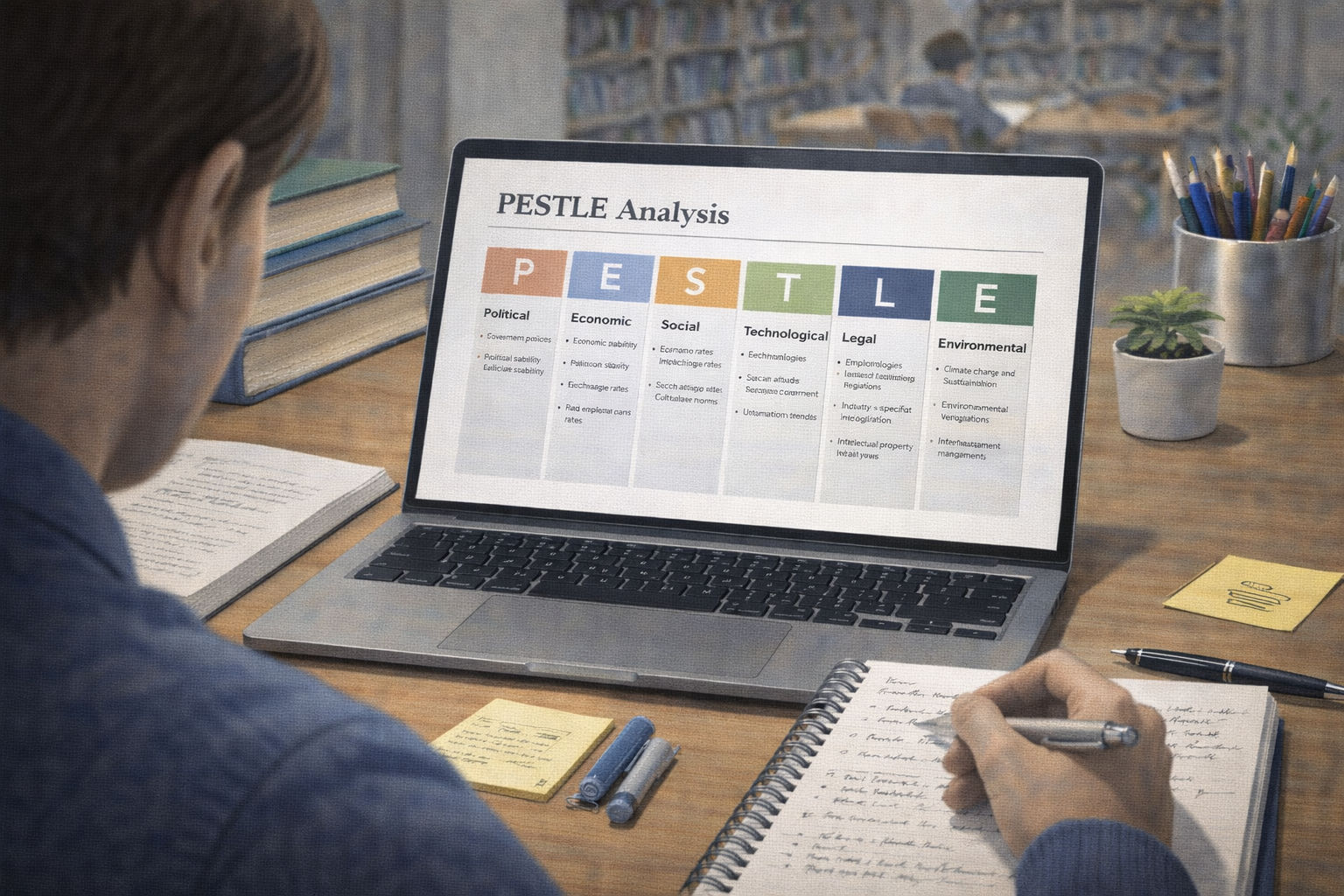
PESTLE analysis is one of the most frequently used strategic frameworks in university-level assignments, particularly in business, management, economics, international relations, and public policy courses. Despite its widespread use, many students struggle to apply it at an academic level.
In practice, PESTLE analysis is often reduced to a superficial checklist of political, economic, social, technological, legal, and environmental factors. While this may demonstrate basic understanding, it rarely meets university expectations for critical analysis.
This guide explains how to use PESTLE analysis effectively in academic assignments and provides a structured, discipline-appropriate example that demonstrates analytical depth, clarity, and relevance.
What Is PESTLE Analysis in an Academic Context?
PESTLE analysis is a macro-environmental analysis tool used to examine external factors that influence organisations, industries, policies, or strategic decisions. In academic writing, its primary function is analytical rather than descriptive.
The framework encourages students to evaluate how external forces shape opportunities, constraints, risks, and strategic choices. Unlike internal analyses, PESTLE focuses exclusively on factors outside the direct control of the organisation or subject being studied.
At university level, PESTLE analysis is expected to demonstrate awareness of context, use evidence appropriately, and link external factors to strategic or theoretical implications.
In academic assignments, PESTLE analysis should explain impact, not just identify factors.
Why PESTLE Analysis Is Commonly Used in University Assignments
Lecturers frequently require PESTLE analysis because it helps students engage with complexity and uncertainty in real-world contexts. It also encourages structured thinking about external environments.
PESTLE analysis is particularly valuable in case study assignments, strategic reports, policy evaluations, and consultancy-style coursework.
However, because the framework is simple to understand, it is often applied too narrowly or without sufficient academic justification.
The Six Components of PESTLE Analysis Explained
Each element of the PESTLE framework addresses a distinct category of external influence. Clear understanding of these categories is essential for academic accuracy.
Misclassifying factors or overlapping categories can weaken analytical credibility.
| Factor | Focus | Typical Academic Considerations |
|---|---|---|
| Political | Government influence | Policy stability, trade regulation, public funding |
| Economic | Economic conditions | Inflation, unemployment, interest rates |
| Social | Societal trends | Demographics, cultural values, lifestyle changes |
| Technological | Innovation and technology | Digitalisation, automation, R&D intensity |
| Legal | Regulatory environment | Employment law, data protection, compliance requirements |
| Environmental | Ecological factors | Climate change, sustainability, environmental regulation |
Correct categorisation ensures conceptual clarity and avoids analytical overlap.
Academic Expectations When Using PESTLE Analysis
University examiners assess PESTLE analysis based on relevance, depth, and integration rather than volume. Simply listing external factors is insufficient.
High-quality academic work explains why each factor matters, how it influences decision-making, and what implications arise.
Students are expected to use academic sources, data, or credible reports to justify claims.
PESTLE Analysis Example: Retail Industry in the United Kingdom
The following example demonstrates how PESTLE analysis should be presented and explained in a university assignment. The focus is a hypothetical analysis of the UK retail industry.
Political Factors
Political stability in the United Kingdom provides a relatively predictable environment for retail operations. Government trade policies following Brexit, however, have introduced regulatory complexity for supply chains.
Changes in import tariffs and customs procedures have increased administrative costs for retailers reliant on international suppliers. This has implications for pricing strategies and inventory management.
Economic Factors
Economic conditions significantly influence consumer spending in the retail sector. Rising inflation and interest rates have reduced disposable income, leading to more price-sensitive purchasing behaviour.
Economic uncertainty has also encouraged retailers to focus on cost efficiency and value-based offerings.
Social Factors
Shifts in consumer behaviour toward online shopping and ethical consumption have reshaped the retail landscape. Social awareness of sustainability has increased demand for ethically sourced products.
Demographic changes, including an ageing population, further influence product mix and service design.
Technological Factors
Technological advancement has transformed retail operations through e-commerce platforms, data analytics, and automation. Digital payment systems and personalised marketing tools have become standard expectations.
Retailers that fail to invest in technology risk losing competitiveness in an increasingly digital market.
Legal Factors
Retailers must comply with employment law, consumer protection regulations, and data protection legislation such as GDPR. Non-compliance can result in financial penalties and reputational damage.
Legal requirements also influence operational processes, including staff management and customer data handling.
Environmental Factors
Environmental concerns have become increasingly prominent in retail strategy. Pressure to reduce carbon emissions and packaging waste has influenced supply chain decisions.
Retailers are increasingly expected to demonstrate environmental responsibility through sustainable sourcing and waste reduction initiatives.
Presenting PESTLE Analysis in Academic Assignments
PESTLE analysis can be presented in table format, narrative form, or a combination of both. Most university assignments benefit from summarising key points in a table followed by analytical discussion.
Tables improve clarity, while narrative explanation demonstrates critical engagement.
| Element | Purpose |
|---|---|
| Summary Table | Organises key external factors clearly |
| Written Analysis | Explains impact and strategic implications |
Using tables alone rarely meets academic marking criteria.
Common Mistakes Students Make with PESTLE Analysis
Several recurring issues reduce the effectiveness of PESTLE analysis in university work.
- Listing factors without explanation
- Using outdated or unsupported information
- Overlapping categories incorrectly
- Failing to link analysis to assignment objectives
- Ignoring academic sources
Avoiding these errors significantly improves analytical quality.
Linking PESTLE Analysis to Strategy and Theory
In higher-level assignments, PESTLE analysis should be linked to strategic recommendations or theoretical discussion.
For example, external pressures identified through PESTLE may justify strategic change, policy reform, or organisational adaptation.
This linkage demonstrates higher-order thinking and theoretical application.
How Much Weight Should PESTLE Analysis Carry?
While PESTLE analysis is valuable, it should not dominate an assignment unless explicitly required. It is most effective when used as a foundation for deeper analysis.
Excessive focus on PESTLE can limit space for evaluation, synthesis, and argument development.
Balance is critical to strong academic performance.
Final Academic Guidance on PESTLE Analysis Examples
PESTLE analysis is a powerful academic tool when used critically and supported by evidence. It enables students to demonstrate contextual awareness and analytical reasoning.
However, its effectiveness depends on explanation, relevance, and integration into broader arguments.
Students who treat PESTLE analysis as an analytical framework rather than a checklist consistently achieve higher academic outcomes.



Comments