Abstract
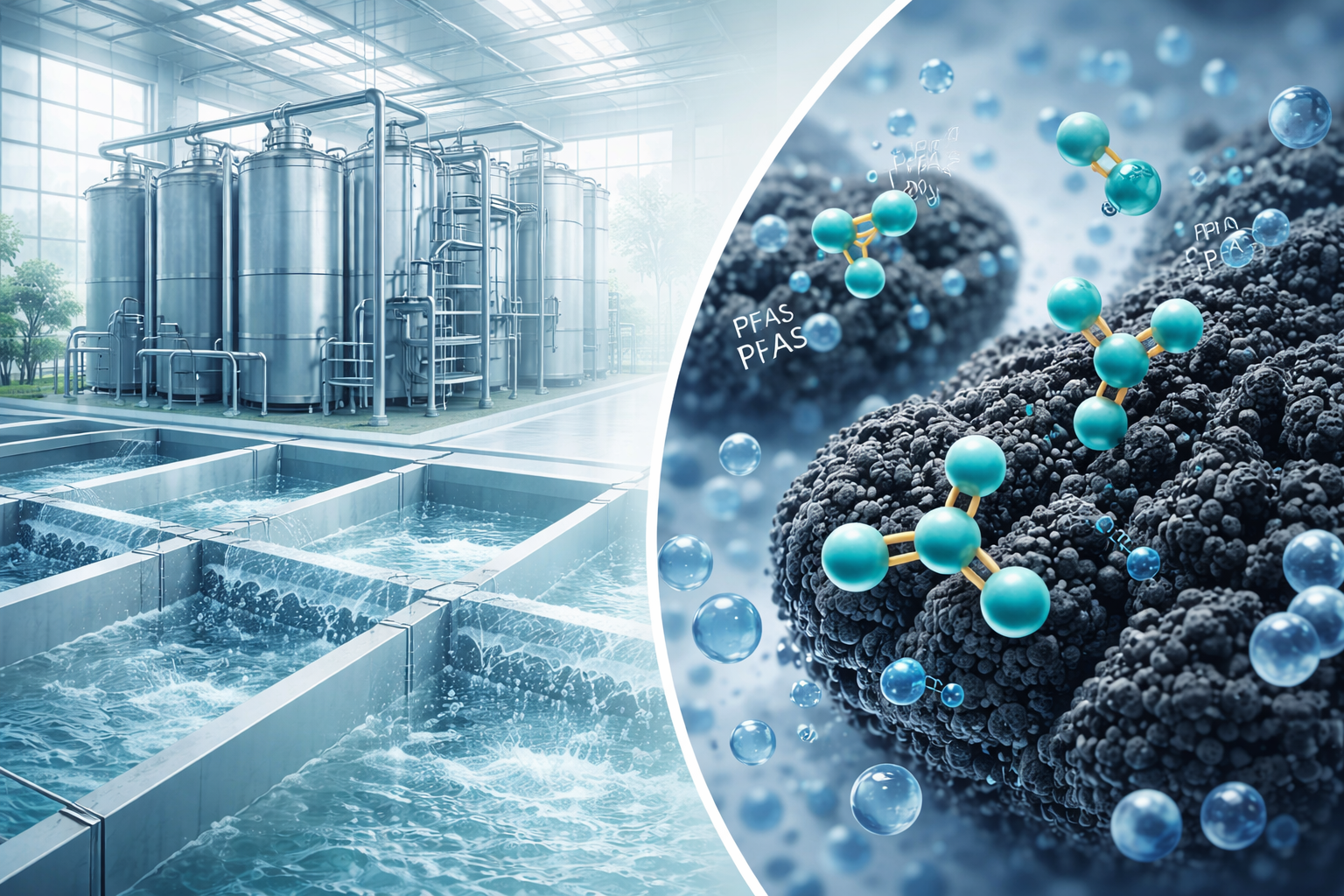
Accumulation of the polyfluoroalkyl substances (PFAS) significantly affects the environment. They have also accumulated in water systems globally, raising serious health issues among the people. The adoption of traditional approaches is not effective; however, the use of the granular activated carbon (GAC) has shown positive results. It is one of the commonly used adsorption techniques in the removal of PFAS in drinking water. This synthesis offers an understanding of the use of GAC, the effect of the PFAS chain length, and their molecular structure on adsorption effectiveness. It also considers how natural organic matter (NOM) and pre-chlorination affect PFAS adsorption. There is also consideration of the current technologies for the detection of PFAS and the removal of the stress on the need for the use of a hybrid approach in adsorption.
Introduction
Globally, safer drinking water is a major challenge among people due to the different contaminants. The most significant class of pollutants are the Per- and polyfluoroalkyl substances (PFAS). They are synthetic compounds adopted around 1950 due to their high resistance to heat, oil, and water (McCleaf et al., 2017). Due to higher levels of bioaccumulation, is has resulted in contamination of groundwater, hence making it unsafe to drink. Several treatment approaches are available, such as coagulation and filtration, that are not effective (Chen et al., 2022). There is current use of granular activated carbon (GAC), which is found to be effective in the removal of PFAS. The articles by McCleaf et al. (2017), Chen et al. (2022) provide insights into the role of the GAC to remove these compounds, while Zahra et al. (2025) offer insights into PFAS detection and treatment technologies. In essence, these articles provides the role of GAC and ion-exchange filtration in the removal of PFAS, that affect quality of water While there are different treatment approaches, GAC is a common method since it is efficient and has adsorption attributes for the numerous hydrophobic compounds (Chen et al., 2022). However, its effectiveness is dependent on the PFA chain length, the amount of dissolved organic carbon levels, and the water composition (McCleaf et al. 2017).
Discussion
The use of the GAC in the removal of PFAS is a common practice supported by the studies. McCleaf et al. (2017) and Chen et al. (2022) evaluate the effect of adopting the use of GAC in the removal of PFAS from drinking water. They both highlight that these are persistent environmental pollutants available in our environment and are often used for industrial and consumer products. Different products play a key role in the exposure of the PFAS in the environment some of them include food packaging and carpets (McCleaf et al., 2017; Chen et al., 2022; Zahra et al., 2025). PFAS are commonly detected in water around the world. However, Zahra et al. (2025) provide insights about the current technologies available for the removal of non-detectable PFAS. The presence of these PFAS contaminates different water sites that are linked with sludge, wastewater, and landfills. McCleaf et al. (2017) indicate that PFAS are developed within the environment in both biotic and abiotic degradation.
The presence of Long-chain PFAs has significant implications of the environment and water treatment due to their persistence and higher level of bioaccumulation. McCleaf et al. (2017) indicate that some of the long-chain PFAS include PFOs, which are common. They also enhance hydrophobic adsorption causing longer breakthrough times and higher retention. Additionally Chen et al. (2022) and Zahra et al. (2025) stress that the long-chain PFAs are common and the most toxic. In that case while these toxic components are phased out in some nations they are globally available. In essence Zahra et al. (2025) indicate that in the case of long-chained PFAs, a combination of various strategies is required to support their removal from drinking water.
PFAS Adsorption Mechanisms and Influencing Factors
The adsorption mechanism is a major factor influencing the removal of PFAs. Indeed the adsorption of the PFAs from the drinking water is dependent on the physicochemical properties of the contaminants and the methods used. In essence, the absorption of PFAs often combines different mechanisms such as electrostatic attraction, ion exchange and hydrophobic interactions (McCleaf et al., 2017; Chen et al., 2022). According to McCleaf et al. (2017) the influence of perfluorocarbon chain length since it has an implication on the amount of PFAs adsorption. The presence of long-chain compounds, especially the PFOs and PFOA, often exhibits a higher hydrophobic interaction and affinity to GAC and AE resin compared to short-chain compounds. Chen et al. (2022) further indicate that the presence of the natural organic matter (NOM) may block the micropores and hence compete for the adsorption sites, hence reducing the effectiveness of the PFASs. Zahra et al. (2025) indicate that the adsorption capacity is influenced by the different materials with a large micropore volume, which have higher surface areas since they support van der Waals interactions.
Detection and Removal Techniques
The studies highlight the significance of the detection and adoption of effective removal techniques. McCleaf et al. (2017) indicate that some of the traditional treatment mechanisms are phased out. Some of them include sedimentation, free choline, and the use of UV disinfection since they are not affected in the removal of PFAs. McCleaf et al. (2017) and Chen et al. (2022) stress the use of GAC and AE methods in the removal of PFAs in drinking water. The studies found that the use of GAC significantly supports the adsorption of the long-chain PFAs, while the short compounds showcase poor retention. Chen et al. (2022) further note that alteration of water quality for example the pre-chlorination and presence of the natural organic matter reduces the GAC performance through blockage of the adsorption sites.
Zahra et al. (2025) provided a comprehensive evaluation of the different detection techniques for PFAs. Key among them is liquid and gas chromatography. The LC and GC are part of the key analytical procedures in the detection of the PFAs. With the current technologies, the use of chromatographic procedures has helped in the PFAs separation approaches. It helps on the separation of the chemicals using selective adsorption to the porous substrate due to the difference in boiling temperatures. There is also the use of optical-based approaches, such as colorimetric assays. It helps in the detection of the analyte; the assays are organic dyes that react with the analyte of interest, making it shift to a visible color. Further, the application of fluorescent and luminescent detection is also common. It is applied since it is associated with a higher-level sensitivity compared to the colorimetric approach. The generated fluorescence is proportional to the concentration of the PFAS (Zahra et al, 2025). The application of the nanoparticle-based sensor is also a major approach due to the unique physical, chemical, and optical attributes. As a result of these distinct properties, numerous nanoparticle-based sensors are under development for the identification of PFAs.
The studies collectively offer an understanding of the significance and the advancement in the detection and removal processes for PFAs. McCleaf et al. (2017) and Chen et al. (2022) focused on the adoption of the GAC and anion-exchange methods. The study by McCleaf et al. (2017) adopted the use of controlled experimentation to evaluate the presence of dissolved organic carbon (DOC) in municipal drinking water. The samples were evaluated using the HPLC-MS/MS to evaluate the concentrations . The findings indicate that longer PFAs and PFSAs were removed more efficiently than the PFCASs. Based on the result, it was indicated that PFAs removal showed selective adsorption behavior. The linear isomers show a higher removal of the branched one; however, in the case of the short chains, such as PFBA, a higher desorption behavior. However, Chen et al. (2022) employed a field-based investigation where the GAC samples were collected from the drinking water treatment plant. The results indicated that pre-chlorination increased the molecular weight of the natural organic matter (NOM) that competed with PFAS for the adsorption sections and significantly minimized the GAC efficiency. The result further indicates that GAC with a higher level of micropores had stability and retention of long-chain PFASs such as PFOS. This is consistent with the results obtained by McCleaf et al. (2017) when the long-chain PFAs were significantly removed. Furthermore, McCleaf et al. (2017) and Chen et al. (2022) suggest that pore blockage and NOM accumulation result in a reduction in adsorption capacity.
Zahra et al. (2025) have built upon empirical studies by McCleaf et al. (2017) and Chen et al. (2022) through a literature review. It offers a comprehensive review of the different PFAS detection technologies, such as LC-MS/MS and GC-MS, and the advancement in sensor-based technologies. Some of them include electrochemical and fluorescence, with the analysis indicating that the use of LC-MS/MS and GC-MS is the most common and sensitive way of detecting the PFAS in drinking water. Zahra et al. (2025) further note that the adoption of hybrid analytical tools, which combine the use of spectrometry and electrochemical sensors, helps advance site monitoring. The review further concludes that the adoption of the GAC technologies and the use of the ion exchange is the most effective in large-scale operations; however, they should be supplemented with other measurement techniques, such as the use of oxidative and membrane-based techniques, as they support complete PFAS deregulation.
While McCleaf et al. (2017), Zahra et al. (2025), and Chen et al. (2022) support the adoption of the GAC for the removal of PAFS. Zahra et al. (2025) stress that the use of biochar, which is a porous and eco-friendly material, is essential due to the higher adsorptive abilities of GAC. The use of the materials is essential as has 99.6% removal efficiency of PFOS. Zahra et al. (2025) indicates that the use of biochar that is generated from seaweed has a removal efficiency of 92% for PFBA and PFBS. As a result, the adsorption abilities of biochar may be improved by enhancing the surface area through pyrolysis and use of higher temperature. As a result, it helps to activate them and also engineer the biochar. However, in the case of the activated carbon, help in the removal of PFAS since they have a larger surface area. A consensus in the adoption of the powdered and granulated carbon for the removal of PFAS (McCleaf et al. (2017), Zahra et al. (2025), and Chen et al. (2022)).
Summary
In summary, the studies demonstrate the need for the adoption of the GAC and AE in the removal of the PFAS. They also offer an understanding that the removal of these compounds in drinking water is dependent on their structures for example the long-chain PFASs are effectively removed through GAC however, the short chains pose a significant challenge. Further, the adoption of the different detection technologies is essential for the removal of PFAS from drinking water. Some of these detection technologies include the use of fluorescent and luminescent detection, optical-based approaches, and Colorimetric assays
References
Chen, R., Huang, X., Li, G., Yu, Y., & Shi, B. (2022). Performance of in-service granular activated carbon for perfluoroalkyl substances removal under changing water quality conditions. Science of The Total Environment, 848, 157723. http://dx.doi.org/10.1016/j.scitotenv.2022.157723
McCleaf, P., Englund, S., Östlund, A., Lindegren, K., Wiberg, K., & Ahrens, L. (2017). Removal efficiency of multiple poly-and perfluoroalkyl substances (PFASs) in drinking water using granular activated carbon (GAC) and anion exchange (AE) column tests. Water research, 120, 77-87. http://dx.doi.org/10.1016/j.watres.2017.04.057
Zahra, Z., Song, M., Habib, Z., & Ikram, S. (2025). Advances in per-and polyfluoroalkyl substances (PFAS) detection and removal techniques from drinking water, their limitations, and future outlooks. Emerging Contaminants, 11(1), 100434. https://doi.org/10.1016/j.emcon.2024.100434
Comments