
Dissertations are expected to demonstrate originality, methodological rigour, and analytical depth, yet they are also constrained by strict structural and word-count requirements. As a result, not all relevant material can or should appear in the main body of the text.
Appendices in a dissertation exist to manage this tension. They allow candidates to present supporting documents, extended data, and technical materials while preserving clarity, coherence, and argumentative focus in the main chapters.
This article explains what appendices are in a dissertation context, why they matter, how they are structured, and how examiners interpret their use.
What Are Appendices in a Dissertation?
Appendices are supplementary sections placed after the reference list in a dissertation. They contain material that supports the research but is not essential for understanding the central argument or conclusions.
A defining feature of a dissertation appendix is that the dissertation remains fully intelligible without it. Readers should be able to follow the research problem, methodology, analysis, and findings without consulting the appendices.
Appendices therefore function as evidentiary support rather than analytical spaces.
Core academic rule: Appendices may support a dissertation, but they must never carry essential argumentation or interpretation.
Why Appendices Matter in Dissertation Writing
Doctoral and master’s dissertations are assessed not only on their findings but also on their transparency, methodological integrity, and scholarly discipline. Appendices contribute directly to these expectations.
They allow examiners to verify research processes, inspect instruments, and assess data integrity without overloading the core chapters.
Well-designed appendices signal that the candidate understands advanced academic conventions and respects the reader’s cognitive load.
When a Dissertation Should Include Appendices
Appendices are most common in empirical dissertations, particularly those using quantitative, qualitative, or mixed-methods approaches.
Survey-based dissertations often include questionnaires or scales, while qualitative studies may attach interview schedules, observation protocols, or coding frameworks.
Even theoretical or conceptual dissertations may require appendices when they rely on extended primary texts, formal derivations, or supplementary models.
What Belongs in Dissertation Appendices
Only material that directly supports the research design, data collection, or analysis should be included in dissertation appendices.
Common dissertation appendix content includes:
- Survey instruments and questionnaires
- Interview and focus group guides
- Ethics approval documentation
- Consent forms and participant information sheets
- Extended statistical tables or robustness checks
- Detailed coding schemes or analytic frameworks
Each appendix item must be clearly connected to a section of the dissertation where it is referenced or discussed.
What Must Never Go in Dissertation Appendices
Appendices are frequently misused as repositories for material removed from the main text to satisfy word limits.
The following elements must always remain in the dissertation chapters:
- Literature review synthesis
- Methodological justification
- Data interpretation and discussion
- Theoretical contributions and conclusions
If an examiner must consult an appendix to understand your argument, the dissertation structure is academically flawed.
How to Structure Appendices in a Dissertation
Appendices must follow a clear and consistent structure that aligns with institutional guidelines.
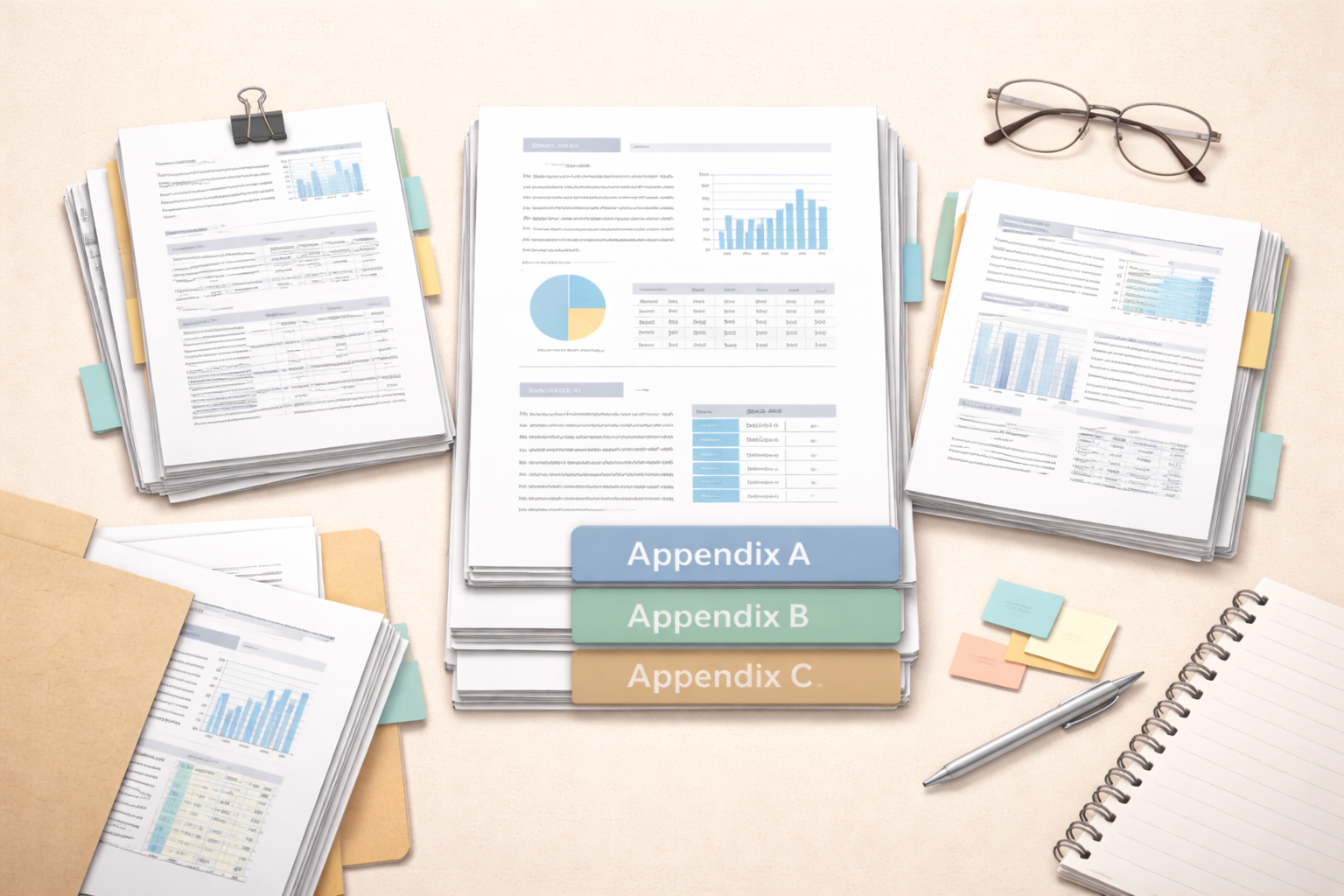
Each appendix begins on a new page and is labelled using capital letters, such as Appendix A, Appendix B, and Appendix C.
Appendix Titles and Headings
Every appendix must include a concise, descriptive title explaining its content.
Vague titles reduce examiner engagement and undermine the appendix’s academic value.
Ordering of Appendices
Appendices should be ordered according to the sequence in which they are first mentioned in the dissertation.
This ordering reinforces logical flow and improves navigability for examiners.
Referring to Appendices in Dissertation Chapters
All appendices must be explicitly referenced in the dissertation text. Unreferenced appendices are often ignored during examination.
References should explain the appendix’s relevance rather than merely pointing to its existence.
For example, a methods chapter may indicate that the full survey instrument appears in Appendix A.
Appendices and Dissertation Word Count Rules
In most universities, appendices are excluded from the formal word count. However, this exclusion does not permit misuse.
Examiners are alert to attempts to relocate required discussion or analysis into appendices.
Appendices should enhance clarity, not function as a loophole to bypass assessment criteria.
How Examiners Use Dissertation Appendices
Examiners typically consult appendices selectively rather than reading them in full.
They use appendices to verify claims, assess methodological rigour, and confirm ethical compliance.
Clear, well-organised appendices increase examiner confidence in the credibility of the dissertation.
Common Errors in Dissertation Appendices
Frequent mistakes include including irrelevant material, duplicating content from the main text, and failing to label appendices consistently.
Another common issue is presenting raw data without sufficient contextual explanation.
Effective appendices are planned alongside the research design, not added at the final submission stage.
| Aspect | Main Dissertation Chapters | Appendices |
|---|---|---|
| Primary purpose | Argument and analysis | Supporting documentation |
| Assessment weight | High | Supplementary |
| Word count inclusion | Included | Usually excluded |
| Reader priority | Essential reading | Consulted as needed |
Using Appendices Effectively in a Dissertation
Appendices should be treated as an integral but subordinate component of dissertation writing.
When used strategically, they enhance transparency, demonstrate methodological competence, and strengthen academic credibility.
Mastery of appendix use is therefore a key marker of advanced research-writing skill.

Comments