Academic and professional reports are designed to present findings clearly, logically, and concisely. Whether the report is based on research, fieldwork, case analysis, or data collection, the main body must remain focused on interpretation and discussion rather than excessive detail. At the same time, readers and examiners often expect access to supporting material that demonstrates transparency and methodological rigour.
This tension between clarity and completeness is resolved through the use of appendices. An appendix allows writers to include supplementary material without interrupting the flow of the report. However, many students struggle with how an appendix should look in practice, what an appropriate appendix example for reports involves, and how appendices differ from those used in essays or dissertations.
This article explains, step by step, how appendices function in reports and provides practical appendix examples for common report-based assignments. The aim is to help students understand not just the format, but the academic reasoning behind using appendices effectively.
What is an appendix in a report?
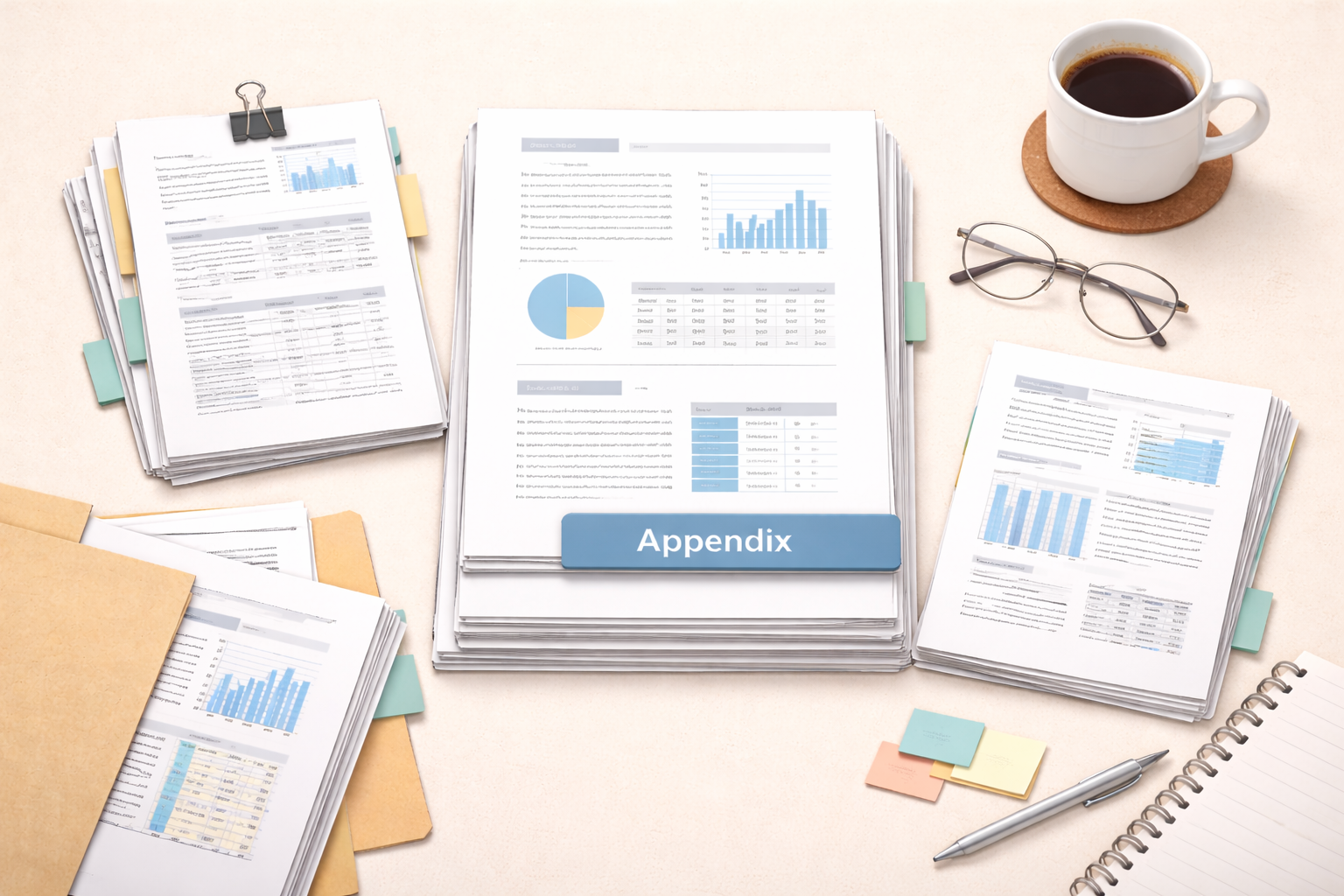
In report writing, an appendix is a section placed after the main body and reference list that contains detailed or supporting information. This material is relevant to the report but not essential for understanding the main discussion. By placing such content in an appendix, the writer ensures that the report remains readable while still providing full documentation.
Unlike essays, which may not always require appendices, reports frequently rely on them. Reports often involve data collection, procedures, or technical outputs that cannot be fully integrated into the narrative without disrupting structure. Appendices allow these materials to be presented systematically and accessed when needed.
An appendix in a report supports the main text but does not replace explanation, interpretation, or analysis.
When appendices are required in report writing
Not all reports require appendices, but many university assignments explicitly expect them. Appendices are particularly common in laboratory reports, business reports, research reports, and evaluation studies. In these contexts, the appendix demonstrates methodological transparency and academic integrity.
An appendix is usually appropriate when the report includes material that is too long, too technical, or too detailed for the main body. This might include raw data, extended tables, or full copies of research instruments.
Importantly, appendices should be used selectively. Including unnecessary material simply because it exists can weaken the report and suggest a lack of academic judgement.
Common appendix examples for reports
To understand how appendices work in practice, it is helpful to examine common types of appendix content used in reports. Each example below illustrates material that supports the report while remaining separate from the core discussion.
Appendix example: Survey questionnaire
In research-based reports, especially in social sciences or business studies, survey instruments are frequently placed in an appendix. The main report may describe how the survey was designed and administered, while the full list of questions appears separately.
This approach allows the reader to assess the validity of the instrument without overwhelming the report’s main sections.
Research instruments should be accessible to the reader, but not embedded within analytical sections.
Appendix example: Raw data tables
Reports that involve quantitative analysis often rely on large datasets. Including all raw data in the body of the report would be impractical and distracting. Instead, summary statistics and interpreted results appear in the main text, while complete datasets are placed in an appendix.
This separation ensures transparency while keeping the report focused on analysis rather than presentation of numbers.
Appendix example: Technical procedures or protocols
In laboratory or technical reports, detailed procedures may be necessary for replication but are not required for understanding the results. In such cases, the appendix may contain step-by-step protocols, calibration details, or equipment specifications.
The report body then focuses on outcomes and implications rather than procedural minutiae.
How to label and organise appendices in reports
Clear organisation is essential for effective appendices. Each appendix must be easy to locate, clearly labelled, and logically connected to the report. Confusing or inconsistent labelling is a common source of examiner frustration.
Appendices are usually labelled alphabetically, starting with Appendix A, followed by Appendix B, Appendix C, and so on. Each appendix should begin on a new page and include a concise, descriptive title.
| Effective Appendix Labelling | Ineffective Appendix Labelling |
|---|---|
| Appendix A: Survey Questionnaire | Appendix 1 |
| Appendix B: Raw Data Tables | Additional Information |
Consistency in formatting signals professionalism and attention to academic conventions.
How appendices should be referenced within the report
An appendix should never appear without explanation. Every appendix included must be referenced explicitly in the main body of the report. This reference informs the reader why the appendix exists and how it relates to the discussion.
References to appendices are usually brief and functional. For example, a report might state that full survey results are provided in Appendix A or that detailed calculations appear in Appendix C.
Failure to reference appendices can lead examiners to question their relevance or to ignore them entirely.
What should not be included in a report appendix
Students often misuse appendices by placing core content there in an attempt to bypass word limits or avoid detailed explanation. This practice is academically inappropriate and frequently penalised.
The following content should remain in the main body of the report:
- Key findings and results
- Interpretation and discussion
- Conclusions and recommendations
- Essential evidence required to follow the argument
If the report cannot be understood without consulting the appendix, the appendix has been misused.
Formatting differences between appendices in reports and essays
Although appendices serve similar functions across academic genres, their use in reports differs slightly from essays. Reports tend to be more data-driven and procedural, which means appendices are often more substantial.
Essays, particularly theoretical or literature-based assignments, may not require appendices at all. Reports, by contrast, frequently rely on appendices to house extensive supporting documentation.
Understanding these disciplinary expectations helps students decide whether an appendix is appropriate and how extensive it should be.
Checklist for a strong appendix in a report
Before submitting a report, students should review their appendices carefully. A systematic check helps ensure that appendices strengthen rather than undermine the assignment.
- Is each appendix clearly labelled and titled?
- Is every appendix referenced in the report?
- Does the appendix contain only relevant supporting material?
- Can the report stand alone without the appendix?
Answering these questions positively indicates that the appendix has been used appropriately and effectively.
Applying appendix examples effectively in report writing
Appendices are not an afterthought but an integral part of high-quality report writing. When used strategically, they demonstrate research depth, methodological transparency, and academic discipline.
By studying clear appendix examples for reports and understanding their purpose, students can present supporting material confidently and professionally. This approach allows the main report to remain focused and persuasive while still meeting academic expectations for completeness and rigour.



Comments