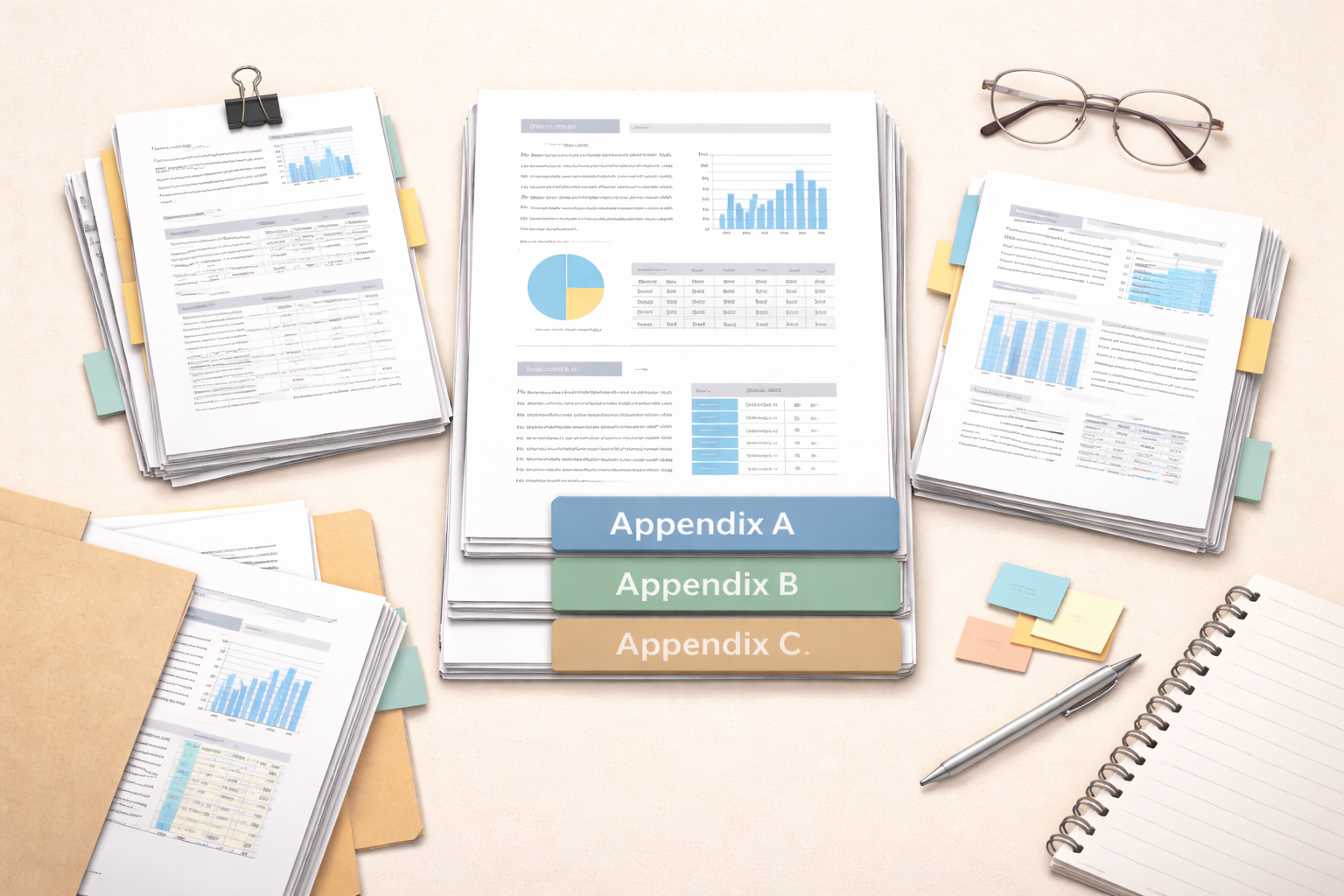
Research papers are designed to present original inquiry, critical analysis, and evidence-based conclusions. Whether the discipline is social science, business, health, education, or engineering, academic research requires both clarity of argument and transparency of method. These two goals can sometimes conflict, particularly when a paper relies on extensive data, instruments, or technical material.
The appendix exists to resolve this tension. By moving detailed or supplementary content out of the main body, the researcher preserves the logical flow of the paper while still providing access to supporting material. However, many students struggle to understand what a strong appendix example for research papers looks like and how appendices should function within academic conventions.
This article explains, in depth, how appendices are used in research papers. It provides clear examples, explains formatting expectations, and outlines best practices so students can include appendices confidently and correctly.
What is an appendix in a research paper?
An appendix in a research paper is a section placed after the main text and reference list that contains supplementary material relevant to the study. This material supports the research but is not essential for understanding the core argument or findings.
The defining feature of an appendix is its supportive role. It does not introduce new arguments or interpretations. Instead, it provides additional detail that enhances transparency, allows replication, or documents methodological choices without overwhelming the reader.
An appendix supports the research paper but should never carry the main analysis or argument.
Understanding this principle is essential. If the appendix becomes necessary for understanding the paper’s conclusions, it has been misused.
Why research papers rely heavily on appendices
Research papers often involve complex processes such as data collection, sampling, coding, or statistical testing. Including all of this detail in the main body would distract from interpretation and discussion. Appendices allow researchers to document these processes thoroughly without compromising readability.
From an academic perspective, appendices also demonstrate research integrity. They allow examiners, reviewers, or readers to verify claims, assess instruments, and evaluate methodological rigour. In many disciplines, the absence of appropriate appendices may raise concerns about transparency.
However, appendices must be used strategically. More material does not automatically mean better research, and excessive appendices can signal poor judgement rather than thoroughness.
Common appendix examples for research papers
To understand how appendices function in practice, it is useful to examine common types of appendix content found in research papers. Each example below illustrates material that strengthens the paper without intruding on the main discussion.
Appendix example: Research instruments
In empirical research, full copies of data collection instruments are commonly placed in an appendix. These may include questionnaires, interview guides, observation checklists, or experimental protocols.
The main paper typically summarises how the instrument was developed and used, while the appendix provides the complete version. This allows readers to evaluate validity and reliability without disrupting the narrative.
Research instruments should be accessible to readers, but not embedded within analytical sections.
Appendix example: Raw or extended data
Quantitative research often generates large datasets. While summary statistics and key results appear in the main text, full datasets or extended tables are placed in appendices.
This approach ensures transparency and allows interested readers to examine the underlying data without burdening the core analysis. It is especially common in theses, dissertations, and journal-style research papers.
Appendix example: Supplementary qualitative material
In qualitative research, appendices may include extended interview excerpts, coding frameworks, or thematic matrices. These materials support claims made in the analysis but are too detailed to include in the main body.
The researcher should clearly explain how this material was used, ensuring that the appendix enhances credibility rather than functioning as a data dump.
How to label and structure appendices in research papers
Clear structure is essential for effective appendices. Each appendix must be clearly identified, logically organised, and easy to navigate. Poor labelling is one of the most common reasons appendices are ignored or misunderstood.
Standard academic practice is to label appendices alphabetically, beginning with Appendix A, followed by Appendix B, Appendix C, and so on. Each appendix should start on a new page and include a descriptive title.
| Strong Appendix Structure | Weak Appendix Structure |
|---|---|
| Appendix A: Interview Guide | Appendix 1 |
| Appendix B: Raw Survey Data | Extra Information |
Consistent labelling helps readers locate material quickly and signals adherence to academic conventions.
Referencing appendices within the research paper
An appendix should never stand alone. Every appendix included must be explicitly referenced in the main text. These references explain why the appendix exists and how it relates to the research.
References are typically brief and functional. For example, a paper may state that the full questionnaire is provided in Appendix A or that detailed regression outputs appear in Appendix C.
If an appendix is not referenced, examiners may assume it is irrelevant and disregard it entirely.
What should not be included in a research appendix
One of the most serious mistakes students make is using appendices to avoid writing or analysis. While appendices support the paper, they cannot substitute for critical engagement in the main text.
The following content should always remain in the body of the research paper:
- Core arguments and hypotheses
- Interpretation of results
- Discussion of findings
- Conclusions and implications
If your argument relies on the appendix to make sense, the appendix has been misused.
Differences between appendices in research papers and reports
Although appendices appear in both research papers and reports, their use can differ slightly. Research paper appendices tend to emphasise methodological transparency and theoretical justification, while report appendices often focus on operational or procedural detail.
In research papers, appendices are closely tied to scholarly standards such as replicability and validity. This means that material included must be clearly justified and academically relevant.
Understanding these distinctions helps students adapt their appendices to the specific genre and expectations of their assignment.
Checklist for a strong research paper appendix
Before submitting a research paper, students should review their appendices carefully. A final checklist helps ensure that appendices add value rather than confusion.
- Is every appendix clearly labelled and titled?
- Is each appendix referenced in the main text?
- Does the appendix contain only relevant supporting material?
- Can the paper be understood fully without reading the appendix?
Affirmative answers to these questions indicate that the appendix has been used effectively and in line with academic expectations.
Using appendix examples to strengthen research writing
Appendices are not optional add-ons but strategic tools in research writing. When used correctly, they enhance transparency, demonstrate methodological rigour, and support academic credibility.
By studying strong appendix examples for research papers and applying best practices consistently, students can present their research professionally and confidently. This approach allows the main paper to remain focused and persuasive while meeting the highest standards of academic documentation.



Comments