Introduction
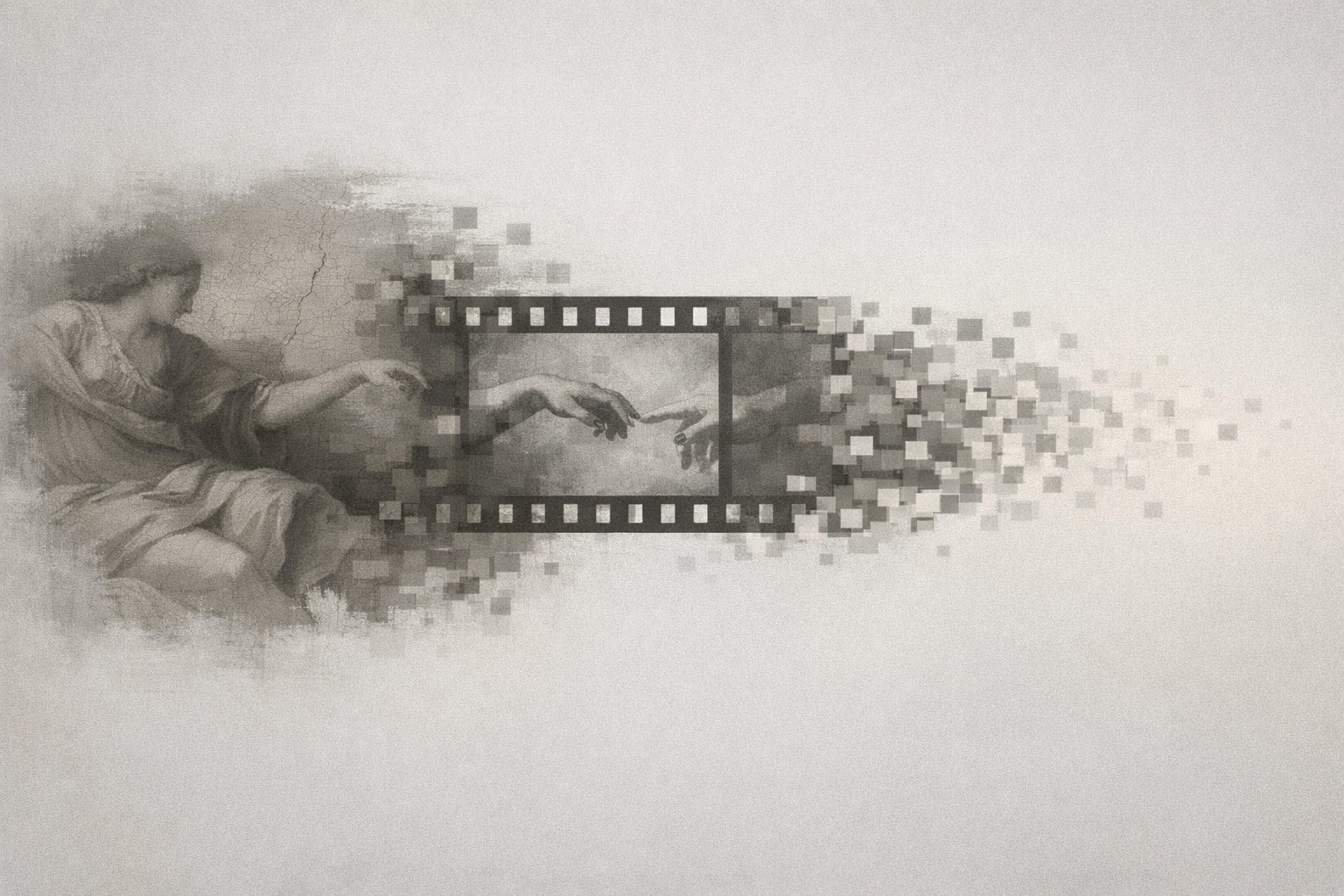
• It is an essay written in 1936 by Walter Benjamin, which talks about the change in nature and purpose of art in terms of technology.
• He introduces the concept of aura which characterizes personality and genuineness of a work of art.
• Benjamin believes that this aura is killed through mechanical reproduction, including photography and film.
• The essay also explores the issue of how art can lose its ritual value and acquire new social and political meanings.
• It looks at the changes in human perception and culture brought about by mass production.
• Benjamin is still considered to be fundamental to contemporary media, cultural, and art theory.
• The essay was done in the 1930s, which was characterised by accelerated industrial change and technological transformation.
• Photography and cinema were coming up as the dominant forms of culture, creating new experiences of reality.
• Traditional artworks were also associated with religious or ritual settings and focused on uniqueness and worship.
• Industrialization made art mass-produced and removed the connection between art and ritual.
• Art was made available to people and not exclusive, but for mass participation.
• Some backgrounds of the ideas of Benjamin include political turmoil, modernism, and fascism that arose in Europe.

The Concept of “Aura”
- Aura is the feeling of reality and originality that encloses a unique piece of art.
- It is related to the presence of the artwork in a certain time, place and in a certain cultural tradition.
- Mechanical reproduction reduces the aura in that it dissociates the artwork from its context.
- Copies do not have any physical and historical richness in them that gives originals their powers.
- The fact that we lose aura gives birth to another form of aural experience - more impersonal, timely, community-based.
- Benjamin thinks of this loss as a cultural degradation and as a fresh opportunity for social interaction.

Mechanical Reproduction and Its Effects
- Technological reproduction enables the duplication and distribution of works of art in an enormous manner.
- This process takes the work out of its original context, changing its meaning and purpose.
- Art comes to lose the value of ritual and spirituality and begins to acquire the value of exhibition and even political value.
- The individuality of the artwork is substituted with accessibility and the involvement of democracies.
- They are forced to see art in the mass media, advertising, and entertainment instead of in the sacred spaces.
- Having changed the consumption of art, reproduction also transformed the perception of reality itself.

The Role of Film and Photography
- The most prominent examples of mechanically reproduced forms of art are film and photography, as discussed by Benjamin.
- Photography is imprinted with reality, but is altered in its meaning by the form of framing and repetition.
- Film creates a new reality using editing, montage and controlled perspective.
- They both solve the puzzle of the aura of reproducibility rather than singularity.
- Cinema brings art to the citizens, and makes it humanly great.
- Technology as a mediating element in human perception through film: Intertwining illusion and social commentary.

Transformation of Human Perception
- The modern age educates people to see reality in terms of technology.
- The human eye is trained to live in expectation of constant change, movement and repetition.
- Film and photography transform people’s perception of space, time and experience.
- The focus is removed in favour of immediacy and visual stimulation.
- Viewing the artwork turns the viewer into an observer and not a passive admirer of art.
- Benjamin views this change as a wider change in the progress of contemporary consciousness.

Art and Politics
- Benjamin says that technological reproduction alters the political role of art.
- In traditional cultures, art had a religious, ritual, or aristocratic purpose.
- In the contemporary era, art turns out to be an instrument of political expression and mass influence.
- The images are reproducible, and this has enabled the ideologies to disseminate quickly through the media.
- The collective emotions and social awareness can be rallied by film, especially.
- The artists are subject to the political influence of art because it has the ability to reach the masses and to touch them.

The Artist and the Masses
- The artist loses his or her creator of individual works and becomes the producer of reductive media.
- The art production is made shared, which includes directors, editors and technicians.
- The audience ceases being a mere viewer, but is now a critic and an interpreter.
- And, as a part of mass culture, it is the boundary between the artist and the viewer that becomes less distinct.
- Democratisation of reproduction is used to create space where there are multifarious voices.
- But it also jeopardises taste homogeneity and artistic uniqueness.

Loss and Liberation
- Using auras as an example, loss of aura is an act of loss of culture and a move of freedom.
- Devoid of aura, art is no longer a prisoner to high culture and spiritualisation.
- The audience is liberated to perceive and interpret art in their normal lives.
- Art would be incorporated into political struggle, educational process and experience.
- Reproduction can make the masses think critically about society.
- This, according to Benjamin, is a revolutionary consciousness in art.

The Role of Technology
- Technology is more than just a tool; it is a power that creates a new perception and culture.
- The new media of photography, film, and digital media all change the definition of reality.
- Technological innovation alters the production, distribution and editing of art.
- The detachment of art by tradition in the mechanical process invents meanings.
- Technology reduces art to an exploitable, common cultural language.
- Benjamin has foreseen the current digital society of pictures and instantaneous access.

Cinematic Perception
- Cinema is a good example of how reproduction changes human perception.
- The camera is considered a mechanical eye, which opens up secret planes of reality.
- Filming structure: To construct new sensory experiences, film breaks time and space.
- The viewer sees the reality as something that is created, but not something that is provided.
- Such a new perception reflects the speed and the discontinuity of contemporary life.
- Cinema is a good example of how reproduction changes human perception.
- The camera is considered a mechanical eye, which opens up secret planes of reality.
- Filming structure: To construct new sensory experiences, film breaks time and space.
- The viewer sees the reality as something that is created, but not something that is provided.
- Such a new perception reflects the speed and the discontinuity of contemporary life.
Critique of Capitalism and Fascism
- Benjamin is also concerned about the fact that mass reproduction can be used against political power.
- Fascist regimes also manipulated feelings and imposed ideology with the aid of art and cinema.
- Capitalism transforms art into a commodity, where profit is the primary consideration, rather than significance.
- Mechanical image may enlighten or deceive, depending on how it is utilised.
- Benjamin urges against the aestheticisation of politics, but the politicisation of art.

Modern Relevance
- Benjamin’s thoughts envision the online era of social networking and mass media.
- An example is that the aura remains and will continue to decline with the digital art and AI making it blurry in terms of originality and authorship.
- This is because modern audiences are indeed consuming art around the clock, although frequently without critical thinking.
- The speed of reproduction and spread of images is unprecedented on social media.
- The democratisation of art is a process that goes on, and it is a contributor to shallow consumption.
- The essay by Benjamin is one of the important frames of media and machine.

The Digital Age and the New “Aura”
- By digital technology, the theory of Benjamin has been redefined in the 21st century.
- Online media and artificial intelligence erase the distinction that exists between the original and the imitation.
- Other researchers believe that digital works provoke a new type of aura that is achieved by interaction and individualisation.
- Virtual exhibitions and NFTs reinstill singularity in the virtual worlds (Hansen, 2012).
- Digital aura is movable - it does not rely on physical originality, rather upon experience.
- The insights made by Benjamin still inform our perception of digital creativity and authenticity.

Conclusion
- As a redefinition of art in the contemporary world, The Work of Art in the Age of Mechanical Reproduction redefines modern times.
- Benjamin exposes the way that technology alters the artistic value and the way human beings perceive things.
- Owing to the disappearance of the aura, there is a transition between sacred art and social and political art.
- Cinema and photography renew group experience and consciousness.
- The difficulty in the current times is to strike a balance between accessibility and authenticity and meaning.
- The vision of Benjamin makes us remember that technology should not dominate people but be used as a way to create awarene
Speakers Note
Slide 2 Introduction
The essay by Benjamin is a critical observation of the impact that technological reproduction has on the nature of art. He says that new technologies not only change the production of art, but the way of observation of the world, as well (Benjamin, 1936). Essence and originality of a piece of art, known as the aura, start to be lost when the art is reproduced and spread on a mass scale.
Slide 3 Historical Context
The ideas of Benjamin need to be contextualised into history so as to understand what they entailed. The first half of the 20th century in Europe was marked by the acceleration of industrialisation, urbanisation, and political turmoil. The new forms of art were photography and cinema, which were able to use mass production and be put into circulation (Buck-Morss, 1989). The art that was traditionally attributed to religion as a ritual and unique form of art had to compete with images that could be easily duplicated.
Slide 4 The Concept of “Aura”
The aura is one of the key components of the theory of Benjamin. It is the authenticity, originality, and historical presence that make art (i.e., a given work of art) unique (Benjamin, 1936). The Mona Lisa painting has an aura, since it only has one, inimitable form, associated with time and location. Making copies, however, the copy does not have this unique presence.
Slide 5 Mechanical Reproduction and its Effects
The functioning of art in society is changed by mechanical reproduction, which occurs through printing, photography, and film. Images were able to reach out to millions of people at a time, for the first time ever. Art images did not remain in the museums or temples; they became a part of the life of the people. According to Benjamin (1936), this process substitutes the ritual of the artwork with an exhibition value, i.e., the end of art as divine worship turns into its exhibition and publicity.
Slide 6: The Process of Film and Photography
Benjamin uses film and photography as the most influential of the reproducible art items. Photography represents an instant in time, and at the same time, reality is re-packaged using technology. Film has gone ahead to create a new experience with editing, montage, and close-ups. According to Benjamin (1936), the camera shows things that cannot be perceived by the naked eye, and he terms it the optical unconscious.
Slide 7: The Metamorphosis of Human Perception
The perception of man is also being transformed with the emergence of the cinema and photography. The current generation gets used to looking beyond machines, beyond fragmented, dynamic images, and replacing them with slow thinking (Hansen, 2012). The spectator gets accustomed to a different flow of experience determined by technology. Benjamin reckoned that this change was reflective of industrial modernity, where workers and citizens witnessed accelerated movement, diversions, and repetition.
Slide 8 Art and Politics
Benjamin makes art as an outcome of politics. The art loses its ritual value, but becomes a political one (Benjamin, 1936). The masses can be educated, mobilised, or even manipulated by reproducible images, whether posters, films, or photographs. In the case of Benjamin, this power may be emancipation or domination. Art can be a political instrument that forms the mass emotions and social awareness.
Slide 9 The Artist and the Masses
The role of the artist becomes different in contemporary times. Art is industrialised as a joint venture and involves a number of creators and technicians (Jay, 1993). The viewer as well varies: instead of silent observers, the viewers will grow into critics and participants. Benjamin loved the fact that audiences of a movie could analyse and interpret what they had seen, making consumption selfless.
Slide 10 Loss and Liberation
The loss of aura is a metaphor of a cultural loss and freedom gained. The defection is the decay of piety, enigma, and genuineness. Nevertheless, the struggle against elitism and ritualism in art brings freedom (Benjamin, 1936). Benjamin had a revolutionary vision of this transformation, the possibility of art to stir critical consciousness and social change to take place due to its availability and its participation by the masses (Lunn, 1982).
Slide 11: The Role of Technology
To Benjamin, technology is not neutral, but it literally transforms the reality perception and understanding of people. The world of senses is changed by every new medium, and the very definition of authenticity is redefined (Buck-Morss, 1989). The camera, the printing press, and currently the digital media remove art from its native realm and enable it to be reproduced and viewed anywhere around the world.
Slide 12 Cinematic Perception
Cinema, as defined by Benjamin, has restructured the senses through the reconfigulation of technology. Through montage, the film camera disregards reality by cutting it up into shots, twisting them around, and gluing back meaning (Benjamin, 1936). This process reflects the fractured view of contemporary life that is fast, mechanical, and built.
Slide 13 Critique of Capitalism and Fascism
Mechanical reproduction may also be used to suppress systems, which is also cautioned by Benjamin. The film and art created during the 1930s were used in the propaganda of fascist regimes, which aestheticised politics and idealised power (Benjamin, 1936). Capitalism, in turn, also commodifies art making, innovativeness, and a profit-driven product. He urges the politicisation of art in response to the exploitation of aesthetics into the hands of an authoritarian regime (Hansen, 2012).
Slide 14 Modern Relevance
The concepts of Benjamin are particularly still dramatic in the digital era of today. The aura is still being eroded by taking advantage of social media, the capability to stream, and even AI-generated art, as technology allows limitless reproduction. Uniqueness is erased, and genuineness is made more difficult to find. However, democratisation continues as Benjamin foresaw; everyone is able to create, share, and remake images (Jay, 1993).
Slide 15 The Digital Age and the New “Aura”
The argument by Benjamin becomes even more applicable in the twenty-first century when digital media is redefining the concept of originality. Interestingly, because of the digital art, according to some of the scholars of modern times, the aura, as we might refer to it now, may not be uncovered based on physical difference; rather, it will be through interaction, time, and emotion (Hansen, 2012).
Slide 16 Conclusion
The Work of Art in the Age of Mechanical Reproduction by Walter Benjamin reinterprets the conceptualisation of art, technology, and culture. The loss of aura will mean not only dissipation but also transformation, a change of perception of human perception and social relations. Art through film and photography is made available, political as well as participatory. The thoughts of Benjamin pre-empt our own battle against digital reproduction and authenticity.
References
Benjamin, W. (1936). The work of art in the age of mechanical reproduction. In H. Arendt (Ed.), Illuminations (pp. 217–251). Schocken Books, 1969. https://www.taylorfrancis.com/chapters/edit/10.4324/9781315668505-19/work-art-age-mechanical-reproduction-walter-benjamin
Buck-Morss, S. (1991). The dialectics of seeing: Walter Benjamin and the Arcades Project. mit Press. https://books.google.com/books?hl=en&lr=&id=5Ejq67KMYoIC&oi=fnd&pg=PR9&dq=Buck-Morss,+S.+(1989).+The+dialectics+of+seeing:+Walter+Benjamin+and+the+Arcades+Project.+MIT+Press.&ots=MpW3XkqGQK&sig=aEsOKmKmZwMqSh2eIEbMZkf2ja0
Hansen, M. (2012). Cinema and Experience: Siegfried Kracauer, Walter Benjamin, and Theodor W. Adorno (Vol. 44). Univ of California Press. https://books.google.com/books?hl=en&lr=&id=Dn4QkO-RKv8C&oi=fnd&pg=PR1&dq=Hansen,+M.+B.+(2012).+Cinema+and+experience:+Siegfried+Kracauer,+Walter+Benjamin,+and+Theodor+W.+Adorno.+University+of+California+Press.&ots=Df2GtPkLKm&sig=Cj6FI8_jelJH2BjuHoiGQ0Y8Ls0
Jay, M. (1993). Downcast eyes: The denigration of vision in twentieth-century French thought. Univ of California Press. https://books.google.com/books?hl=en&lr=&id=2aMwDwAAQBAJ&oi=fnd&pg=PR9&dq=Jay,+M.+(1993).+Downcast+eyes:+The+denigration+of+vision+in+twentieth-century+French+thought.+University+of+California+Press.&ots=i1rsWoyOmk&sig=iW-XqH2ir7T_1GLuRoFw_ZXwuao
Lunn, E. (1984). Marxism and modernism: An historical study of Lukács, Brecht, Benjamin, and Adorno. Univ of California Press. https://books.google.com/books?hl=en&lr=&id=oyTmxd7OPhkC&oi=fnd&pg=PP11&dq=Lunn,+E.+(1982).+Marxism+and+modernism:+An+historical+study+of+Luk%C3%A1cs,+Brecht,+Benjamin,+and+Adorno.+University+of+California+Press.&ots=l_knPstbUB&sig=OgxB9ts7U0Q24vs0I6EuwJYqPkk
Comments