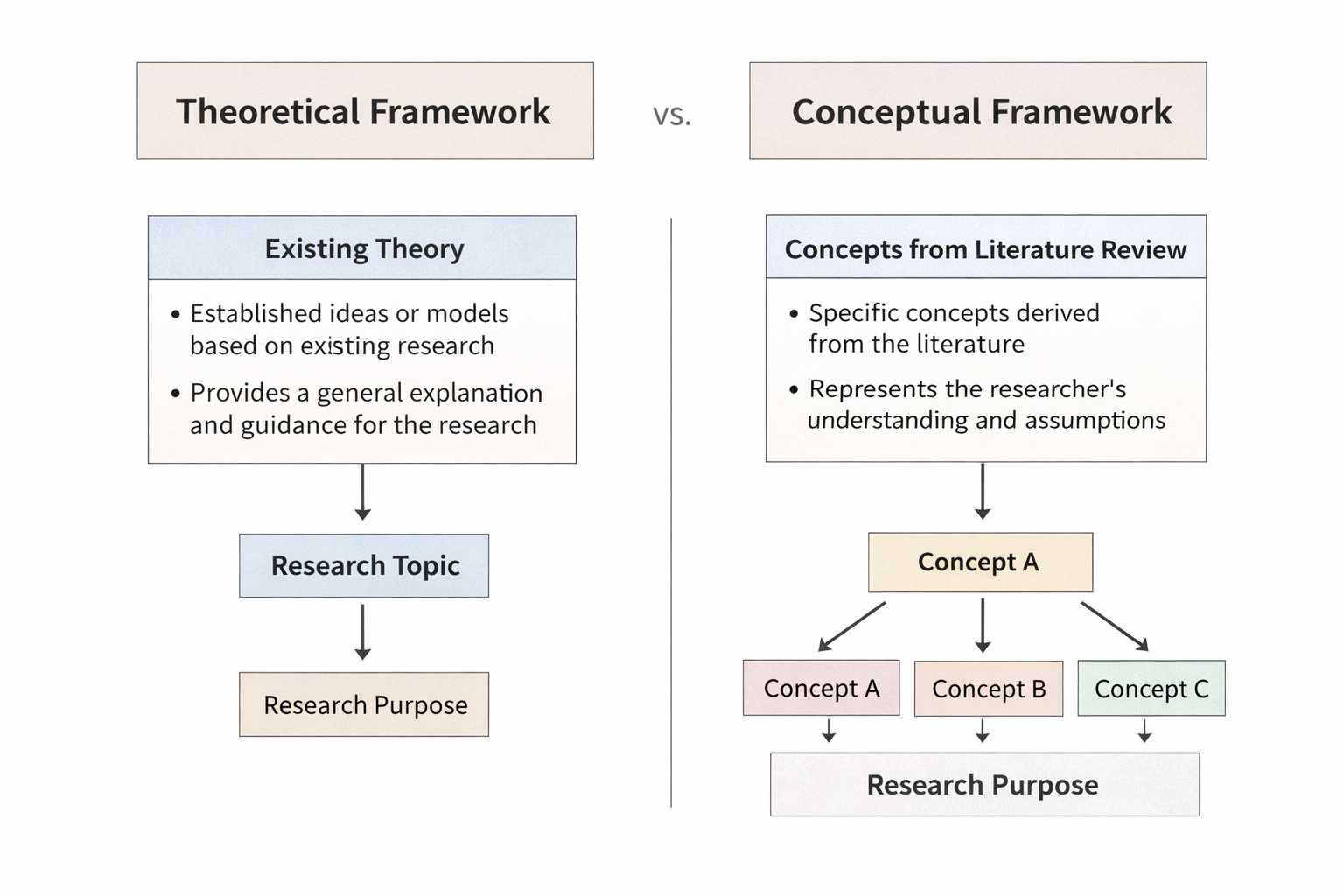
One of the most common sources of confusion in academic research writing is the distinction between a theoretical framework and a conceptual framework. Students frequently use the terms interchangeably, yet examiners treat them as distinct intellectual tools with different purposes.
This confusion often emerges during proposal writing, dissertation chapters, or methodology discussions, where feedback such as “framework unclear” or “theoretical grounding is weak” is common. In many cases, the issue is not a lack of reading, but a misunderstanding of what each framework is designed to do.
This article clarifies the difference between a theoretical framework and a conceptual framework, explains how each is constructed, and shows how to choose and justify the correct framework in academic research.
Why Frameworks Matter in Academic Research
Frameworks provide the intellectual foundation of a research study. They explain how a researcher understands the problem being studied and how key variables or concepts are expected to relate to one another.
Examiners use frameworks to assess whether a study is theoretically informed, logically structured, and methodologically coherent. A poorly defined framework signals weak conceptual thinking, regardless of the quality of data collected.
Understanding the distinction between theoretical and conceptual frameworks allows students to meet disciplinary expectations with clarity and confidence.
What a Theoretical Framework Is
A theoretical framework is grounded in established theories that have been developed, tested, and validated by previous researchers. It provides an explanatory lens through which a research problem is analysed.
Theories used in a theoretical framework typically originate from recognised scholars and academic traditions. They explain why phenomena occur, not just how they are observed.
A theoretical framework explains a study through existing theory.
In this sense, the researcher positions their work within an existing body of theoretical knowledge.
Core Characteristics of a Theoretical Framework
A theoretical framework is explicitly theory-driven. It relies on formal theories such as social learning theory, constructivism, systems theory, or critical theory.
The framework is usually presented in the literature review or a dedicated theory section, showing how the chosen theory informs the research questions, variables, or hypotheses.
Theories used must be clearly defined, cited, and justified in relation to the study’s objectives.
Examples of When a Theoretical Framework Is Required
Theoretical frameworks are commonly required in dissertations, doctoral theses, and theory-driven quantitative studies.
They are especially important when research aims to test, extend, or apply an existing theory to a new context.
Fields such as psychology, sociology, education, and management frequently expect explicit theoretical frameworks.
What a Conceptual Framework Is
A conceptual framework is a researcher-developed model that explains how key concepts in a study are related. Unlike a theoretical framework, it is not limited to a single established theory.
Instead, it synthesises ideas from multiple sources, including theories, empirical studies, and contextual factors relevant to the research problem.
A conceptual framework explains a study through the researcher’s conceptual understanding.
This makes conceptual frameworks particularly flexible and context-specific.
Core Characteristics of a Conceptual Framework
A conceptual framework is integrative rather than purely theoretical. It combines concepts drawn from literature and aligns them with the specific focus of the study.
It often includes variables, constructs, or themes identified through prior research, but arranged in a way that reflects the researcher’s analytical logic.
Conceptual frameworks are frequently visualised using diagrams, though textual explanations are equally important.
When a Conceptual Framework Is More Appropriate
Conceptual frameworks are common in exploratory, qualitative, or mixed-methods research.
They are especially useful when no single theory adequately explains the phenomenon under investigation.
Applied research, case studies, and interdisciplinary projects often rely on conceptual rather than theoretical frameworks.
Key Differences Between Theoretical and Conceptual Frameworks
Although both frameworks guide research, they differ in origin, purpose, and structure. The table below summarises these differences clearly.
| Aspect | Theoretical Framework | Conceptual Framework |
|---|---|---|
| Source | Established theories | Multiple sources and researcher synthesis |
| Purpose | Explain phenomena using theory | Map relationships between concepts |
| Flexibility | More rigid | Highly flexible |
| Typical use | Theory-testing studies | Exploratory or applied studies |
| Researcher role | Applies existing theory | Constructs analytical model |
This comparison highlights why examiners treat the two frameworks differently.
How Examiners Evaluate Framework Choice
Examiners assess whether the chosen framework aligns logically with the research aims and questions.
Using a theoretical framework when no relevant theory exists may appear forced. Conversely, using a conceptual framework when theory is central may appear superficial.
Clear justification is more important than the framework type itself.
Can a Study Use Both Frameworks?
In some cases, studies may incorporate both a theoretical and a conceptual framework. This is common in complex or interdisciplinary research.
The theoretical framework provides foundational theory, while the conceptual framework adapts and integrates concepts for the specific study.
However, roles must be clearly distinguished to avoid conceptual confusion.
Common Student Mistakes with Frameworks
A frequent mistake is labelling a conceptual framework as theoretical simply because theories are cited.
Another error is presenting a list of concepts without explaining their relationships.
A framework is not a summary of literature; it is an analytical structure.
Precision in terminology is essential.
Where Frameworks Appear in Academic Writing
Frameworks are commonly introduced in the literature review or a standalone framework chapter.
They should be referenced throughout the methodology, analysis, and discussion to demonstrate coherence.
Frameworks that disappear after introduction weaken argumentative consistency.
How Frameworks Shape Research Design
Frameworks influence variable selection, data collection methods, and analytical approaches.
A theoretical framework may dictate hypothesis testing, while a conceptual framework may guide thematic analysis.
This alignment strengthens methodological justification.
Explaining Your Framework in Clear Academic Language
Students should explain why the chosen framework is appropriate, not merely describe it.
This includes defining key concepts, explaining relationships, and linking the framework to research questions.
Clarity here signals intellectual maturity.
Frameworks in Proposals vs Completed Research
In proposals, frameworks are often provisional and justified as guiding assumptions.
In completed research, frameworks should be reflected and refined based on findings.
This evolution demonstrates reflexive thinking.
Choosing the Right Framework with Confidence
Choosing between a theoretical framework and a conceptual framework depends on research purpose, discipline, and available theory.
Neither framework is inherently superior; appropriateness is the key criterion.
When clearly justified and consistently applied, either framework strengthens academic credibility and analytical depth.
Comments