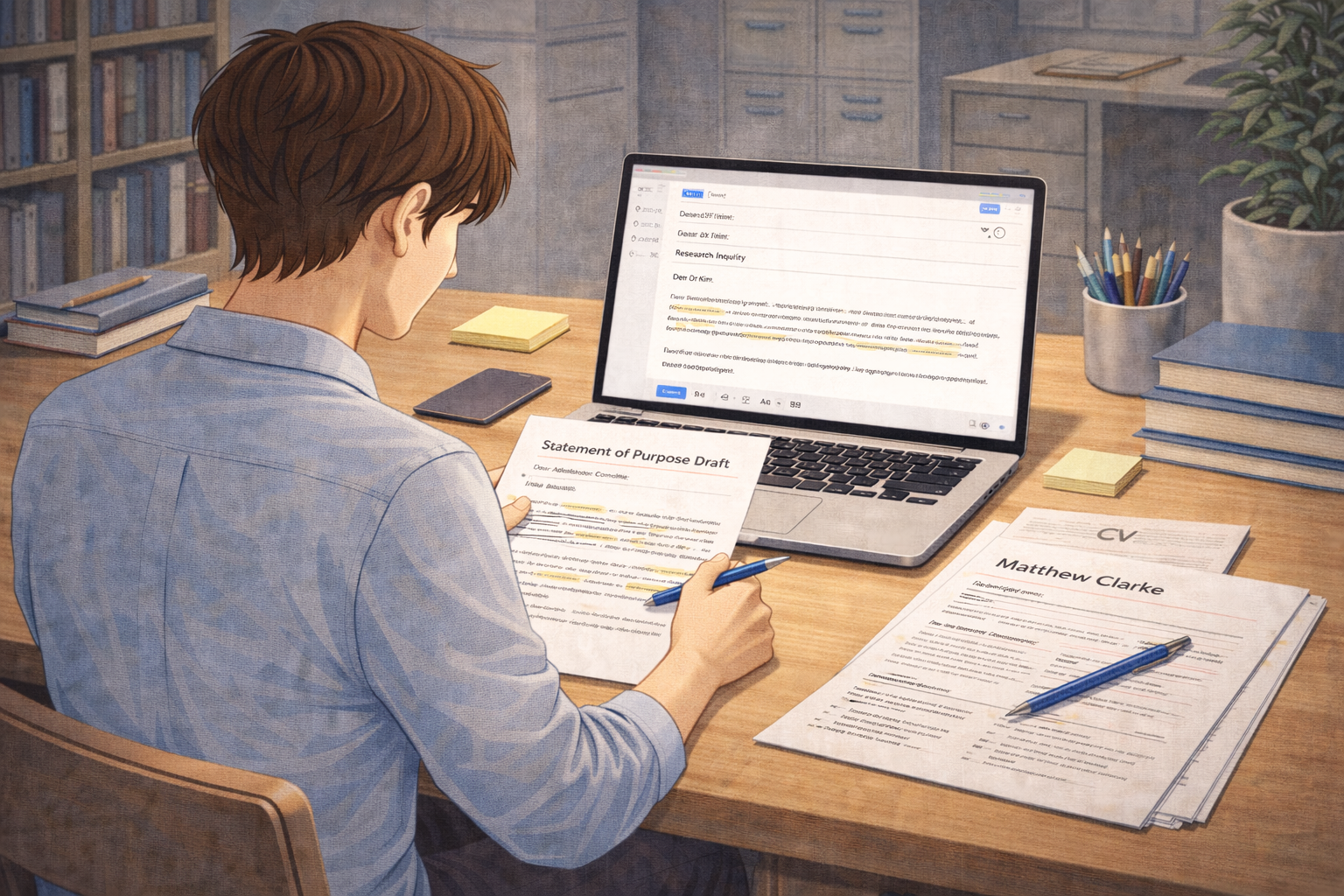
Contacting a potential PhD supervisor is one of the most sensitive and consequential steps in a doctoral application. In many disciplines, a concise, well-structured email to a professor is the first informal evaluation of your academic maturity, research alignment, and communication skills.
Students often underestimate this step, treating it as a casual enquiry rather than a professional academic introduction. However, professors receive dozens—sometimes hundreds—of PhD enquiry emails each year. Most are ignored not because the applicant is unqualified, but because the email fails to demonstrate focus, preparation, or relevance.
This guide explains how to write an effective email to a professor for a PhD application and provides formal examples that align with academic expectations across UK, EU, US, and Commonwealth universities.
Why the Initial PhD Email Matters Academically
The first email to a professor functions as a screening mechanism. Before reviewing transcripts, proposals, or CVs, many supervisors assess whether the applicant can communicate clearly, respect academic conventions, and demonstrate genuine research alignment.
A strong email signals that you understand the professor’s work, have a viable research direction, and are capable of doctoral-level professionalism. A weak email suggests poor preparation or a transactional mindset, both of which are red flags in research supervision.
Examiner expectation: A PhD enquiry email should read like a miniature research introduction, not a generic admissions request.
For this reason, the email must be treated as an academic document, not informal correspondence.
When You Should Email a Professor for a PhD Application
Timing plays a critical role in whether your email is read and considered seriously. Professors are most receptive when your enquiry aligns with application cycles, funding calls, or advertised PhD opportunities.
In most cases, you should email a professor before submitting a formal PhD application, particularly in systems where supervisor approval is required. This is common in the UK, Europe, Australia, and increasingly in North America.
Emailing too early without a clear research direction, or too late after deadlines have passed, significantly reduces your chances of receiving a response.
Core Components of a Strong PhD Application Email
Although disciplines differ slightly, successful PhD enquiry emails share a common academic structure. Each element serves a specific evaluative purpose.
- Clear and professional subject line
- Formal salutation using academic title
- Brief self-introduction with academic background
- Specific reference to the professor’s research
- Concise description of your proposed research interest
- Polite request for supervision or discussion
- Professional closing with contact details
Omitting any of these elements weakens the overall credibility of the message.
What Professors Look for When Reading PhD Emails
Professors do not expect a full research proposal in an email. However, they do expect intellectual coherence and evidence that the applicant understands the field.
Most supervisors quickly scan for three signals: relevance to their expertise, feasibility of the research idea, and the applicant’s academic preparedness.
The table below summarises how professors typically evaluate first-contact emails.
| Evaluation Area | What the Professor Looks For | Common Student Mistake |
|---|---|---|
| Research Alignment | Clear connection to their published work | Generic or copied statements |
| Clarity | Focused and concise research interest | Overly broad or vague topics |
| Professionalism | Formal tone and structure | Casual or informal language |
| Preparation | Evidence of prior academic training | No mention of background or skills |
Understanding these criteria allows you to shape your email strategically rather than emotionally.
Email to Professor for PhD Application Example (General)
The following example illustrates a formal, discipline-neutral email suitable for most PhD enquiries. It should be adapted to reflect your specific background and the professor’s research area.
Subject: Prospective PhD Student – Research Interest in [Specific Area]
Dear Professor [Last Name],
I hope this message finds you well. My name is [Your Name], and I am currently completing a [Master’s degree/Research qualification] in [Field] at [University]. I am writing to enquire whether you would be open to supervising a PhD project beginning in [intended start year].
I have been reading your recent work on [specific topic or publication], particularly your study on [brief, precise reference]. This research aligns closely with my academic interests and has significantly informed my developing research direction.
My proposed PhD research would examine [concise description of topic], with a particular focus on [specific angle or methodology]. I believe this project fits well within your current research profile.
I would be grateful for the opportunity to discuss whether this research direction might be suitable for supervision. I have attached my CV and academic transcript for your reference.
Thank you very much for your time and consideration.
Kind regards,
[Your Full Name]
[Current Institution]
[Email Address]
This example demonstrates clarity, relevance, and restraint—qualities supervisors consistently value.
Email Example for Funded or Advertised PhD Positions
When applying for a funded or advertised PhD position, the tone should remain formal but slightly more directive, referencing the specific opportunity.
Subject: PhD Enquiry Regarding Advertised Project in [Area]
Dear Professor [Last Name],
I am writing in relation to the advertised PhD position in [project title or area], which I understand you are supervising. I hold a Master’s degree in [Field] from [University], where my research focused on [brief summary].
Your work on [specific research theme] closely aligns with my academic training, particularly my experience with [methods, theory, or data]. I am very interested in applying for this position and would welcome any guidance regarding suitability or expectations.
Please find my CV attached for your reference. I would be grateful for the opportunity to discuss the project further.
Yours sincerely,
[Your Name]
This version shows awareness of institutional context while maintaining academic courtesy.
Common Mistakes to Avoid in PhD Enquiry Emails
Even strong candidates are often rejected at this stage due to avoidable errors. The most common issue is treating the email as an administrative request rather than an academic introduction.
Critical warning: Never send mass emails or use identical wording for multiple professors.
Other frequent mistakes include excessive length, overly ambitious research claims, informal language, and failing to reference the professor’s work directly.
Editing and Proofreading Your PhD Email
Because this email functions as an academic writing sample, language accuracy and tone matter. Grammar errors or awkward phrasing can undermine otherwise strong content.
Before sending, students often benefit from professional academic proofreading to ensure clarity and formality without altering intent. Services such as Epic-Essay’s academic proofreading support focus on language precision while preserving authorial voice.
This final quality check can significantly improve response rates, particularly for non-native English speakers.
Final Guidance on Emailing Professors for PhD Applications
An effective email to a professor for a PhD application is concise, targeted, and academically grounded. It demonstrates respect for the professor’s expertise while positioning you as a serious prospective researcher.
Rather than trying to impress through volume or ambition, focus on clarity, relevance, and professionalism. A well-crafted email does not guarantee acceptance, but a poorly written one almost guarantees rejection.
Approach this step as the first page of your doctoral journey—and write accordingly.

Comments