Community Health Assessments (CHAs) are systematic processes used to identify health-related needs, resources, and inequalities within a defined population. In rural and semi-rural contexts, food security and nutrition are frequent focal areas due to economic vulnerability, supply-chain instability, and limited access to healthy food options. This article outlines a structured approach to conducting a CHA focused on food and nutrition systems.
Building a Multidisciplinary CHA Team
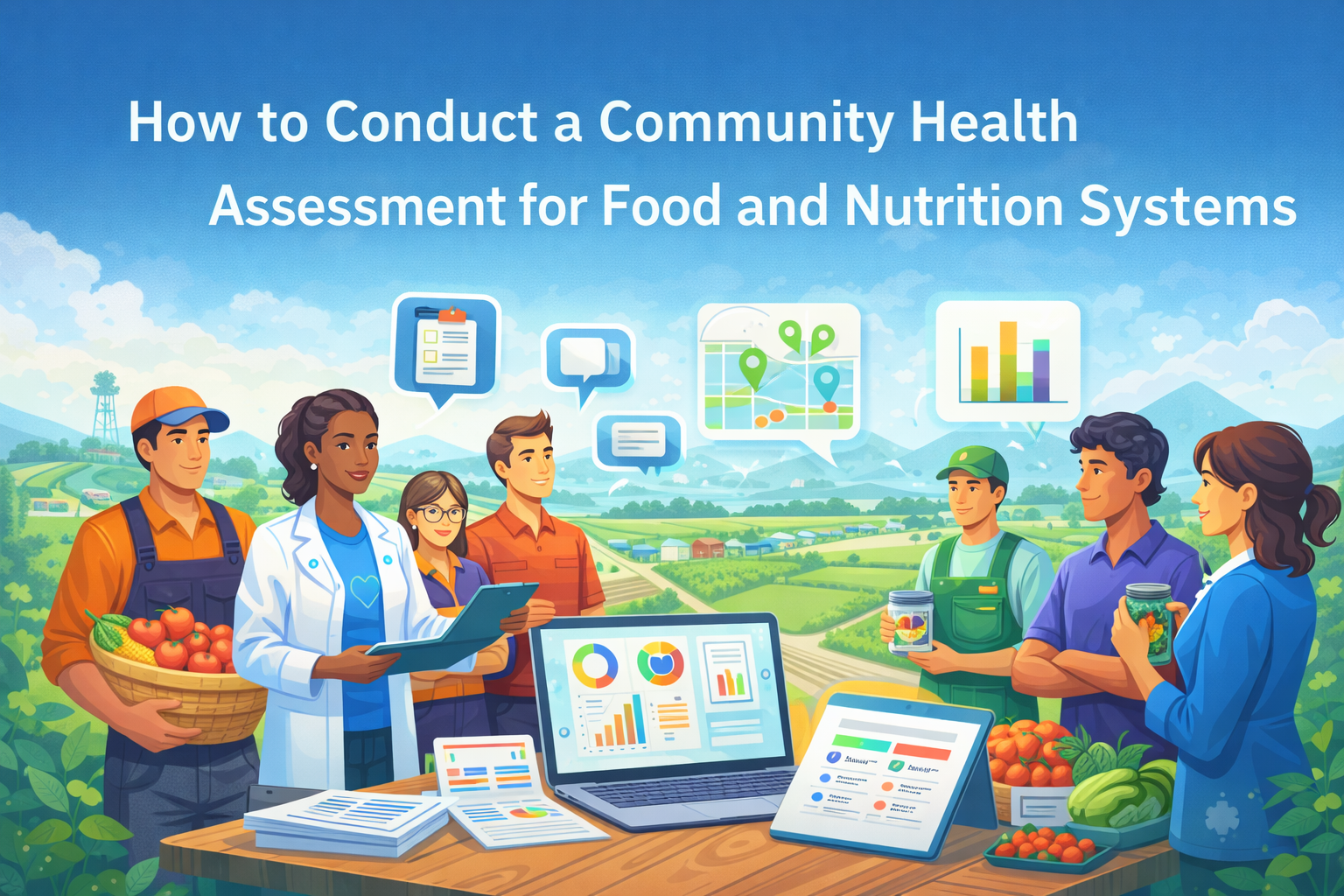
Effective community health assessments rely on collaboration across multiple stakeholder groups. A well-composed CHA team typically includes public health professionals, epidemiologists, educators, community organisations, food system stakeholders, and local residents.
This diversity ensures that the assessment captures technical expertise, lived experience, and institutional knowledge. Broad representation also improves trust and community engagement, which are critical for accurate data collection and successful implementation of recommendations.
Defining the Community and Purpose
A CHA must clearly define its geographic and population boundaries. In food and nutrition assessments, this often involves a town, county, or service area where economic or food-system disruptions are suspected.
The purpose of the assessment should be explicit, such as evaluating food availability, affordability, and nutritional stability. Clear scope definition ensures that data collection remains focused and that findings are actionable.
Funding and Resource Considerations
Community health assessments are frequently constrained by limited budgets. Funding may come from state or local health agencies, grants, in-kind contributions, or volunteer efforts.
Resource planning should account for personnel time, meeting spaces, data collection tools, and reporting materials. Aligning assessment scope with available resources helps maintain feasibility while preserving analytical depth.
Data Collection Strategies
Robust CHAs use a combination of primary and secondary data to capture both objective indicators and community perspectives.
Common data sources include:
-
Sociodemographic and economic indicators
-
Food security surveys
-
Availability and affordability of food outlets
-
School meal programs and assistance schemes
-
Local food production and distribution policies
Mixed methods—such as surveys, interviews, focus groups, and GIS mapping—allow triangulation of findings and enhance analytical validity.
Expected Findings and Analysis
Food and nutrition-focused CHAs often reveal patterns such as elevated food insecurity, economic pressure on local producers, and uneven access to affordable healthy food. These findings should be analysed using both quantitative summaries and qualitative insights to provide context.
Clear reporting using tables, maps, and concise narratives improves accessibility for both policymakers and community members.
Reporting and Communication
The final CHA report should include:
-
A description of the community
-
Key findings and disparities
-
Evidence-based interpretations
-
Practical recommendations
Effective reporting translates data into understandable insights that can guide decision-making and resource allocation.
From Assessment to Action
The ultimate goal of a CHA is not data collection but community improvement. Findings should inform education initiatives, policy advocacy, program design, and the formation of local action committees.
By linking assessment outcomes to implementation strategies, CHAs function as catalysts for sustainable health and food system improvements.
Conclusion
Community health assessments provide a structured, evidence-based approach to understanding food and nutrition challenges at the local level. Through inclusive team composition, mixed-methods data collection, and action-oriented reporting, CHAs support informed decision-making and meaningful community change.
Comments