
Completing a doctoral dissertation is one of the most demanding academic tasks in higher education. A PhD dissertation must present original research, demonstrate deep engagement with academic literature, and contribute meaningful knowledge to a specific field of study. Because the document often exceeds tens of thousands of words, understanding how to structure a PhD dissertation is essential for communicating research clearly and effectively.
A well structured dissertation allows examiners to follow the research process from the initial research problem to the final conclusions. Without a clear structure, even high quality research may appear confusing or incomplete. Proper organization ensures that each chapter contributes logically to the overall research argument.
This guide explains the standard structure of a PhD dissertation, describes the purpose of each chapter, and provides practical strategies for organizing doctoral research effectively.
Why Dissertation Structure Matters in Doctoral Research
The structure of a PhD dissertation serves as the framework that connects every part of the research project. A clearly organized dissertation helps readers understand how the research question was developed, how data were collected, and how conclusions were reached.
Doctoral research often involves complex theoretical frameworks and detailed data analysis. Without a clear structure, readers may struggle to understand the relationships between different parts of the research. A logical chapter organization allows examiners to evaluate the research systematically.
Strong structure also demonstrates the researcher’s ability to organize and communicate complex ideas, which is a key expectation of doctoral-level scholarship.
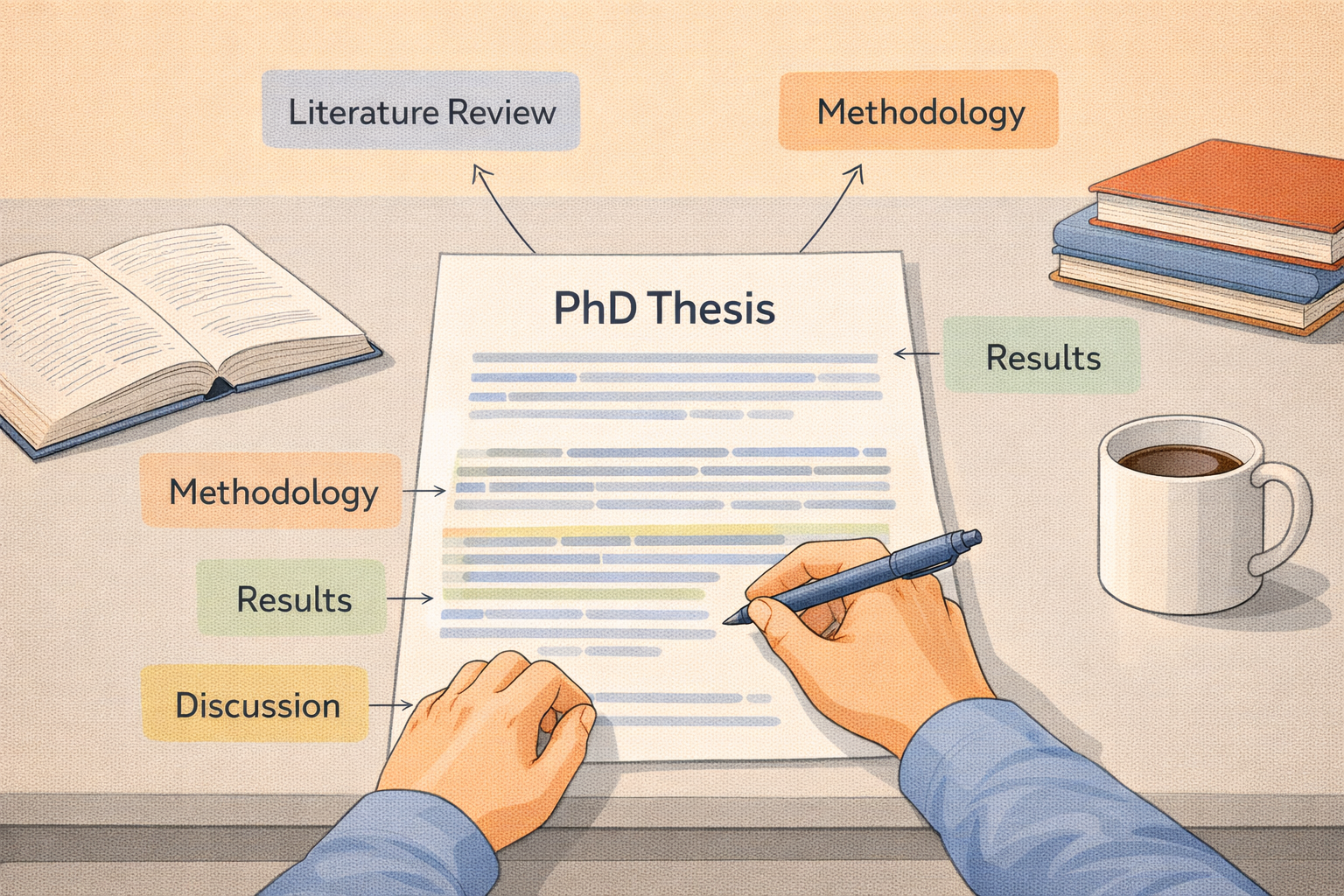
A well structured dissertation allows examiners to follow the research process clearly from problem to conclusion.
Typical Structure of a PhD Dissertation
Although exact dissertation structures vary between universities and disciplines, most doctoral dissertations follow a similar organizational framework. Each chapter performs a specific role in presenting and supporting the research.
| Chapter | Purpose |
|---|---|
| Introduction | Introduces the research problem, objectives, and significance of the study. |
| Literature Review | Examines existing research and identifies gaps in knowledge. |
| Methodology | Explains the research design, data collection, and analysis methods. |
| Results or Findings | Presents research data and key findings. |
| Discussion | Interprets findings and connects results to existing literature. |
| Conclusion | Summarizes the research contributions and suggests future research directions. |
Each chapter builds upon the previous one, guiding readers through the research journey step by step.
The Introduction Chapter
The introduction chapter establishes the foundation of the entire dissertation. It introduces the research problem, explains the importance of the topic, and outlines the objectives of the study.
This chapter typically includes the research questions, the purpose of the study, and the significance of the research within the academic field. The introduction may also provide a brief overview of the research methodology and dissertation structure.
A strong introduction clearly explains why the research matters and prepares readers for the chapters that follow.
The Literature Review Chapter
The literature review examines existing research related to the dissertation topic. This chapter demonstrates the researcher’s understanding of the academic field and positions the dissertation within the broader scholarly conversation.
Rather than simply summarizing previous studies, the literature review critically evaluates different perspectives and identifies gaps in existing knowledge. These gaps help justify the research question addressed by the dissertation.
A well developed literature review shows how the doctoral research contributes new insights to the field.
The Research Methodology Chapter
The methodology chapter explains how the research was conducted. It describes the research design, data collection methods, and analytical techniques used to investigate the research problem.
Doctoral researchers must justify their methodological choices carefully. This includes explaining why particular research methods were selected and how they are appropriate for answering the research question.
Transparency in the methodology chapter ensures that other researchers could replicate or evaluate the research process.
The Results or Findings Chapter
The results chapter presents the data collected during the research process. This chapter focuses on reporting findings rather than interpreting them.
Depending on the research design, the findings may include statistical analysis, qualitative observations, or thematic patterns identified within the data. Tables, figures, and charts are often used to present results clearly.
The results chapter should present information objectively, allowing readers to understand the evidence before the interpretation provided in later chapters.
The Discussion Chapter
The discussion chapter interprets the research findings and explains their significance. This section connects the results to the research questions and theoretical frameworks presented earlier in the dissertation.
Researchers analyze how their findings support, contradict, or expand existing literature. The discussion may also examine the implications of the research for theory, policy, or practice within the field.
By interpreting the results in a broader context, the discussion demonstrates the scholarly contribution of the doctoral research.
The Conclusion Chapter
The conclusion chapter summarizes the major findings of the dissertation and highlights the research contributions. It also reflects on the limitations of the study and suggests directions for future research.
Rather than introducing new information, the conclusion synthesizes insights from the entire dissertation. This chapter helps readers understand the significance of the research and how it advances knowledge in the field.
A strong conclusion highlights the contribution of the research and its relevance to future scholarship.
Additional Sections in a PhD Dissertation
In addition to the main chapters, most PhD dissertations include several supporting sections that provide important contextual information.
Common supplementary sections include:
- Abstract summarizing the research
- Acknowledgements recognizing academic support
- Table of contents listing dissertation sections
- List of figures and tables
- Reference list of cited academic sources
- Appendices containing supplementary research materials
These sections help readers navigate the dissertation and locate relevant information efficiently.
Maintaining Logical Flow Between Chapters
A well structured dissertation requires more than simply dividing content into chapters. Each chapter should connect logically to the next, guiding readers through the research narrative.
For example, the literature review should clearly lead to the research question, while the methodology chapter should explain how the research question will be investigated. Similarly, the discussion chapter should interpret the findings in relation to the literature reviewed earlier.
Maintaining these connections ensures that the dissertation presents a coherent and persuasive academic argument.
Practical Tips for Structuring a PhD Dissertation
Organizing a long academic document requires careful planning. Doctoral researchers can improve their dissertation structure by following several practical strategies.
Effective structuring strategies include:
- Creating a detailed chapter outline before writing
- Using clear headings and subheadings
- Ensuring each chapter addresses a specific research purpose
- Reviewing transitions between chapters for logical flow
- Revising the structure during the writing process
These strategies help researchers maintain clarity and coherence throughout the dissertation.
Building a Strong Foundation for Doctoral Research Writing
Understanding how to structure a PhD dissertation is a critical step in producing high quality doctoral research. A clear structure allows readers to follow the research process, evaluate the methodology, and understand the significance of the findings.
By organizing the dissertation into well defined chapters and maintaining logical connections between sections, doctoral researchers can present their work clearly and effectively. Strong structure not only improves readability but also strengthens the overall impact of the research.
Ultimately, a carefully structured dissertation helps doctoral candidates communicate their scholarly contributions and demonstrate their readiness to join the academic research community.
Comments