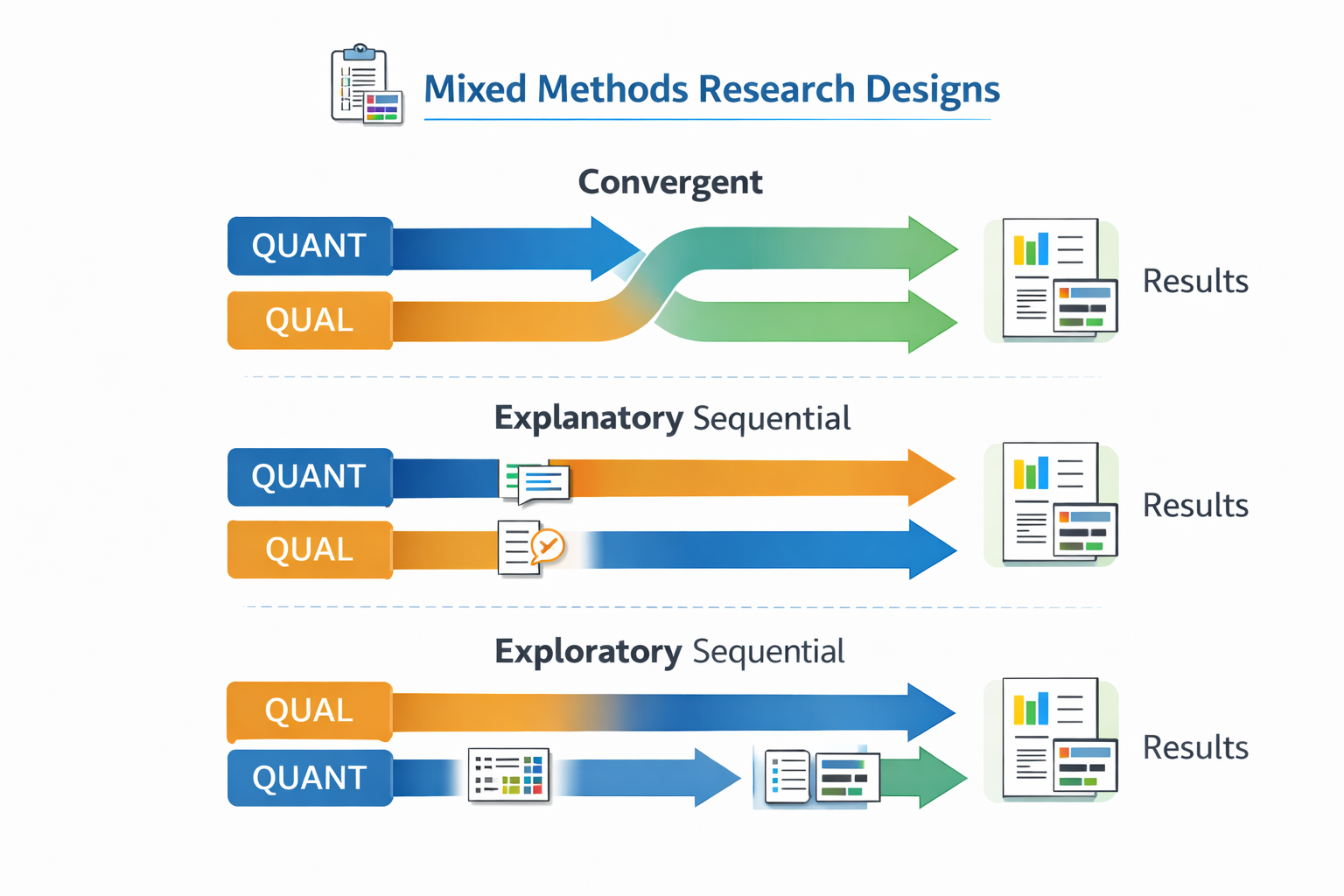
Research in the social sciences, education, health, business, and psychology increasingly requires approaches that capture both numerical trends and human experiences. Mixed methods research design explained simply refers to a structured approach that combines quantitative and qualitative methods within a single study. Rather than treating numbers and narratives as separate worlds, mixed methods integrates them to provide a more comprehensive understanding of complex research problems.
Many university students encounter mixed methods research design at the dissertation stage and find it conceptually appealing but practically confusing. Questions often arise: How do you combine surveys and interviews? Which method comes first? How do you justify integration? How should findings be written up? This guide explains mixed methods research design in a clear, academically rigorous way, helping students move from basic understanding to confident application in coursework and dissertations.
What Is Mixed Methods Research Design?
Mixed methods research design is a methodological approach that intentionally integrates quantitative and qualitative research within a single study to answer research questions more fully than either method alone. Quantitative methods provide measurable data and statistical relationships, while qualitative methods explore meaning, context, and lived experience. The power of mixed methods lies in its integration — not merely using both approaches, but deliberately connecting them.
Mixed methods research is not simply “adding interviews to a survey.” It requires purposeful integration of quantitative and qualitative strands.
For example, a study examining student academic performance might use survey data to identify patterns in grades (quantitative) and follow-up interviews to explore students’ experiences of academic pressure (qualitative). Together, these strands produce a richer explanation than either could provide independently.
Why Use Mixed Methods in Academic Research?
Mixed methods research design is particularly useful when research problems are complex and multifaceted. Many social phenomena involve both measurable outcomes and subjective interpretations. For instance, evaluating a public health intervention may require statistical outcome data alongside participant experiences of implementation.
Students often choose mixed methods when:
- The research question requires both measurement and interpretation.
- Quantitative results need explanation through qualitative insight.
- Qualitative findings require broader validation using numerical data.
- A single method would provide an incomplete perspective.
Examiners value mixed methods research when it is clearly justified, coherently structured, and methodologically integrated. However, poorly designed mixed methods projects can appear unfocused, so clarity and structure are essential.
Core Designs in Mixed Methods Research
Mixed methods research design is not random combination; it follows recognised design structures. Understanding these designs helps students justify their methodological choices in dissertations.
| Design Type | Sequence | Purpose | Priority |
|---|---|---|---|
| Convergent Design | Concurrent | Compare and integrate results | Equal |
| Explanatory Sequential | Quant → Qual | Explain quantitative findings | Quantitative |
| Exploratory Sequential | Qual → Quant | Develop and test theory | Qualitative |
These core designs structure how data collection and analysis occur. Selecting the appropriate design depends on the research objectives and theoretical framework.
Convergent Mixed Methods Design
In a convergent design, quantitative and qualitative data are collected simultaneously. The results are analysed separately and then merged during interpretation. This approach allows direct comparison of findings, identifying convergence or divergence between numerical trends and narrative insights.
For example, a study on workplace satisfaction may administer a structured survey while conducting interviews during the same period. After analysing both datasets, the researcher integrates the findings to identify areas of agreement and contradiction.
Explanatory Sequential Design
This design begins with quantitative data collection and analysis. The qualitative phase follows, designed specifically to explain or elaborate on statistical results. It is particularly useful when survey findings reveal unexpected trends that require deeper interpretation.
Students often use this design when dissertation proposals begin with large-scale survey data and then move to interviews for clarification.
Exploratory Sequential Design
In contrast, exploratory sequential design starts with qualitative exploration. Findings from interviews or focus groups inform the development of quantitative instruments such as questionnaires. This design is useful when limited prior research exists and conceptual development is required.
Integration: The Heart of Mixed Methods Research
Integration distinguishes strong mixed methods research from superficial combination. Integration can occur at several stages: research design, data collection, analysis, or interpretation. The key is demonstrating how one strand informs the other.
Without clear integration, a mixed methods study risks becoming two disconnected mini-studies.
Integration strategies include merging datasets for comparison, connecting phases sequentially, or embedding one method within another. For example, qualitative themes may be used to explain statistical anomalies, or quantitative results may validate qualitative patterns.
Strengths and Limitations of Mixed Methods Research
Understanding advantages and limitations strengthens methodological justification and critical reflection in academic writing.
| Advantages | Limitations |
|---|---|
| Comprehensive understanding of complex issues | Time-intensive and resource demanding |
| Enhanced validity through triangulation | Requires competence in two methodologies |
| Flexibility in design | Complex data integration process |
Students should critically discuss these factors in methodology chapters. Demonstrating awareness of limitations increases academic credibility.
Designing a Mixed Methods Dissertation
When designing a mixed methods dissertation, clarity is paramount. The research problem must justify the need for both methods. The sequencing must be explicitly stated. Integration strategies must be planned in advance, not improvised during analysis.
A well-structured methodology chapter typically includes:
- Justification for mixed methods research design.
- Explanation of chosen design (convergent, explanatory, or exploratory).
- Detailed description of quantitative procedures.
- Detailed description of qualitative procedures.
- Clear explanation of integration strategy.
Each section must demonstrate methodological coherence and alignment with research objectives.
Reporting Mixed Methods Findings
Writing up mixed methods research requires balanced presentation. Results may be structured by method first and then integrated, or presented through integrated themes that combine numerical and qualitative evidence. Whichever structure is chosen, clarity and logical progression are essential.
Students should avoid presenting disconnected quantitative and qualitative chapters without interpretative linkage. Instead, integration should be visible in the discussion section, demonstrating how combined findings enhance theoretical or practical understanding.
Mastering Mixed Methods Research Design for Academic Excellence
Mixed methods research design explained effectively reveals a powerful approach for addressing complex research questions. By combining statistical precision with interpretative depth, students can produce nuanced, credible, and academically robust research. However, success depends on deliberate integration, clear sequencing, and transparent methodological justification.
When thoughtfully designed and rigorously implemented, mixed methods research strengthens dissertations and research projects by demonstrating analytical sophistication and methodological breadth. Students who master this approach develop advanced research competencies that extend beyond academia into professional and policy-making environments.
Comments