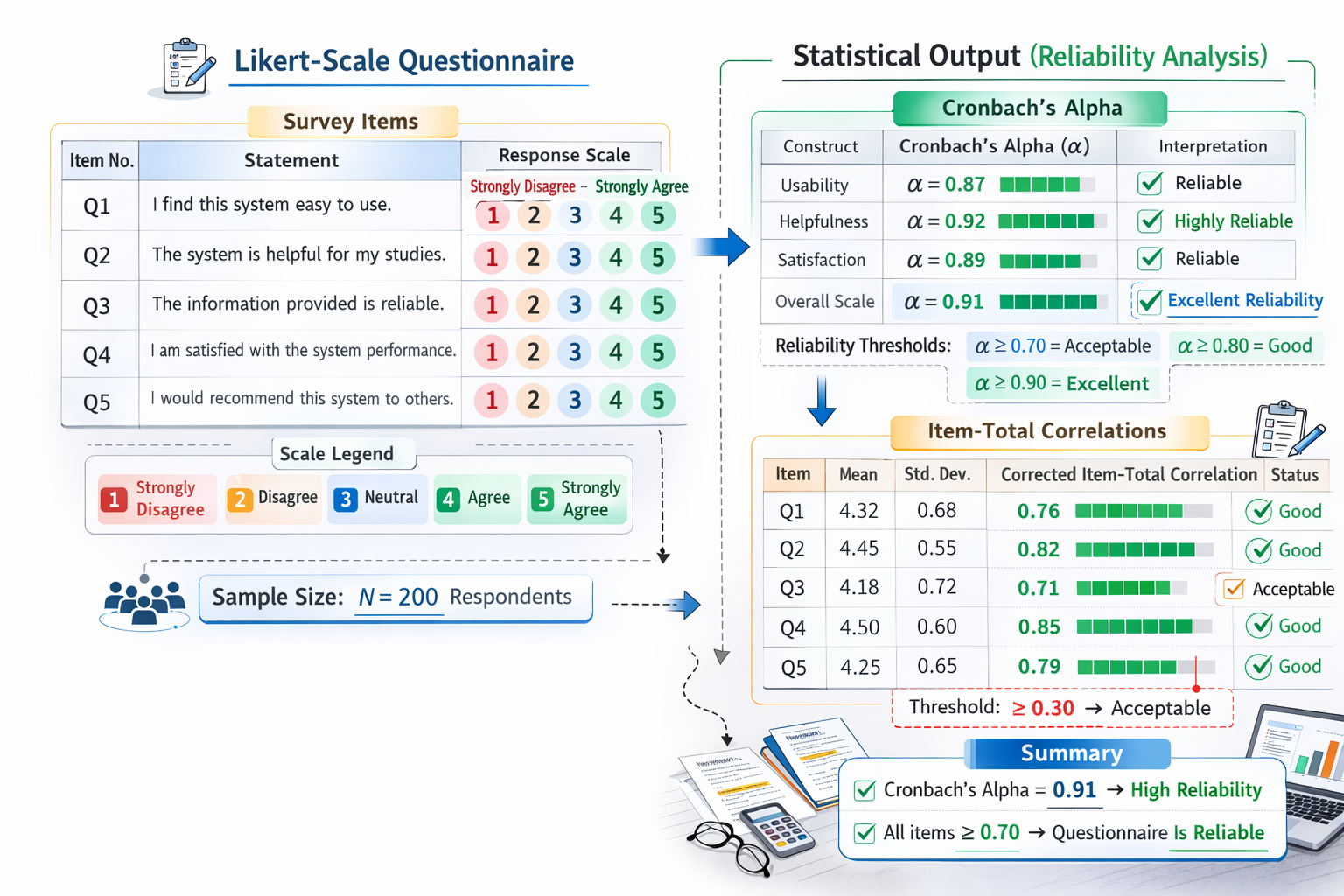
When conducting survey-based or scale-based research, students are often required to demonstrate that their measurement instruments are reliable. One of the most widely used statistical indicators of internal consistency is Cronbach’s alpha. A clear Cronbach alpha interpretation guide is essential for students working with questionnaires, Likert scales, psychological constructs, or composite variables in quantitative research.
Despite its popularity, many students misunderstand what Cronbach’s alpha actually measures. Does a higher alpha always mean better reliability? Is 0.70 always acceptable? What happens if alpha is too high? This guide explains Cronbach’s alpha in depth, clarifies interpretation thresholds, highlights common reporting mistakes, and provides structured guidance for academic writing.
What Is Cronbach’s Alpha?
Cronbach’s alpha is a statistical coefficient that measures the internal consistency of a scale. Internal consistency refers to the degree to which items within a questionnaire measure the same underlying construct. If multiple items are designed to assess “academic motivation,” for example, Cronbach’s alpha evaluates whether those items are sufficiently correlated to justify combining them into a single composite score.
Cronbach’s alpha assesses how closely related a set of items are as a group.
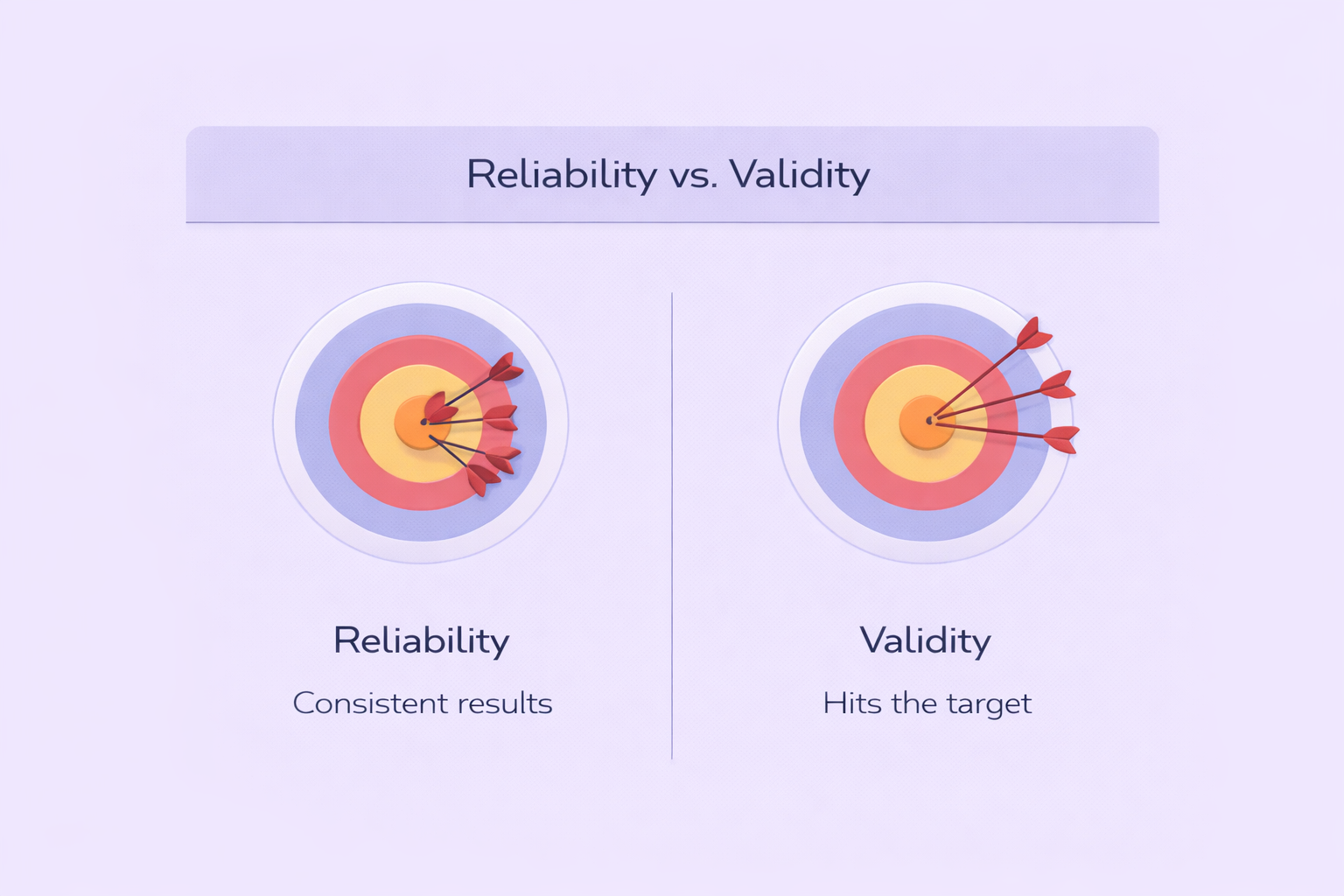
Importantly, Cronbach’s alpha does not measure validity. It only measures reliability in terms of internal consistency. A scale can have a high alpha but still fail to measure the intended construct accurately.
How Cronbach’s Alpha Is Calculated
Although students are not always required to calculate the formula manually, understanding the logic behind Cronbach’s alpha strengthens interpretation. The coefficient is based on the average inter-item correlation and the number of items in the scale. In general:
- Higher inter-item correlations increase alpha.
- More items in a scale tend to increase alpha.
- Poorly correlated items reduce alpha.
This explains why very long scales sometimes produce artificially high alpha values. It also explains why removing problematic items can improve internal consistency.
Interpreting Cronbach’s Alpha Values
One of the most common student questions concerns acceptable alpha thresholds. While interpretation depends on context and discipline, the following guidelines are widely used in social sciences research.
| Alpha Value | Interpretation | Reliability Level |
|---|---|---|
| ≥ 0.90 | Excellent (may indicate redundancy) | Very High |
| 0.80 – 0.89 | Good | High |
| 0.70 – 0.79 | Acceptable | Moderate |
| 0.60 – 0.69 | Questionable | Low |
| < 0.60 | Poor | Unacceptable |
While 0.70 is commonly cited as a minimum acceptable threshold, context matters. Exploratory research may tolerate slightly lower values, whereas high-stakes measurement (such as psychological assessment) requires stronger reliability.
When Alpha Is Too High
Students often assume that higher alpha values are always better. However, extremely high alpha values (above 0.95) may indicate redundancy. This suggests that items are overly similar and may not contribute unique information to the construct.
An extremely high alpha can indicate duplicated or redundant items rather than superior reliability.
In such cases, researchers should review item wording and consider whether some questions are repetitive.
Item-Total Statistics and Scale Refinement
Statistical software such as SPSS provides “Item-Total Statistics” alongside Cronbach’s alpha results. This output shows how alpha would change if a particular item were deleted. Reviewing this table helps identify weak or inconsistent items.
If removing an item substantially increases alpha, the item may not align well with the overall construct. However, decisions to remove items should not be based solely on statistics; theoretical alignment must also be considered.
Cronbach’s Alpha in Dissertation Methodology
When reporting Cronbach’s alpha in a dissertation, students should clearly state:
- The construct being measured.
- The number of items included in the scale.
- The Cronbach’s alpha coefficient obtained.
- Whether the reliability level is acceptable.
An example of appropriate academic reporting might be:
The academic motivation scale demonstrated acceptable internal consistency (Cronbach’s α = 0.82), indicating good reliability.
This concise reporting format ensures clarity and methodological transparency.
Limitations of Cronbach’s Alpha
Although widely used, Cronbach’s alpha has limitations. It assumes that all items measure a single unidimensional construct. If a scale contains multiple underlying dimensions, alpha may underestimate or misrepresent reliability.
Additionally, alpha is sensitive to the number of items in a scale. Longer scales often produce higher alpha values even when inter-item correlations are modest. Therefore, researchers should interpret results alongside factor analysis and theoretical considerations.
Cronbach’s Alpha and Validity
Students frequently confuse reliability with validity. Cronbach’s alpha measures internal consistency but does not guarantee that a scale measures the intended construct. Validity requires additional procedures such as construct validation, expert review, and factor analysis.
Therefore, alpha should be reported as part of a broader reliability and validity framework rather than as a standalone indicator of measurement quality.
Common Mistakes in Cronbach Alpha Interpretation
Several recurring mistakes appear in student dissertations:
- Reporting alpha without explaining what it measures.
- Assuming 0.70 is universally sufficient.
- Failing to report the number of items.
- Ignoring theoretical justification when removing items.
Avoiding these errors strengthens methodological credibility and demonstrates research competence.
Mastering Cronbach Alpha Interpretation for Academic Excellence
This Cronbach alpha interpretation guide demonstrates that internal consistency reliability is more nuanced than a single number. Cronbach’s alpha evaluates the coherence of scale items, but interpretation requires contextual judgement, theoretical alignment, and statistical awareness.
By understanding acceptable thresholds, recognising limitations, and reporting findings transparently, students can confidently present reliability analysis in dissertations and research projects. Mastery of Cronbach’s alpha not only improves methodological rigour but also enhances overall research quality and academic credibility.

Comments