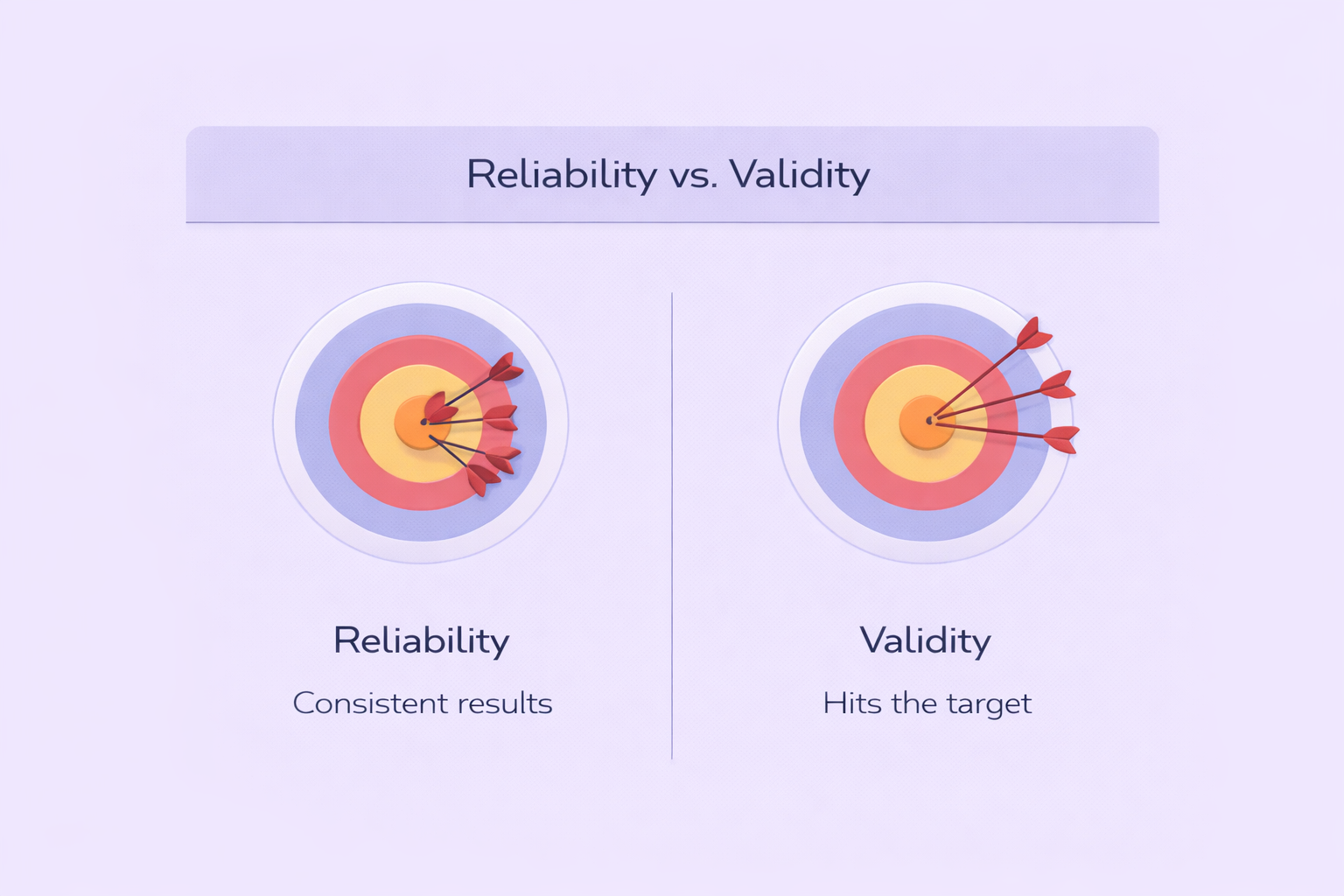
In academic research, the credibility of findings depends heavily on two foundational concepts: reliability and validity. Reliability and validity in research explained clearly refer to the consistency and accuracy of measurement within a study. Whether conducting quantitative surveys, qualitative interviews, experiments, or mixed methods research, students must demonstrate that their data collection tools and analytical procedures produce trustworthy results.
Many university students struggle to distinguish between reliability and validity. Is reliability about accuracy? Is validity about repetition? Why can a study be reliable but not valid? These questions are common in methodology chapters and research proposals. This guide provides a structured, academically rigorous explanation of reliability and validity in research, helping students apply these principles effectively in dissertations and coursework.
Understanding Reliability in Research
Reliability refers to the consistency and stability of a measurement instrument or research procedure. If a study were repeated under similar conditions, a reliable instrument would produce similar results. Reliability is primarily concerned with repeatability and internal consistency rather than truth or accuracy.
Reliability answers the question: “Would we get the same results if we measured this again?”
For example, if a questionnaire measuring student stress produces consistent scores across repeated administrations under stable conditions, it demonstrates high reliability. However, consistency alone does not guarantee that the questionnaire accurately measures stress — this relates to validity, which we will examine later.
Types of Reliability
There are several recognised forms of reliability in research methodology. Understanding these distinctions strengthens academic justification in methodology chapters.
| Type | Description | Common Application |
|---|---|---|
| Test–Retest Reliability | Consistency over time | Repeated surveys |
| Inter-Rater Reliability | Agreement between observers | Qualitative coding |
| Internal Consistency | Consistency within instrument items | Questionnaire scales |
| Parallel Forms Reliability | Equivalence of different test versions | Standardised assessments |
Each type addresses a specific dimension of consistency. Selecting the appropriate reliability test depends on research design and data collection methods.
Understanding Validity in Research
Validity refers to the accuracy and truthfulness of a measurement instrument or research findings. While reliability focuses on consistency, validity addresses whether the instrument measures what it claims to measure. A tool can be reliable without being valid, but it cannot be valid without being reliable.
Validity answers the question: “Are we measuring what we intend to measure?”
For example, if a survey intended to measure academic motivation actually measures exam anxiety, it lacks validity even if results are consistent. Ensuring validity requires careful conceptualisation of variables and alignment between research questions and measurement tools.
Types of Validity
Validity can be categorised into several forms, each addressing different aspects of research accuracy.
| Type | Focus | Key Concern |
|---|---|---|
| Construct Validity | Measurement of theoretical constructs | Conceptual accuracy |
| Internal Validity | Cause-and-effect relationships | Control of confounding variables |
| External Validity | Generalisation of findings | Applicability to wider populations |
| Content Validity | Coverage of relevant concepts | Comprehensiveness of items |
Understanding these categories enables students to justify research design choices and critically evaluate study limitations.
Key Differences Between Reliability and Validity
Although reliability and validity are closely related, they represent distinct methodological concerns. Reliability focuses on consistency; validity focuses on accuracy. A highly reliable instrument may consistently produce incorrect results, meaning it is reliable but not valid.
Consider a weighing scale that consistently shows five kilograms more than actual weight. The scale is reliable because it produces consistent readings, but it lacks validity because the readings are inaccurate. This example illustrates why both concepts must be addressed in research design.
Reliability and Validity in Quantitative Research
In quantitative research, reliability is often assessed statistically through measures such as Cronbach’s alpha for internal consistency. Validity may be evaluated using factor analysis, pilot testing, or comparison with established instruments.
Researchers must clearly report reliability coefficients and validity procedures in methodology sections. Examiners frequently look for evidence that instruments were tested before full deployment.
Failing to report reliability and validity testing weakens methodological credibility.
Clear documentation of statistical testing strengthens academic rigour and increases confidence in findings.
Reliability and Validity in Qualitative Research
In qualitative research, reliability and validity are addressed differently. Instead of statistical testing, researchers emphasise trustworthiness, credibility, dependability, and confirmability. Techniques such as member checking, triangulation, and audit trails enhance qualitative reliability and validity.
For example, returning interview transcripts to participants for verification strengthens credibility. Similarly, maintaining detailed documentation of coding decisions improves transparency and dependability.
Strategies for Enhancing Reliability and Validity
Strengthening reliability and validity requires deliberate planning at the research design stage. Students should integrate methodological safeguards before data collection begins.
- Conduct pilot studies to refine instruments.
- Use established measurement scales when possible.
- Provide clear operational definitions of variables.
- Apply triangulation where appropriate.
- Document coding procedures transparently.
These strategies demonstrate methodological awareness and enhance academic credibility.
Common Misconceptions About Reliability and Validity
One common misconception is that reliability automatically ensures validity. As discussed earlier, this is incorrect. Another misconception is that qualitative research does not require reliability and validity considerations. In reality, all research must address credibility and accuracy.
Students should also avoid presenting reliability and validity as afterthoughts. These concepts must be integrated into research design rather than discussed briefly at the end of methodology chapters.
Applying Reliability and Validity in Dissertations
In dissertation writing, reliability and validity should be discussed explicitly within the methodology section. Researchers must explain how instruments were tested, how bias was minimised, and how findings can be trusted. Quantitative studies should report statistical reliability measures, while qualitative studies should describe trustworthiness strategies.
Examiners expect methodological transparency. Demonstrating awareness of potential threats to reliability and validity strengthens academic evaluation and shows research competence.
Ensuring Research Integrity Through Reliability and Validity
Reliability and validity in research explained thoroughly reveal the foundation of trustworthy academic inquiry. Reliability ensures consistency, while validity ensures accuracy. Both are essential for producing credible findings that withstand academic scrutiny.
By carefully designing instruments, testing procedures, and transparently reporting methodological safeguards, students can enhance the strength of their research. Mastery of reliability and validity not only improves dissertation quality but also builds advanced research skills applicable across academic and professional environments.

Comments