One of the most common reasons university essays receive average or low marks is not weak language or poor referencing, but the absence of a defensible argument. Many students present information accurately yet fail to take a clear, reasoned position that can withstand academic scrutiny. As a result, their essays read as descriptive rather than analytical.
This article explains how to write a defensible argument in an essay. It breaks the process into practical academic steps, clarifies examiner expectations, and shows how evidence, logic, and structure work together to produce a convincing and assessable argument.
What Does “Defensible Argument” Mean in Academic Writing?
A defensible argument is a position that is clearly stated, logically developed, and supported by credible academic evidence. It is not merely an opinion, nor is it a summary of sources. Instead, it is a claim that can be challenged and justified through reasoning and scholarship.
In university marking criteria, defensibility refers to whether an argument can reasonably withstand counter-arguments. An essay that makes strong claims without justification, or avoids taking a position altogether, is unlikely to meet higher-grade descriptors.
A defensible argument is one that a critical reader could challenge, but not easily dismiss.
Why Defensible Arguments Matter to Examiners
University assessments are designed to evaluate critical thinking rather than information recall. Examiners look for evidence that a student can interpret material, weigh perspectives, and arrive at a reasoned conclusion.
An essay without a defensible argument often appears structurally sound but intellectually shallow. It may contain relevant sources and correct formatting, yet fail to demonstrate independent academic judgement.
Start with a Clear and Arguable Position
Every defensible argument begins with a clear position, usually expressed through a strong thesis statement. This position must be specific enough to be argued, rather than so broad that it becomes self-evident.
For example, stating that “education is important” does not constitute an argument. In contrast, arguing that “standardised testing undermines educational equity by privileging socioeconomic advantage” establishes a position that requires defence.
Characteristics of an Arguable Claim
A strong argumentative position typically has the following features:
- It takes a clear stance rather than remaining neutral
- It addresses a debatable issue within the discipline
- It implies the need for justification and evidence
Without these elements, an essay cannot sustain analytical depth.
Use Evidence Strategically, Not Excessively
Defensible arguments rely on evidence, but quantity alone does not create strength. Evidence must be relevant, credible, and directly connected to the claim being advanced.
Academic sources should be used to support reasoning, not replace it. An essay that strings together quotations without analysis demonstrates dependence on sources rather than argumentative control.
Evidence supports an argument; it does not substitute for one.
Link Claims, Evidence, and Analysis Explicitly
One of the most common weaknesses in student essays is the failure to explain how evidence supports a claim. Examiners expect students to articulate this connection clearly.
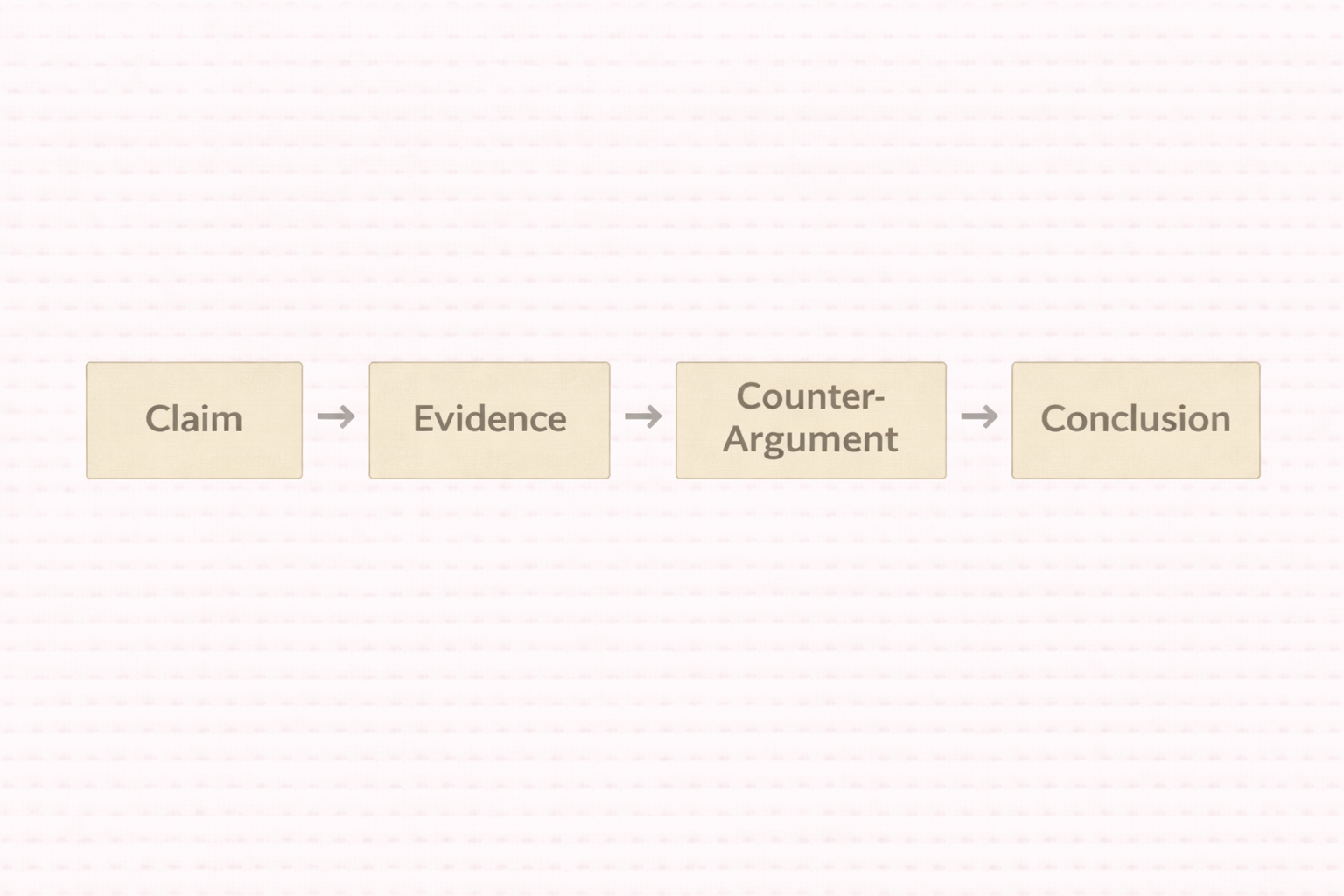
Each paragraph should follow a logical sequence: introduce a claim, present evidence, and explain its relevance. Without this explanatory step, even strong sources lose argumentative force.
Address Counter-Arguments to Strengthen Defensibility
A key marker of a defensible argument is the ability to acknowledge and respond to opposing viewpoints. Ignoring counter-arguments can make an essay appear one-sided or intellectually naïve.
Addressing alternative perspectives does not weaken an argument. On the contrary, it demonstrates critical awareness and strengthens credibility when rebuttals are well reasoned.
Effective Ways to Handle Counter-Arguments
Counter-arguments can be incorporated in several academically appropriate ways:
- Conceding limited validity while rejecting broader implications
- Demonstrating empirical or theoretical weaknesses
- Explaining contextual limitations
This approach signals analytical maturity rather than indecision.
Maintain Logical Progression Throughout the Essay
Even strong arguments fail if they are poorly structured. Defensibility depends not only on what is argued, but on how coherently the argument unfolds.
Each section of the essay should build on the previous one, advancing the central position rather than introducing disconnected points. Logical transitions help the reader follow the argumentative thread.
Common Mistakes That Undermine Defensibility
Many essays lose argumentative strength due to avoidable errors. Recognising these pitfalls helps students refine their work before submission.
| Mistake | Why It Weakens the Argument |
|---|---|
| Descriptive writing | Lacks critical engagement or position |
| Unsupported assertions | Claims appear subjective or speculative |
| Over-quoting sources | Reduces authorial voice and analysis |
| Ignoring counter-arguments | Makes the argument appear fragile |
Identifying these issues early can significantly improve essay quality.
An argument that cannot withstand reasonable challenge is unlikely to receive high academic marks.
Align Your Argument with the Assignment Question
A defensible argument must directly answer the assignment question. Essays often fail not because the argument is weak, but because it addresses a different problem than the one posed.
Revisiting the wording of the question and mapping each major claim to it ensures relevance and focus throughout the essay.
Editing and Refinement as Part of Argument Development
Strong arguments are rarely produced in a single draft. Revision allows students to tighten claims, clarify reasoning, and remove inconsistencies.
Many students benefit from structured academic support such as editing and proofreading services or guided feedback through essay writing support, particularly when working on complex or high-stakes assignments.
Defensible Arguments in Dissertations and Long Projects
In extended research projects, defensibility becomes even more important. Arguments must be sustained across chapters and supported by comprehensive evidence.
Students undertaking major projects often require advanced guidance, especially at the proposal and analysis stages. Dedicated dissertation writing support can help ensure coherence and argumentative strength across the entire document.
Final Academic Guidance
Writing a defensible argument is not about sounding confident; it is about reasoning convincingly. Clear positions, logical development, credible evidence, and engagement with alternative views are the foundations of academic defensibility.
When these elements are aligned with the assignment brief and refined through revision, essays move beyond description and demonstrate the critical thinking that university assessors reward.



Comments