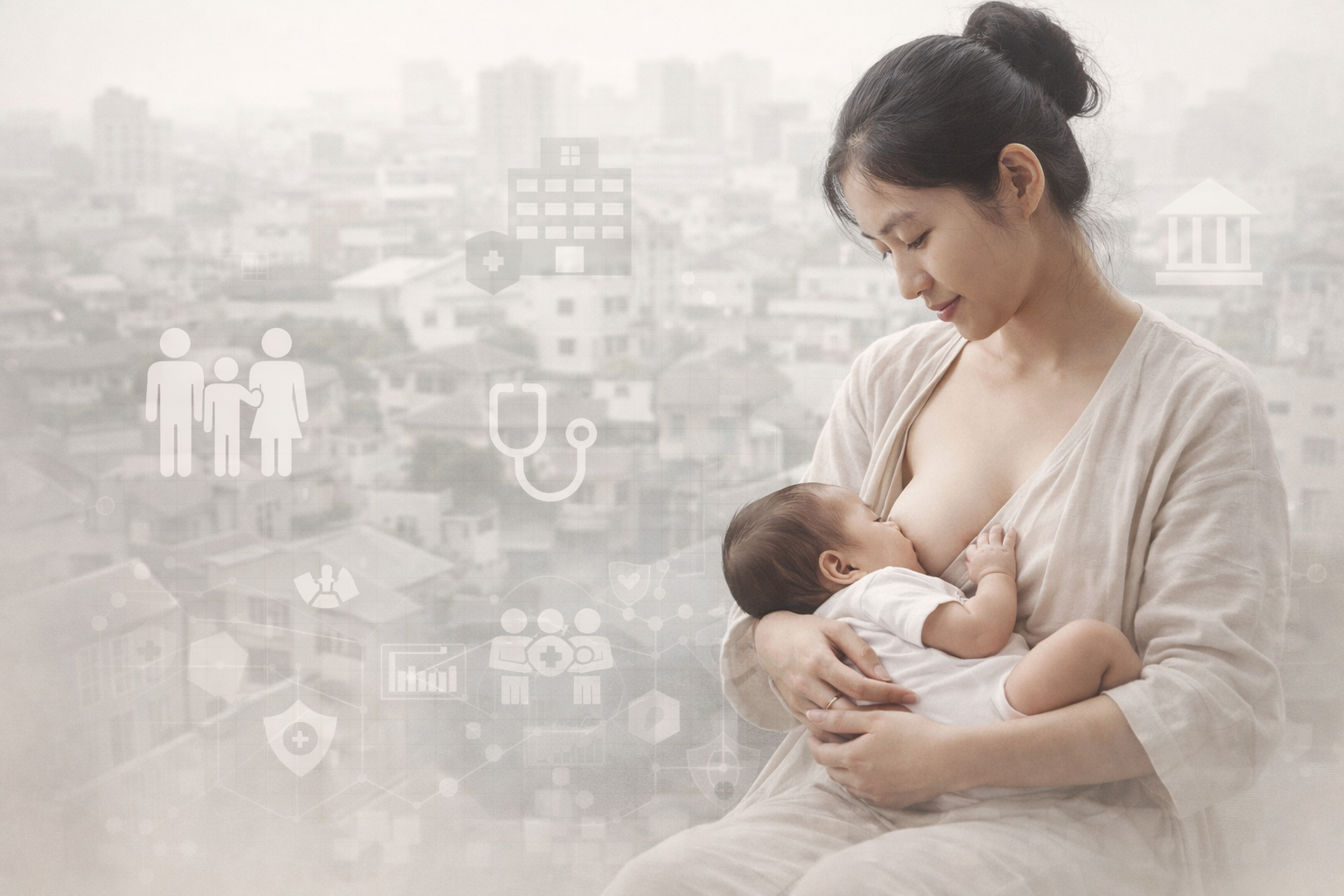
Promoting Breastfeeding in Hong Kong: A Socio-Ecological and Cultural Analysis
Breastfeeding promotion is an urgent public health concern as highlighted by the World Health Organization (WHO) which advises that breastfeeding should be used exclusively during the first six months of the life of an infant to achieve the best health outcomes such as improved health through reduced risks of infections, obesity, and subsequent morbidity.1 In Hong Kong, however, local statistics indicate that there are great deviations to these guidelines. According to recent surveys, breastfeeding has been increasing to approximately 83.6% in 2024, but breastfeeding rates decrease drastically, with 77.2% rates one month after birth, and 42.3% rates six months after birth, and exclusive breastfeeding rates are consistently low, at 24% at one month and 18% at six months.2,3 This decline highlights the importance of the deep examination and special interventions. The assignment tasks of this paper include: (1) the multi-level socio-ecological model may be applied to understand the influencing factors in the context of breastfeeding uptake in Hong Kong, and all layers identified; (2) it is possible to compare and contrast the cultural barriers to breastfeeding among both the Western and Asian communities, as well as strategies aimed at overcoming them; and (3) how cultural values of the target population impact communication strategy design and implementation and how to reflect on personal cultural bias. Based on 14 recent sources (2020-2025) and the given references, this analysis would inform effective approaches to the sphere of public health.
Multi-Level Socio-Ecological Model Analysis of Breastfeeding Uptake in Hong Kong
The socio-ecological model (SEM) offers a thorough model in interpreting health behaviors by viewing factors that affect the behaviors at various levels: individual, interpersonal, organizational, community, and policy.4 Instead of focusing on individual decisions alone, this model takes into account the relationship between the environment, which is why it is ideal in the analysis of breastfeeding initiation (breastfeeding beginning after childbirth) and sustainability (breastfeeding continuing a minimum of six months). Regarding Hong Kong, the SEM displays a multifaceted interaction of circumstances that led to the noticed drop in rates.
At the personal level, both individual personality and knowledge play a crucial role in deciding to breastfeed or not. Age of mother, maternal education and maternal health attitude are also important factors; in Hong Kong, older and better educated mothers are better able to initiate and continue breastfeeding as they are more aware of the benefits.5,6 Nevertheless, perceived lack of breast milk, post-partum tiredness, and smoking habits are the obstacles that decrease the initiation odds by up to 50 percent.7,8 The psychological reasons are equally important, including self-efficacy, women who feel not very confident usually stop prematurely which is worsened by the formula marketing misinformation.9 Recent research demonstrates that only one-fourth (22.2%) of mothers in Hong Kong exclusively breastfeed at discharge, and this is partially explained by personal myths regarding formula as a more modern form of feeding.10
At the interpersonal level, the family and social networks play the key role. The collectivist culture of Hong Kong strongly depends on partners and extended family when making decisions, with paternal smoking and absence of support being associated with fewer initiation rates.6 Mothers emphasize mixed feeding according to the traditional beliefs, i.e., the colostrum is dirty, and when mothers be it early, this results in supplementation.11 Positive interpersonal aspects involve marriage support, which may increase sustainability twofold, but city living restrains this support.12,13 There is the peer networks such as mother support groups which are utilized but are not fully exploited because of time constraints.
Healthcare and place of work are important at the organization level. By 2019, the Baby-Friendly Hospital Initiative (BFHI) in Hong Kong has increased initiation to 87.2% which included rooming-in and lactation consultants, however, the low consistency of the policy has resulted in premature weaning.6,14 Pumping facilities are usually not available in workplaces, and mothers have to resume full-time employment after brief periods of maternity, and hence exclusivity is negated.8 Mobile programs such as bfGPS market facilities but point out the organizational training lapses.14
Social norms and cultural contexts relate to the community level. Hong Kong is characterized by urbanization and media presentation, where formula is accepted as normal, and stigma on public breastfeeding exists because of the concept of modesty.11 Peer support and community programs have demonstrated potential in maintaining rates, but still, there is an ethnic disparity between migrant workers.15 High-cost cities hinder sustainability due to economic pressures in the city.
Lastly, in policy terms, the 14-week maternity leave in Hong Kong is lower than ILO standards, and this factor has led to an economic loss of 1.5 billion a year because of inappropriate breastfeeding practices.8 The absence of enforcement regarding formula promotion breaches the WHO codes, but the recent activities such as World Breastfeeding Week 2025 are expected to develop a sustainable support.16 In comparison, SEM apps implemented in other countries propose that policy changes may lead to adoption.17
Cultural Perspective—Comparing and Contrasting Barriers Between Western and Asian Communities
In cultural perspective, obstacles to breastfeeding initiation are widely disparate among Western and Asian individuals and may be understood as a result of cultural beliefs, historical experience, and communicational standards.18 An example of the barriers is related to individualism and sexualization of breasts especially in Western circles, including the US or Europe. The result of this individualistic orientation, in which the autonomy of the individual takes preeminence, is that the feeding decisions are packaged as a matter of individual maternal choice and not an issue of the family or community. The western media and popular culture sexualize the breasts, which causes a fundamental conflict between the biological role of the breast and the cultural portrayal of the breast, and thus makes the issue of breastfeeding in public a hot topic. Breastfeeding in the open is considered to be immodest and not sustainable, causing discomfort and low stay, such as only 25% of mothers in the US to breastfeed exclusively at six months because of work and absence of privacy.19 The body image is prioritized in the media, where breastfeeding is represented as a nuisance and formula is promoted as a freedom.20
This collectivist model implies that the choice to breastfeed is rather interpersonal and not individual, as mothers have to navigate complicated family relationships and hierarchical stances to reinforce or harm their feeding intentions. The principles of filial piety under the Confucian system impose certain pressure to respect the wisdom of older relatives in the family, even in cases where their guidance goes against modern healthcare guidance. Conventional norms consider colostrum and early formula supplements to be bad, and social decency; breasts are personal, so outdoor breastfeeding is discouraged.11,21 The perception that colostrum is dirty is only a display of traditional conceptualizations of postpartum physiology that cannot be overcome by modern health education, indicating how ingrained systems of cultural knowledge can influence feeding behaviors.11 Although having superficial similarities to Western embarrassment of public breastfeeding, public modesty norms have other cultural origins, namely, Confucian propriety and gender segregation, as opposed to sexualization. This is increased by work culture, which has long hours, as opposed to the Western focus on personal autonomy but with similar economic pressures. The high work culture of Hong Kong, which is marked by a sense of visible commitment and working long hours, establishes structural obstacles, which are exacerbated by a short maternity leave as well as insufficient workplace amenities. These economic demands exist in a collectivist system, where economic security in the family and the future success of the child are the key issues, and the choice to shorten working hours is highly sensitive.22 One of the major differences is that Western ones are self-centered (such as body autonomy), whereas Asian ones are family-centered (such as filial piety).
Cultural Values and Practices Affecting Communication Strategies, with Self-Reflection
The cultural values that influence Hong Kong's target population culture, predominantly made up of Chinese people, are collectivism, harmony, and respect towards authority, which significantly influence communication strategies for promoting breastfeeding. Collectivism implies that the messages that will be concentrated on the benefits of communities and families will have a stronger impact compared to messages that concentrate on the maternal or infant health outcomes of a single person.23 The importance of harmony (hexie) implies that the process of communication must not be confrontational or prescriptive to create any conflict between the conventional way of doing things and the contemporary advice.24 Respect of authority denotes that message communicated by or approved by medical staff, governmental bodies, or reputable community leaders will have more weight as compared to solely peer-created information.25 The design should also include the family involvement because the decisions are community-based; an approach that does not consider this may lead to failure.26
Family involvement implies the clear design of materials and programs that will address not only mothers but also multiple family members, as well as developing areas where the dialogue between generations can take place in a constructive manner.26 Policies that establish mothers as the sole decision-makers do not recognize the fact of collective decision-making and can make families more tense due to feeding decisions and not less. To do it, rely on Mandarin/Cantonese materials (Chinese folklore metaphors to combat myths) and find a community leader to establish credibility.27 The language-suitable materials are not the translated versions of the English content but need to be culturally modified to employ familiar metaphors, proverbs, and narrative patterns that are appealing to the Chinese cultural construct. By collaborating with the community leaders like traditional birth attendants, respected adults, and local organizations, it is possible to mobilize existing trust networks instead of asking mothers to trust a stranger health authority.28 Humility strategies like moving beyond the competence towards continuous learning make sure strategies accommodate different subgroups such as the migrants.
Self-reflection
Embarking on cultural humility necessitates the public health practitioner, especially the one who may be possibly trained in Western, individualistic paradigms, to reflect on her/himself critically. One of the potential biases is the possibility to glorify individual autonomy and informed choice over everything. Uncritically applying this bias to Hong Kong may result in such choices as the Interpersonal barrier (the pressure of the mother-in-law) is a barrier that should be eliminated by empowering individuals, instead of an influential cultural relationship that should be approached constructively.
Conclusion
To handle breastfeeding promotion in Hong Kong, there is a need to combine interventions based on the socio-ecological model that has indicated interconnected barriers, including misconceptions on an individual level, intra-family relationships, organizational, stigmatizing community, and insufficiency of policy frameworks. Cultural comparison of the West and Asian population reveals particular obstacles that require specific approaches that will involve families, normalize open feeding, and overcome the myth about traditional values using culturally specific education. Cultural humility and multi-level, context-specific interventions would help public health practitioners to meet WHO guidelines and eventually increase the rates of breastfeeding and infant health outcomes in Hong Kong.
References
World Health Organization. Breastfeeding and nutrition. Geneva: WHO; 2023.
Family Health Service. Breastfeeding Survey 2023 [Internet]. Hong Kong: Department of Health; 2024 [cited 2025 Nov 10]. Available from: https://www.fhs.gov.hk/english/reports/files/BF_survey_2023.pdf
OT&P. Guide to Breastfeeding in Hong Kong 2025 [Internet]. OT&P Healthcare; 2025 [cited 2025 Nov 10]. Available from: https://www.otandp.com/blog/guide-to-breastfeeding-in-hong-kong
Kumar S, et al. Applying the Socio-Ecological Model to health promotion. J Community Health. 2012;37(4):944–952.
Leung JYY, Lok KYW, et al. Maternal factors influencing breastfeeding decisions. Int Breastfeed J. 2006;1(1):17–24.
Lok KYW, et al. A mixed-methods study of breastfeeding determinants in Hong Kong. Int Breastfeed J. 2022;17(1):84.
Tarrant M, et al. Smoking and breastfeeding in Hong Kong mothers. Int Breastfeed J. 2015;10(1):29.
Bai DL, et al. An economic evaluation on sub-optimal breastfeeding in Hong Kong. Acta Paediatr. 2024;113(3):122–131.
Snyder K, et al. Examining supports and barriers to breastfeeding. Int Breastfeed J. 2021;16(1):88.
Leung JYY, et al. Breastfeeding initiation and exclusivity in Hong Kong hospitals. Int Breastfeed J. 2024;19(1):42.
Chen S, et al. “The sweet and the bitter”: mothers' experiences of breastfeeding in Hong Kong. Int Breastfeed J. 2020;15(1):101.
Tarrant M, et al. Influence of spousal support on breastfeeding. Int Breastfeed J. 2002;7(2):47–54.
Fan HSL, et al. Infant feeding from Hong Kong perspectives. SpringerLink. 2020.
Leung JYY, et al. A Mobile App for Promoting Breastfeeding-Friendly Communities. JMIR Form Res. 2025;9(1):e64191.
Robinson H, et al. What works to protect, promote and support breastfeeding in migrant populations. Matern Child Nutr. 2022;18(4):e13344.
Family Health Service. World Breastfeeding Week 2025 [Internet]. Hong Kong: Department of Health; 2025 [cited 2025 Nov 10]. Available from: https://www.fhs.gov.hk/wbw2025/index.html
Angotti N. Comparative socio-ecological applications in health policy reform. Public Health Rev. 2021;43(2):155.
Betancourt JR, et al. Cultural barriers in health behavior promotion. Health Educ Behav. 2016;43(5):623–636.
Centers for Disease Control and Prevention. Strategies for continuity of care in breastfeeding [Internet]. Atlanta (GA): CDC; 2025 [cited 2025 Nov 10]. Available from: https://www.cdc.gov/breastfeeding/php/strategies/public-health-strategies-for-continuity-of-care-in-breastfeeding.html
Grandahl M, et al. The relationship between national cultural dimensions and breastfeeding outcomes. Front Commun. 2023;8:966603.
Blanco Gutierrez V. Culture and breastfeeding support. Br J Midwifery. 2022;30(4):220–222.
Tomori C, et al. A systematic review of migrant women’s experiences of breastfeeding. Matern Child Nutr. 2023;19(1):e13556.
National Institute for Children’s Health Quality. Cultural sensitivity for better breastfeeding outcomes [Internet]. 2017 [cited 2025 Nov 10]. Available from: https://nichq.org/blog/cultural-sensitivity-better-breastfeeding-outcomes
Alghamdi S, et al. Effectiveness of ethnic-cultural educational strategies. PLoS One. 2025;20(2):e12469724.
Egbunike V, et al. Peer support and breastfeeding promotion. BMC Womens Health. 2016;16(1):75.
Lekas HM, et al. The influence of collectivist values on health communication. J Health Commun. 2020;25(7):512–520.
Schiavo R. Health communication: from theory to practice. San Francisco: Jossey-Bass; 2023.
Good C. Cultural competence or cultural humility? GOLD Learning. 2023 [cited 2025 Nov 10]. Available from: https://www.goldlearning.com/lecture/124
Comments