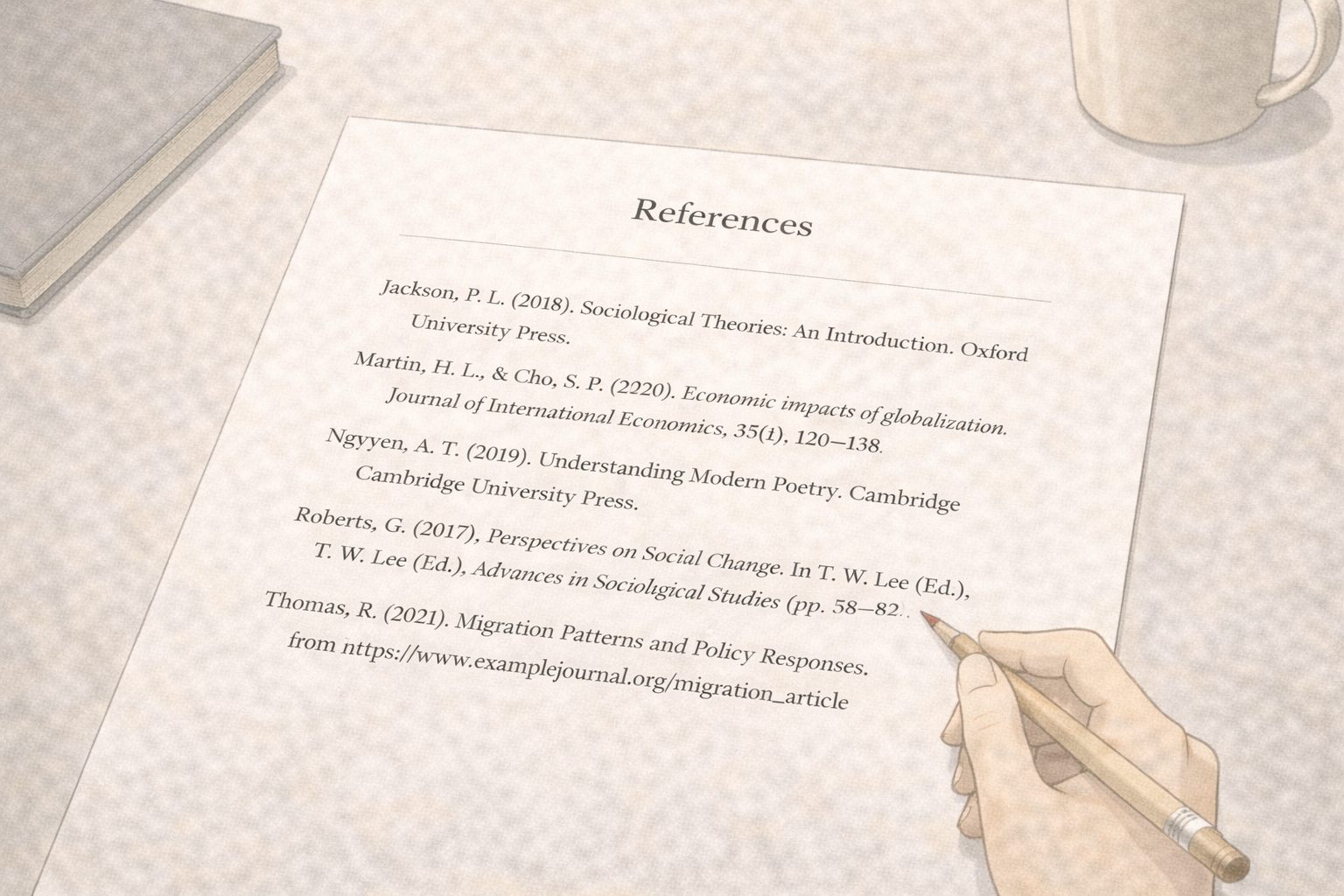
In academic writing, a reference list is more than a formality appended to the end of an assignment. It is a structured record of the intellectual sources that underpin your arguments, analysis, and conclusions. When formatted correctly, a reference list allows readers to trace evidence, verify claims, and understand the scholarly context in which your work sits.
Despite its importance, reference list formatting is one of the most common sources of marks lost in university assessments. Students often understand the need to cite sources but struggle with ordering, punctuation, spacing, and consistency. This guide provides a detailed, practical explanation of reference list formatting, focusing on principles that apply across major academic referencing systems.
What a Reference List Is and Its Role in Academic Writing
A reference list is a complete, alphabetised list of all sources cited within an academic text. It appears at the end of an assignment and contains full publication details that enable readers to locate each source independently. Every in-text citation must correspond to an entry in the reference list, and every reference list entry must be cited in the text.
The reference list plays a critical role in academic integrity. It demonstrates transparency in research practices and ensures that intellectual credit is properly assigned. In many marking rubrics, reference list accuracy is assessed explicitly under criteria such as “use of sources,” “academic conventions,” or “scholarly presentation.”
Key academic rule: A source that appears in the reference list must be cited in the text, and a source cited in the text must appear in the reference list.
Core Principles of Reference List Formatting
Although specific formatting rules vary between referencing styles, reference lists share several universal principles. Entries are arranged alphabetically by the author’s surname or by title if no author is available. Consistent punctuation, spacing, and formatting are essential, as minor inconsistencies signal weak attention to academic detail.
Another core principle is completeness. Each reference must include all required bibliographic elements for that source type, such as author, year, title, publisher, and access information where relevant. Missing elements can make sources difficult or impossible to locate.
Placement and Presentation of the Reference List
The reference list should begin on a new page at the end of the document, following the conclusion and before any appendices. The heading is typically “References” or “Reference List,” depending on the required style, and is formatted consistently with other section headings.
Most academic styles require double spacing throughout the reference list and a hanging indent, where the first line of each entry aligns with the left margin and subsequent lines are indented. This structure improves readability and allows readers to scan entries efficiently.
Common Referencing Styles and Their Reference List Conventions
Different disciplines adopt different referencing systems, each with distinct reference list conventions. While the underlying purpose is consistent, formatting details differ in meaningful ways.
| Referencing Style | Title Used | Key Formatting Features |
|---|---|---|
| Harvard | References | Author–date system, italicised titles, hanging indent |
| APA | References | Author–date system, sentence-case titles, DOI emphasis |
| MLA | Works Cited | Author and title focus, full publication details |
| Chicago | Bibliography | Flexible formatting, footnote alignment |
Students must always follow the style specified by their institution or module handbook, even when familiar with another system.
Formatting Author Names Correctly
Author names are the anchor of most reference list entries. Typically, the surname appears first, followed by initials. Multiple authors are listed in the order they appear in the source, not alphabetically within the entry.
Inconsistent formatting of author names is a frequent student error. Switching between full first names and initials, or misplacing commas, creates inconsistency and undermines presentation quality. Careful proofreading of names is essential, especially for sources with multiple authors.
Handling Sources Without Authors
Some sources, such as institutional reports or web pages, may not have an identifiable individual author. In these cases, the organisation name is used as the author. If no organisation is evident, the title moves to the author position.
These entries are alphabetised based on the first significant word of the organisation name or title, excluding articles such as “the” or “a.”
Formatting Titles of Works
Titles must be formatted according to the rules of the chosen referencing style. In many systems, book and journal titles are italicised, while article or chapter titles appear in plain text. Capitalisation rules also vary, with some styles using sentence case and others title case.
Incorrect capitalisation or italicisation is one of the most visible reference list errors and is often penalised in formal assessments.
Publication Details and Source Types
Reference list formatting changes depending on source type. Books, journal articles, chapters in edited volumes, and online sources each require specific information in a prescribed order. Understanding these distinctions is crucial for accurate referencing.
For example, journal articles typically require volume, issue, and page range details, while books require publisher information. Online sources often require a DOI or URL and an access date, depending on the style.
Digital Sources and Online Material
As academic research increasingly relies on digital sources, correct formatting of online materials has become essential. Many referencing styles prioritise stable identifiers such as DOIs over URLs, as these provide permanent access to sources.
When URLs are required, they should be presented exactly as provided, without line breaks or added punctuation. Access dates are included only when mandated by the referencing style or when content is likely to change.
Alphabetisation Rules in Reference Lists
Alphabetisation is based on the first element of each reference entry, usually the author’s surname. Multiple works by the same author are ordered chronologically, from earliest to most recent publication.
If an author has multiple works published in the same year, letters such as “a,” “b,” and “c” are added after the year and used consistently in both in-text citations and the reference list.
Consistency as an Academic Expectation
Markers often assess reference lists holistically, looking for consistency as much as accuracy. Even when individual entries are technically correct, inconsistent formatting across the list can lead to lower marks.
Consistency includes spacing, punctuation, capitalisation, and indentation. Applying one rule correctly across all entries is preferable to mixing correct and incorrect formats.
Examiner warning: Inconsistent reference list formatting signals poor academic control, even when sources themselves are appropriate.
Common Reference List Errors Students Make
Several recurring mistakes appear across student assignments regardless of discipline. Recognising these patterns can help prevent avoidable errors.
- Mismatch between in-text citations and reference list entries
- Incorrect ordering of bibliographic elements
- Missing publication details
- Inconsistent punctuation and spacing
- Failure to use a hanging indent
Most of these errors arise from rushing the referencing stage or relying on unreliable automated tools without verification.
Reference Lists and Academic Assessment
Reference list formatting directly affects assessment outcomes. In many courses, referencing errors lead to cumulative penalties, reducing final grades even when content quality is strong.
Accurate formatting demonstrates professionalism, attention to detail, and respect for academic standards—qualities that examiners actively look for.
Practical Strategies for Accurate Reference List Formatting
Developing a systematic approach to reference list formatting reduces stress and errors. Students should format references progressively rather than leaving them until the final stage.
- Record full source details during research.
- Use the official style guide as the primary reference.
- Apply formatting rules consistently from the first entry.
- Cross-check every in-text citation against the reference list.
- Proofread the entire list separately from the main text.
These habits transform referencing from a last-minute task into a controlled academic process.
Why Reference List Accuracy Reflects Academic Maturity
Reference list formatting is often treated as a technical skill, but it reflects deeper academic values. Accurate referencing shows respect for scholarship, commitment to transparency, and mastery of disciplinary conventions.
As students progress through higher levels of study, expectations around reference list precision increase. Developing strong habits early supports long-term academic success.
Final Guidance on Reference List Formatting
Reference list formatting is not optional or cosmetic; it is a core component of academic communication. By understanding the principles behind reference lists and applying rules consistently, students enhance the credibility and professionalism of their work.
With careful attention and practice, reference list formatting becomes a reliable strength rather than a source of lost marks, supporting clear, ethical, and effective academic writing.

Comments