THE IMPACT OF SOCIAL MEDIA ON MENTAL HEALTH
Social media is ingrained into users' daily experiences as they share conversation threads, videos, and images via Twitter, Facebook, Instagram, and Snapchat. Over the last three decades, this transformation process has made social media almost indispensable in today's society, influencing human relations and information acquisition.It is important to review the influence of social media on psychologica wellbeing, due to the increase to the usage of social media. Possible tensions result from the prioritization of features such as information sharing, accumulating likes, and blogging, which demotion the work of the media in the society. Addiction to media that can cause considerable impact on the state of mind remains overlooked quite often. Many people can only imagine their lives with their mobile phones as personal online assistants interacting in SNS to get information about friends and families, celebrities, and sports. The outcomes of these phenomena depend on the opportunities and scenarios in the information sharing and the psychological domains defined by social media, which is now a powerful way of communication. Therefore, this literature review aims to assess the effects that result from the use of social media on the psychological wellbeing of the users, considering the good as well as the bad impacts.
Literature Review
Good Impact of Social Media
Some earlier investigation has proved that social media plays the role of reducing stigma towards those with mental health disorders coupled with boosting psychological well-being. Stigma is a key factor that leads to late presentation to the treatment facilities and poor treatment outcomes among the affected individuals (Jung et al., 2022). In the matter of the decrease in the stigma, social media helps advocate for the discussion of mental health problems since people are free from discrimination based on their problems (Jung et al., 2022). Besides, the social media awareness creation of mental health and public campaigns can play a lot in fighting stigma resulting from ignorance and bias. For instance, the #IAmStigmaFree campaign that began in 2014 aims to remove discrimination revolving around psychological disorders (Jung et al., 2022). It is also apparent that social media enhances the probability of the treatment of mental disorders. The current therapy services are primarily marketed through social media platforms, where therapists can communicate with potential clients. Further, regarding the positive consequences, they extend to disseminating information on the mass media of mental disorders and other purposes that involve increasing awareness of such issues through social networks is the availability of various resources beginning with online communities and ending with materials that could be useful for a person who has, for example, depression. Furthermore, patients, especially those in the developing world, where they can hardly access any mental health services, can get Virtual Mental Health Care, which entails online therapy and counselling (Reer et al., 2021).
Although various published papers indicate that social media negatively impacts users' health, research also reveals various positive impacts of social media. Other platforms like social networks have also efficiently helped raise awareness of general mental health issues and eradicate stigma (Karim et al., 2020). Thus, the existing studies show that social media may be helpful for individuals with mental health problems regarding knowledge, support, and decreasing loneliness (Tkacová et al., 2022). Besides, the outcome of this study supports the fact that social media enhances the quality of well-being in the aspects of Self-esteem and self-actualization, especially among the discriminated or rather ostracised groups of people in society. Researchers established that using social interacting platforms improves on quality of self-esteem and personal-advertisement (Tkacová et al., 2022). These positive impacts are more the people with low social relations or those who are socially restricted due to identity, like Sexual minority persons and disabled persons (Jung et al., 2022).
In addition, social media plays a role in interaction and can improve positive psychological well-being, such as appreciation and acknowledgement. The practical component of mindfulness manages stress while enhancing mental health and happiness; on the other hand, gratitude can raise moods and self-confidence (Robertson et al., 2022). It is also easy to find many websites that deliver activities and printouts regarding mindfulness and gratitude for people with psychological disorders (Brailovskaia et al., 2019).
Social media usage by some groups, such as transgender, people with disabilities, teenagers, and young adults, may have a negative impact. There may be a decrease in the prevalence of pychological instabilities like addictions, hopelessness, and anxiety among young people, particularly teenagers and young adults who utilize social interaction platforms (Roberston et al., 2022). The growing social media utilization is also likely due to the prospect of high rates of rejection in society due to one's gender identity or sexual orientation. Additionally, social networking can help the LGBTQ+ community connect, obtain social support, and lessen social isolation, according to cross-sectional research (Blair et al., 2019). However, utilizing social media can also subject LGBTQ+ individuals to intimidation and cyberbullying that adds to their apprehension and hopelessness.
Apart from this, social media aids individuals in finding other services, such as helplines in the communities like support groups. These mental health-focused organizations also have physical profiles on these social platforms, aiming to post such resources and direct people to these services. They also employ social media to finance research on mental health and services (Biezā, 2020). In their research conducted in 2019, Twenge et al. explained that society needs to unite and eradicate prejudice linked with psychological health and boost using the available platfoms by advertising resources through social media platforms.
The Bad Impacts of Social Media
As mentioned earlier, previous research has established that social media presents positive impact as far as mental health is concerned. However, despite this, there are certain limitations as well. Much research has confirmed a positive correlation between social media and stress and anxiety (O’Day & Heimberg, 2021). One of the reasons is the cases of social comparison, which are offered by social networks and resulted to the feeling of inadequacy and low self-esteem. Due to exposure to edited and improved images of other people’s lives, social media users may develop emotions of loneliness, envy, and jealousy.
Also, social media use can enhance compulsive behaviour and addiction in vulnerable young adults and teenage persons (Boers et al., 2019). Some research papers have found that social media overuse affects students' sleep patterns and academic achievement (Alonzo et al., 2021; Moreno et al., 2022). The research by Orben and Przybylski (2019) established that the use of social media resulted to negative outcomes including cyberbullying harassment, low school grades, and irregular sleeping patterns.
Another possible problem is sharing fake information and fake news using social networks (Brailovskaia et al., 2019). The fast dissemination of fake news hinders the enhancement of confidence in institutions and information providers and contributes to anxiety and uneasiness (O’Day & Heimberg, 2021). Thus, the last disadvantage of using social media could be that it hinders one from freely communicating or speaking to people in person. Due to the ease afforded by technology, it can be surmised that people will choose, for instance, virtual communication instead of face-to-face contact, as that will afford fewer opportunities for social support (Teffer, 2020). This may make people feel lonely and out of place, even worse for individuals who are already prey to social backlash.
A recent study established that social media has both benefits as well as costs based on mental health, and going overboard with the ulitization of social media platforms brings about depression, anxiety, and addiction (Kelzang & Lhendup, 2021). The social media utilization might have effect on the quality of sleep, since it is commonly used at night (Alonzo et al., 2021). There are claims that lack of or poor quality sleep increases the propensity of developing depression and anxiety, and in addition, using social media results in bad habits and compulsion, specifically for young adults and teens (Kelzang & Lhendup, 2021). This might, in turn, cause over-dependency and addiction to the devices, hence poor results in academic work, social isolation, and lack of proper sleep (Moreno et al., 2022).
Additionally, the activities undertaken on social media may affect an individual’s or other’s self-conceptions or projections and, therefore, create an increased probability of different mental diseases. Urgent research (O’Day & Heimberg, 2021) reveals that people who use social media adictively suffer from increased social isolation and loneliness. This is because various people consciously manage and present themselves incorrectly and spend much time comparing self-generated and received evaluations. Brailovskaia et al. (2019) also described this consequence as pessimism, embarrassment, and inadequacy. Besides, the skill, pictures, and information placed constantly before the audience can intensify restlessness, tension, and shyness.
In conclusion, social media cyberbullying may exacerbate the prevalence of mental health problems. Cyberbullying is described as aggressive behaviour that occurs over the Internet. They include posting poisonous or harmful photographs or videos online and sending rude or threatening remarks (Twenge et al., 2019). Cyberbullying can lead to social isolation, anxiety, sadness, and suicidal ideation. Cyberbullying can also deter someone from using social media or the Internet in general, reducing their social relationships and support.
Methodology
The current study provides a literature evaluation that draws on academic publications, books, and credible sources. As a result, databases such as PubMed, PsycINFO, Google Scholar, JSTOR, and ScienceDirect were used to search for studies relevant to the study issue. As a result, the sources used for this literature evaluation were selected based on their relevance, credibility, and the literature's emphasis on the nature and effects of social media. The literature review searched for research published between 2019 and 2024 to get the most up-to-date information. The search only included material published in English, and the goal was to discover social media effects on mental health; considering both positive and negative influence on psychological wellbeing.
Findings and Discussion
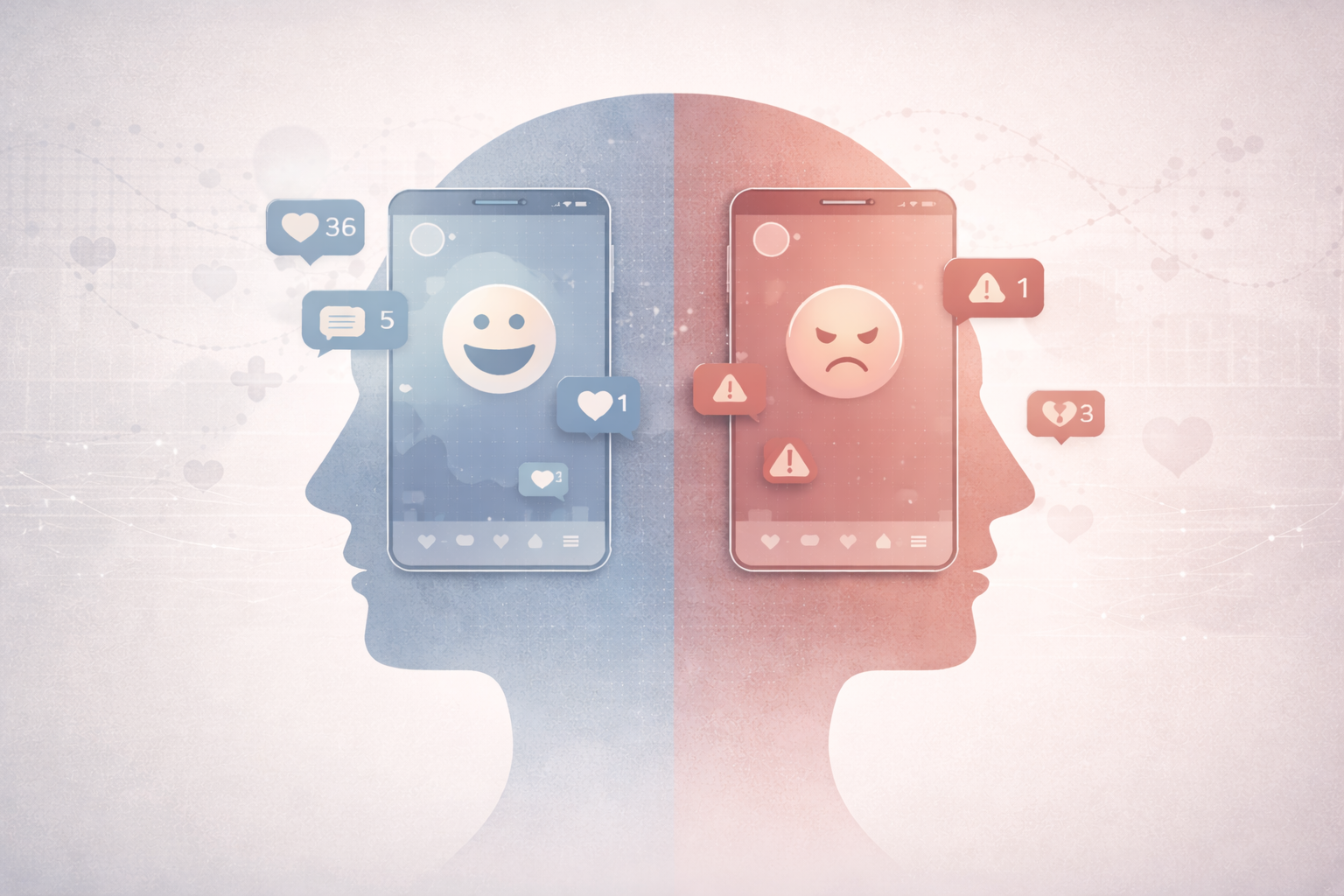
The correlation between social media and psychological wellbeig can be favourable or harmful, with both short-term and long-term impact. These platforms benefits psycxhological health by raising awareness and combating loneliness, but it also has a detrimental impact by increasing feelings of depression, anxiety, and addiction. It is worth noting that minors, people of the LGBTQ gender, and those with physical or mental disabilities are among the most vulnerable populations, and they are more likely to face these adverse outcomes. However, more studies should be conducted determine the degree of the correlation between social media use and psychological well-being to develop prevention and therapy techniques. As a result, they recommend that people exercise caution when using social media and weigh the advantages and disadvantages.
Users of social networking sites should exercise caution and strive to strike a healthy balance when using them, considering both the psychological advantages they may offer and the risks of frequent use. Raising the degree of digital literacy is one strategy to promote social media usage that will benefit many people. Due to the complexity and quick development of the social sphere, digital literacy abilities—which include critical comprehension of media content, appropriate internet communication protocol, and moderation of one's online and offline lives—can be used to manage the media landscape. Creating guidelines and policies is another tactic to promote constructive social media usage, particularly in businesses and educational institutions. Therefore, following these rules can support the display of prudence and a responsible attitude when utilizing social media in both personal and professional contexts. It can entail spreading knowledge of different, more beneficial laws and initiatives that can facilitate responsible and appropriate use of these platforms while improving social media-related mental well-being guidance and support. In actuality, more academic investgations are being conducted to explore the dichotomy between online social spaces and Psychological health in both its primary and more complex forms to develop practical guidelines for responsible usage as well as efficient therapies for pathological online-space members. Online social spaces are still a play a vital role on people's lives, so it is essential to consider potential adverse effects on mental health and promote responsible and healthy use of social media.
Conclusion
While social media has several benefits, it also poses several harms to the mental health of people. This study asserts that social media reduces the stigma that comes with mental health disorders and, at the same time, increases the awareness of such disorders. Research has shown that online social space is a catalyst to growing self-assertion and self-esteem, especially in marginalized persons. In addition, social media may help decrease the stigma associated with mental health disorders. It has also brought about the reduction of stigma, as people can discuss mental health issues on social media platforms without being discriminated against or censured.
On the other hand, there is a linkage between using social media and an increase in stress, worry, and depressive symptoms. Since social networking involves comparison with other people, it leads to low self-esteem and perceived inadequacy. In addition, addiction and other compulsive disorders may ensue from consistent social media usage, particularly among vulnerable groups such as adolescents and college students. Those students who use social sites have low academic performance and disrupted sleep. Due to the reduced physical interactions resulting from virtual communication, many individuals are experiencing loneliness, social isolation, and lack of support. LGBTQ+ individuals are also victims of cyberbullying and harassment. The second type of users include disabled persons who struggle to communicate and engage in social activities resulting of using online social platforms.
References
Alonzo, R., Hussain, J., Stranges, S., & Anderson, K. K. (2021). The interplay between social media use, sleep quality, and mental health in youth: A systematic review. Sleep medicine reviews, 56, 101414. https://doi.org/10.1016/j.smrv.2020.101414
Biezā, K. E. (2020). Digital literacy: Concept and definition. International Journal of Smart Education and Urban Society (IJSEUS), 11(2), 1–15.
Blair, B., KwitowskiMelissa, A., TrujilloMichael, A., & PerrinPaul, B. (2019). Body appreciation in lesbian, bisexual, and queer women: Examining a model of social support, resilience, and self-esteem. Health Equity.
Boers, E., Afzali, M. H., Newton, N., & Conrod, P. (2019). Association of screen time and depression in adolescence. JAMA pediatrics, 173(9), 853-859. http://jamanetwork.com/article.aspx?doi=10.1001/jamapediatrics.2019.1759
Brailovskaia, J., Margraf, J., & Köllner, V. (2019). Addicted to Facebook? Relationship between Facebook Addiction Disorder, duration of Facebook use and narcissism in an inpatient sample. Psychiatry Research, 273, 52-57. https://doi.org/10.1016/j.psychres.2019.01.016
Jung, J., Barron, D., Lee, Y. A., & Swami, V. (2022). Social media usage and body image: Examining the mediating roles of internalizing appearance ideals and social comparisons in young women. Computers in Human Behavior, p. 135, 107357. https://doi.org/10.1016/j.chb.2022.107357
Karim, F., Oyewande, A. A., Abdalla, L. F., Ehsanullah, R. C., & Khan, S. (2020). Social media use and its connection to mental health: a systematic review. Cureus, 12(6). DOI: 10.7759/cureus.8627
Kelzang, U., & Lhendup, T. (2021). Relationship between Facebook usage and academic performance of college students under the Royal University of Bhutan. Journal of Education, Society, and Behavioural Science, 34(2), 29-38.
Moreno, M., Riddle, K., Jenkins, M. C., Singh, A. P., Zhao, Q., & Eickhoff, J. (2022).
Measuring problematic internet use, gaming disorder, and social media addiction in young adults: Cross-sectional survey study. JMIR public health and
surveillance, 8(1), e27719. https://doi.org/10.2196/27719
O'Day, E. B., & Heimberg, R. G. (2021). Social media use, social anxiety, and loneliness: A systematic review. Computers in Human Behavior Reports, p. 3, 100070. https://doi.org/10.1016/j.chbr.2021.100070
Orben, A., & Przybylski, A. K. (2019). The association between adolescent well-being and digital technology use. Nature human behavior, 3(2), 173-182. https://doi.org/10.1038/s41562-018-0506-1
Reer, F., Festl, R., & Quandt, T. (2021). Investigating problematic social media and game use in a nationally representative sample of adolescents and younger adults. Behavior & Information Technology, 40(8), 776-789. https://doi.org/10.1080/0144929X.2020.1724333
Roberston, L., Twenge, J. M., Joiner, T. E., & Cummins, K. (2022). Associations between screen time and internalizing disorder diagnoses among 9-to 10-year-olds. Journal of affective disorders, pp. 311, 530–537. https://doi.org/10.1016/j.jad.2022.05.071
Schmuck, D., Karsay, K., Matthes, J., & Stevic, A. (2019). "Looking Up and Feeling Down." The influence of mobile social networking site use on adult smartphone users' upward social comparison, self-esteem, and well-being. Telematics and informatics, 42, 101240. https://doi.org/10.1016/j.tele.2019.101240
Teffer, A. (2020). It is All about Me: Millennials, Narcissism, and Social Networking Sites.
In Critical Storytelling in 2020: Issues, Elections and Beyond (pp. 80–92). Brill.
Tkacová, H., Králik, R., Tvrdoň, M., Jenisová, Z., & Martin, J. G. (2022). Credibility and Involvement of Social Media in Education—Recommendations for Mitigating the Negative Effects of the Pandemic among High School Students. International Journal of Environmental Research and Public Health, 19(5), 2767. https://doi.org/10.3390/ijerph19052767
Twenge, J. M., Joiner, T. E., Rogers, M. L., & Martin, G. N. (2019). Corrigendum:" Increases in depressive symptoms, suicide-related outcomes, and suicide rates among US adolescents after 2010 and links to increased new media screen time". https://psycnet.apa.org/doi/10.1177/2167702618824060
Comments