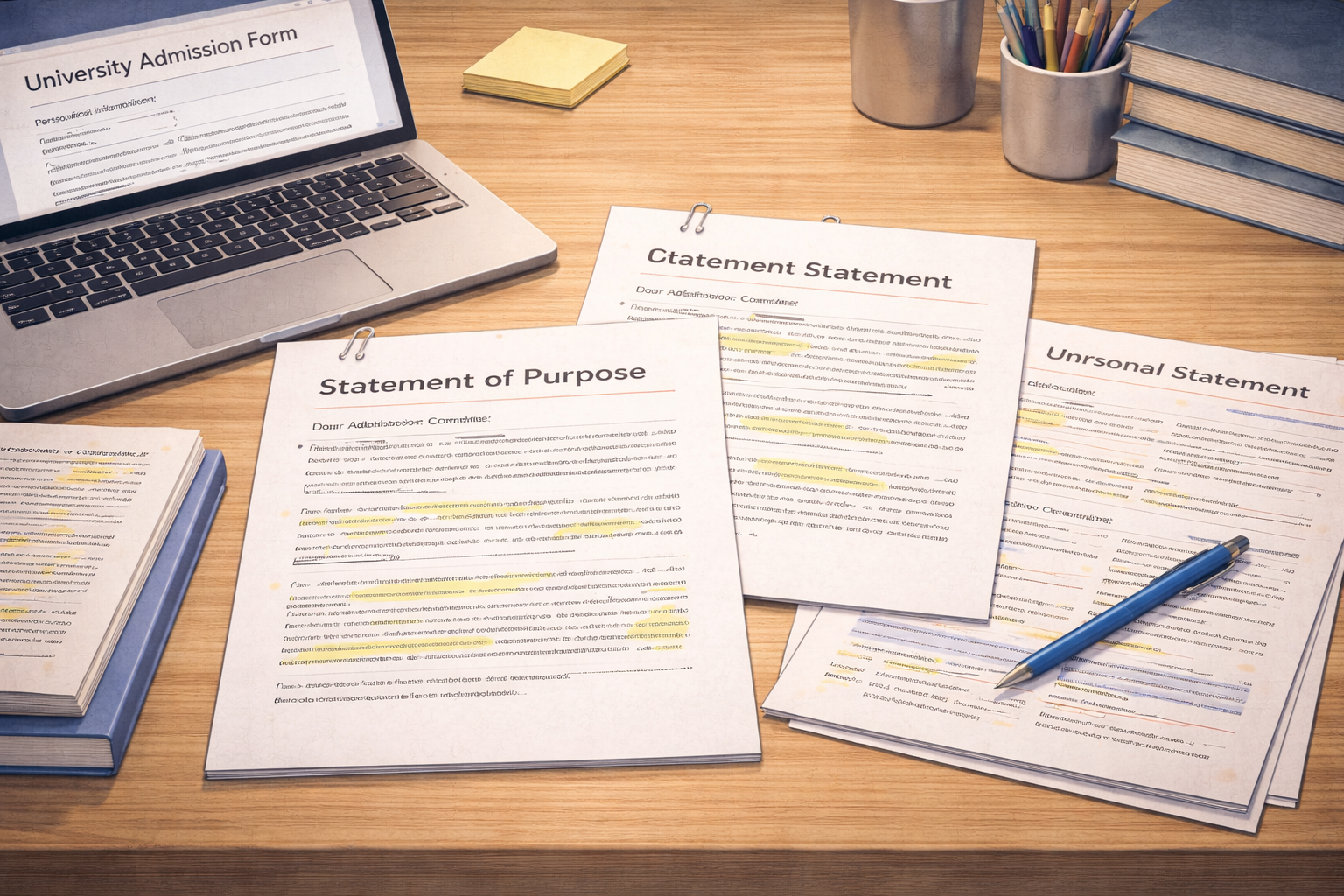
Graduate and postgraduate applications frequently require applicants to submit either a statement of purpose or a personal statement. Despite their similar appearance, these two documents serve distinct academic and evaluative functions.
Confusion between the statement of purpose vs personal statement is one of the most common reasons applications fail to meet admissions expectations. Applicants often submit a reflective personal narrative when an academically focused document is required, or vice versa.
This article clarifies the difference between a statement of purpose and a personal statement, explains how admissions committees use each document, and provides guidance on how to respond correctly to application requirements.
Why the Distinction Between SOP and Personal Statement Matters
Universities do not use these documents interchangeably. Each one answers a different evaluative question posed by the admissions committee. Submitting the wrong type of document can undermine even a strong academic record.
The statement of purpose primarily assesses academic readiness and intellectual direction. In contrast, the personal statement evaluates personal motivation, background, and suitability within a broader educational or professional context.
Key rule: Always write to the document requested. Never assume a statement of purpose and a personal statement are interchangeable.
Understanding this distinction is essential before examining structure or examples.
What Is a Statement of Purpose?
A statement of purpose (SOP) is an academic document explaining your preparation for advanced study, your intended field of focus, and your alignment with a specific programme or department.
It is commonly required for Master’s, PhD, and research-based postgraduate programmes, particularly in the UK, US, Canada, and Australia. Admissions committees read SOPs as academic arguments rather than personal reflections.
The emphasis is on intellectual coherence, research feasibility, and institutional fit. Personal experiences are included only where they directly inform academic interests.
Primary Goals of a Statement of Purpose
An SOP is designed to demonstrate academic maturity and direction. It should answer the question: “Why are you prepared to pursue this programme, here, now?”
- Define clear academic or research interests
- Demonstrate relevant academic preparation
- Show alignment with departmental strengths
- Explain future academic or research goals
A strong SOP reads as a focused, evidence-based academic narrative.
What Is a Personal Statement?
A personal statement is a reflective narrative describing your background, motivations, and personal development. It is widely used in undergraduate admissions, professional programmes, and scholarship applications.
Unlike the statement of purpose, the personal statement allows broader discussion of life experiences, challenges, values, and aspirations. Academic content is important, but not dominant.
Admissions committees use personal statements to assess character, resilience, communication skills, and personal alignment with institutional values.
Primary Goals of a Personal Statement
A personal statement answers the question: “Who are you, and why are you motivated to pursue this opportunity?”
- Explain personal motivation and background
- Highlight formative experiences
- Demonstrate commitment and resilience
- Connect personal values to academic or professional goals
Personal statements are evaluated more holistically than SOPs.
Statement of Purpose vs Personal Statement: Direct Comparison
The differences between these two documents become clearer when viewed side by side. The table below summarises the core distinctions.
| Aspect | Statement of Purpose | Personal Statement |
|---|---|---|
| Primary Focus | Academic and research goals | Personal background and motivation |
| Tone | Formal and academic | Reflective and personal |
| Typical Use | Master’s and PhD applications | Undergraduate, scholarships, professional programmes |
| Content Emphasis | Preparation, fit, future research | Experiences, values, personal growth |
| Use of Personal Stories | Limited and academically relevant | Central and narrative-driven |
This comparison highlights why substituting one document for the other is risky.
Which Document Do Universities Expect?
Universities usually specify which document they require. However, terminology may vary by country and institution, increasing confusion.
In many US graduate applications, the term “statement of purpose” is used explicitly. UK universities may request a “personal statement” even for postgraduate study, but still expect academically focused content.
Examiner warning: Always interpret the prompt, not just the document title.
If the prompt asks about research interests, supervisors, or academic preparation, you are effectively being asked for an SOP, regardless of the label.
Can One Document Serve Both Purposes?
Applicants sometimes ask whether a single document can function as both a statement of purpose and a personal statement. In most cases, the answer is no.
While there may be limited overlap, especially in postgraduate personal statements, combining both approaches usually weakens clarity and focus. Admissions committees expect precision.
Instead, applicants should adapt structure, tone, and emphasis to match each requirement explicitly.
Editing and Proofreading Admissions Statements
Because admissions statements are high-stakes documents, clarity and precision are essential. Minor language issues or unclear structure can distract reviewers from strong content.
Many applicants therefore seek professional academic editing or proofreading before submission. Services such as Epic-Essay’s proofreading support focus on improving clarity, coherence, and academic tone without altering personal voice.
This final stage often determines whether an application appears polished and competitive.
Choosing the Right Approach with Confidence
The debate around statement of purpose vs personal statement is ultimately about purpose, not format. Each document plays a specific role in the admissions process.
By identifying what the admissions committee is truly asking for, and responding with the correct structure and emphasis, applicants can present themselves accurately and persuasively.
When written with intention, either document becomes a powerful tool for academic progression.


Comments