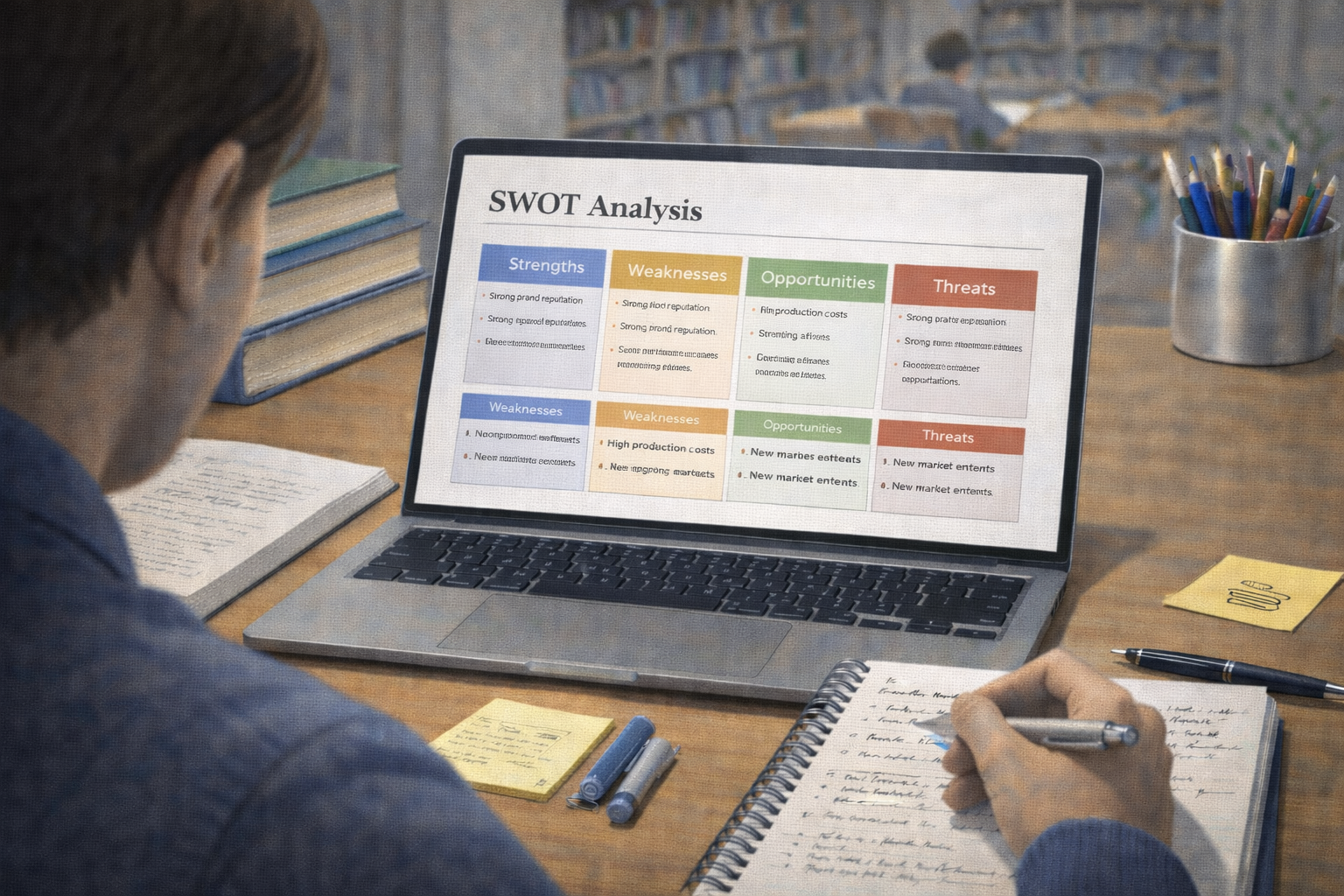
SWOT analysis is one of the most frequently used analytical frameworks in academic assignments, particularly in business, management, marketing, healthcare, and public policy programmes. Despite its popularity, it is also one of the most commonly misused tools in university-level work.
Many students treat SWOT analysis as a simple listing exercise, presenting strengths, weaknesses, opportunities, and threats without analysis or academic justification. This approach rarely meets university marking criteria.
This guide explains how to use SWOT analysis in academic assignments critically, analytically, and in line with examiner expectations, ensuring it strengthens rather than weakens your work.
What Is SWOT Analysis in an Academic Context?
SWOT analysis is a strategic evaluation framework used to assess internal and external factors affecting an organisation, project, policy, or concept. In academic work, its purpose is not just classification but analytical insight.
Strengths and weaknesses refer to internal characteristics, such as resources, capabilities, or limitations. Opportunities and threats relate to external conditions, including market trends, regulation, competition, or societal change.
In academic assignments, SWOT analysis should support argumentation, decision-making, or strategic recommendations rather than exist as a standalone descriptive tool.
In university assignments, SWOT analysis is valued for insight, not for listing.
Why SWOT Analysis Is Commonly Used in University Assignments
SWOT analysis is popular in academic contexts because it provides a structured way to evaluate complex situations. It helps students organise information and demonstrate applied understanding of theory.
Lecturers often include SWOT analysis in assignments to assess students’ ability to integrate theory with real-world or case-based scenarios.
However, its simplicity can be misleading, leading students to underestimate the level of critical engagement required.
Understanding the Four Components of SWOT Analysis
Each element of SWOT analysis serves a distinct analytical function. Understanding these differences is essential for academic accuracy.
Confusing internal and external factors is a common error that weakens analytical credibility.
| Component | Focus | Academic Example |
|---|---|---|
| Strengths | Internal advantages | Strong brand equity or specialised expertise |
| Weaknesses | Internal limitations | Limited funding or skill gaps |
| Opportunities | External favourable conditions | Emerging markets or policy support |
| Threats | External risks | Regulatory change or increased competition |
Correct classification strengthens analytical precision and avoids conceptual errors.
How SWOT Analysis Is Assessed by Examiners
Examiners do not assess SWOT analysis based on completeness alone. Instead, they evaluate how well it supports critical reasoning and strategic judgement.
High-scoring assignments demonstrate why each SWOT factor matters and how it influences decision-making or outcomes.
Unexplained bullet-point lists rarely receive strong marks.
Descriptive vs Analytical Use of SWOT Analysis
A descriptive SWOT analysis merely states factors without interpretation. An analytical SWOT analysis explains implications, relationships, and strategic relevance.
For example, identifying “strong leadership” as a strength is descriptive. Explaining how leadership enables strategic change or mitigates risk is analytical.
University-level work always prioritises analysis over description.
SWOT analysis without explanation is descriptive, not analytical.
Integrating SWOT Analysis into Academic Arguments
SWOT analysis should not appear in isolation. It must be integrated into the broader argument of the assignment.
For instance, in a strategic management essay, SWOT analysis might justify recommended strategies. In a policy paper, it may explain feasibility or risk.
The framework should support claims rather than replace them.
Using Evidence to Support SWOT Points
Academic SWOT analysis requires evidence. Each identified factor should be supported by data, theory, or credible sources.
Evidence may include academic literature, industry reports, policy documents, or case study data, depending on discipline.
Unsupported claims reduce analytical credibility and weaken grading outcomes.
Applying SWOT Analysis to Case Studies
Case study assignments frequently require SWOT analysis to evaluate organisational or strategic performance.
In these contexts, SWOT analysis should be tightly linked to case facts rather than generic assumptions.
Referencing specific case details strengthens relevance and demonstrates close reading.
SWOT Analysis in Business and Management Assignments
In business-related disciplines, SWOT analysis often informs strategic recommendations. Strengths and opportunities are typically leveraged, while weaknesses and threats guide risk management.
Effective academic use explains trade-offs rather than assuming all strengths are exploitable.
Critical balance is essential for credibility.
SWOT Analysis in Non-Business Disciplines
SWOT analysis is also used in healthcare, education, environmental studies, and public policy.
In these contexts, the framework may assess programmes, interventions, or institutional performance.
Adapting SWOT language to disciplinary norms improves academic alignment.
Presenting SWOT Analysis: Table vs Narrative
SWOT analysis can be presented in table form, narrative form, or a combination of both.
Tables improve clarity, while narrative explanation provides depth. Most university assignments benefit from using both.
| Format | Purpose |
|---|---|
| Table | Summarises key factors clearly |
| Narrative | Explains implications and significance |
Relying on tables alone is rarely sufficient at university level.
Common Mistakes in Academic SWOT Analysis
Several recurring errors reduce the effectiveness of SWOT analysis in assignments.
- Confusing internal and external factors
- Using vague or generic points
- Failing to provide evidence
- Listing without analysis
- Repeating case facts without interpretation
Avoiding these mistakes significantly improves assessment outcomes.
Linking SWOT Analysis to Recommendations
In many assignments, SWOT analysis leads directly to recommendations. These recommendations should logically follow from the analysis.
For example, a weakness identified in skills capacity may justify training investment, while an external threat may support diversification.
Clear linkage demonstrates strategic reasoning.
Language and Style Expectations
SWOT analysis in academic writing should maintain formal tone and precise language. Informal expressions or unsupported opinions reduce professionalism.
Analytical verbs such as “indicates,” “suggests,” and “implies” are preferred over absolute claims.
Consistency in terminology also improves clarity.
How Much Space Should SWOT Analysis Take?
The proportion of an assignment devoted to SWOT analysis depends on the task. In most cases, it should support the main argument rather than dominate it.
Overextended SWOT sections can crowd out deeper analysis.
Concise, focused evaluation is usually more effective.
Final Academic Guidance on SWOT Analysis in Assignments
When used critically, SWOT analysis is a powerful academic tool. It helps structure evaluation, supports strategic reasoning, and demonstrates applied understanding.
However, its effectiveness depends on evidence, explanation, and integration into broader arguments.
Students who move beyond listing and engage analytically with SWOT analysis consistently achieve stronger academic outcomes.


Comments