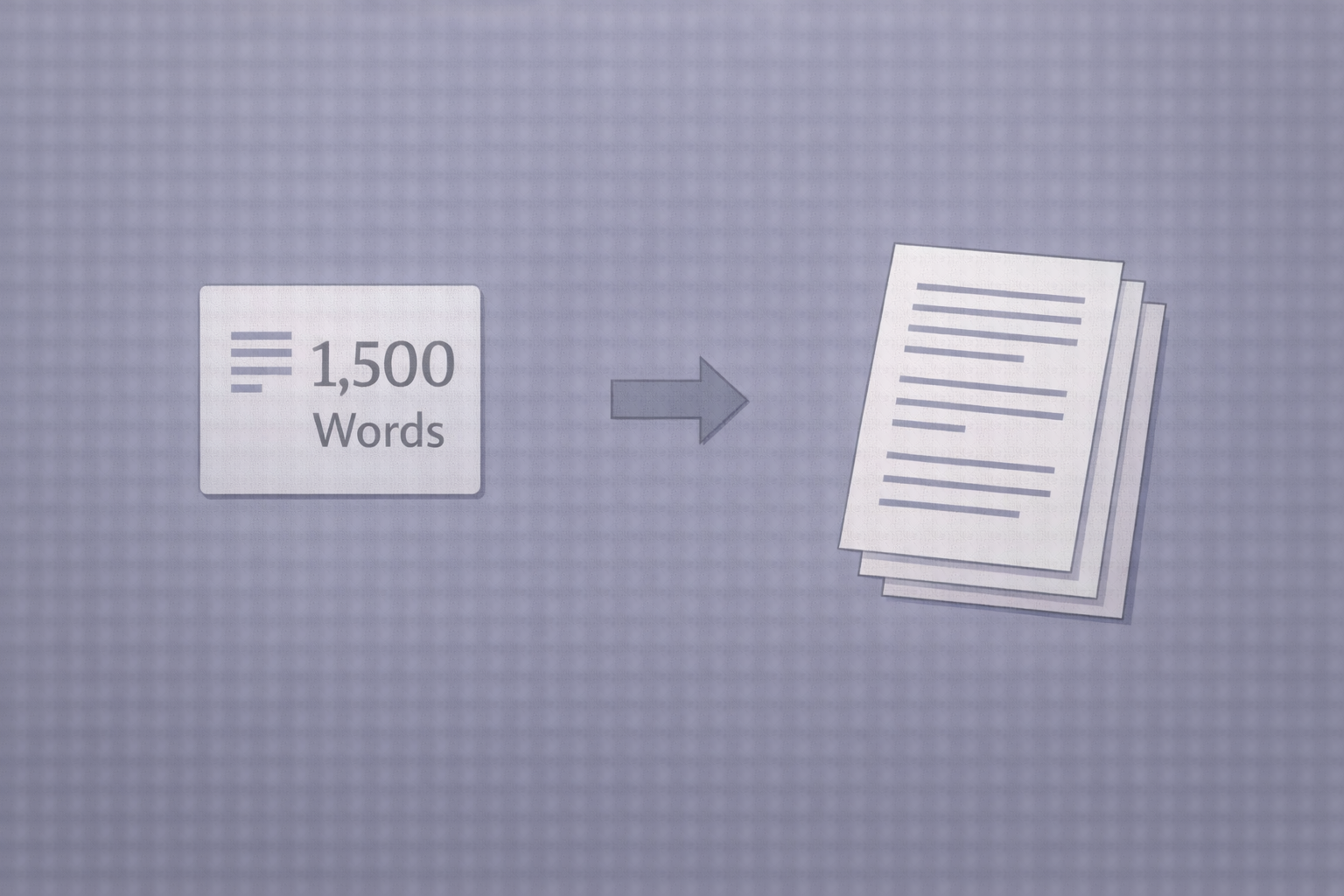
In academic writing, students are frequently given assignments defined by word count, yet many still think in terms of pages. This disconnect often leads to confusion during planning, drafting, and formatting, particularly when submission penalties apply for exceeding or falling short of length requirements.
Understanding how words convert into pages is therefore not a cosmetic formatting issue but a core academic skill. The relationship between words and pages depends on formatting conventions, institutional standards, and disciplinary expectations. This article provides a detailed, practical explanation of words to pages conversion and shows how to apply it reliably in university-level work.
Why Word Count Is the Primary Academic Measure
Universities use word count as the primary measure of assignment length because it provides a precise and consistent benchmark. Unlike page count, which can be manipulated through formatting choices, word count reflects the actual volume of written content.
Markers rely on word count to assess whether a student has demonstrated sufficient depth, scope, and engagement with the task. A paper that appears visually long may still be underdeveloped if the word count is low.
As a result, most academic regulations specify acceptable word count ranges rather than page limits.
Key principle: In academic assessment, word count overrides page count unless explicitly stated otherwise.
Standard Words to Pages Conversion Explained
Words-to-pages conversion is based on assumed formatting standards that are common across universities. When these standards are followed, approximate conversions can be used for planning purposes.
Under standard formatting, 250 words typically equal one double-spaced page, while 500 words equal one single-spaced page. These figures are estimates rather than fixed rules.
Students should treat these numbers as planning tools and always confirm the final word count before submission.
Typical Academic Formatting Assumptions
Words-to-pages estimates usually assume:
- 12-point font size
- Times New Roman or a similar serif font
- Double spacing unless otherwise specified
- Standard margins (approximately 2.5 cm or 1 inch)
Any deviation from these conventions will alter how many words appear on each page.
Words to Pages Conversion Table
The table below shows common words-to-pages estimates using standard academic formatting. These figures are widely used for outlining and drafting.
| Word count | Double-spaced pages (≈250 words/page) | Single-spaced pages (≈500 words/page) |
|---|---|---|
| 500 words | 2 pages | 1 page |
| 1,000 words | 4 pages | 2 pages |
| 2,000 words | 8 pages | 4 pages |
| 3,000 words | 12 pages | 6 pages |
These conversions provide a reliable planning framework, but the actual page count will depend on formatting accuracy.
Factors That Affect Words to Pages Conversion
Words do not convert into pages at a fixed rate because page length is influenced by several formatting variables. Ignoring these variables is one of the most common sources of student error.
Recognising what changes page density allows students to predict layout outcomes more accurately.
Font Style and Font Size
Different fonts occupy different amounts of space on a page. Times New Roman generally fits more words per page than Arial or Calibri at the same font size.
Increasing font size, even slightly, reduces the number of words per page and may result in misleading page estimates.
Line Spacing and Paragraph Spacing
Double spacing roughly halves the number of words per page compared to single spacing. Additional spacing before or after paragraphs further reduces word density.
Most academic style guides specify spacing clearly, and failure to follow these rules can result in penalties.
Margins and Page Layout
Wider margins reduce the available writing space and increase the number of pages required. Narrower margins do the opposite.
Altering margins to change page length is generally discouraged and may be flagged as improper formatting.
Words Versus Pages in Assignment Briefs
Some assignment briefs mention page length, others specify word count, and some reference both. This can create uncertainty for students who are unsure which measure takes priority.
In most cases, word count should be treated as the authoritative requirement. Page count is typically used only as a rough indicator of expected scope.
When instructions are unclear, institutional academic writing guidance should be followed.
Critical warning: Never assume that one page equals the same number of words across different assignments.
Using Words to Pages for Assignment Planning
Converting words to pages is particularly useful during the planning stage of an assignment. It allows students to visualise the scope of their work and distribute content evenly.
For example, a 2,000-word essay equates to roughly eight double-spaced pages, which can then be divided into introduction, body sections, and conclusion.
This approach helps prevent imbalances, such as overly long introductions or underdeveloped analysis sections.
Common Student Errors in Words to Pages Conversion
A frequent mistake is relying on page count alone rather than checking the actual word count. This often leads to submissions that exceed the permitted range.
Another error is assuming that changing formatting does not affect page length, which can result in unexpected page inflation or reduction.
Understanding these risks helps students avoid unnecessary last-minute revisions.
Digital Tools and Accurate Word Counting
Modern word processors provide precise word count tools that should always be used before submission. These tools often allow students to include or exclude references, depending on institutional rules.
Structured academic support environments, such as those emphasised within academic writing services, consistently prioritise accurate word count management as part of good academic practice.
Ultimately, automated word count tools remove guesswork and should be trusted over visual page estimates.
When Page Length Still Matters
Although word count dominates academic assessment, page length can still matter in printed submissions, formatting checks, or presentation-based assessments.
In these cases, page count reflects adherence to formatting standards rather than content volume.
Students should therefore view page length as a secondary formatting consideration.
Applying Words to Pages Knowledge with Confidence
Understanding how words translate into pages allows students to interpret assignment requirements accurately and plan their writing effectively. It reduces uncertainty and supports stronger time management.
By combining approximate conversions with precise word count checks, students can submit work that meets both technical and intellectual expectations.
This practical awareness reflects academic maturity and contributes to consistent performance across coursework.


Comments