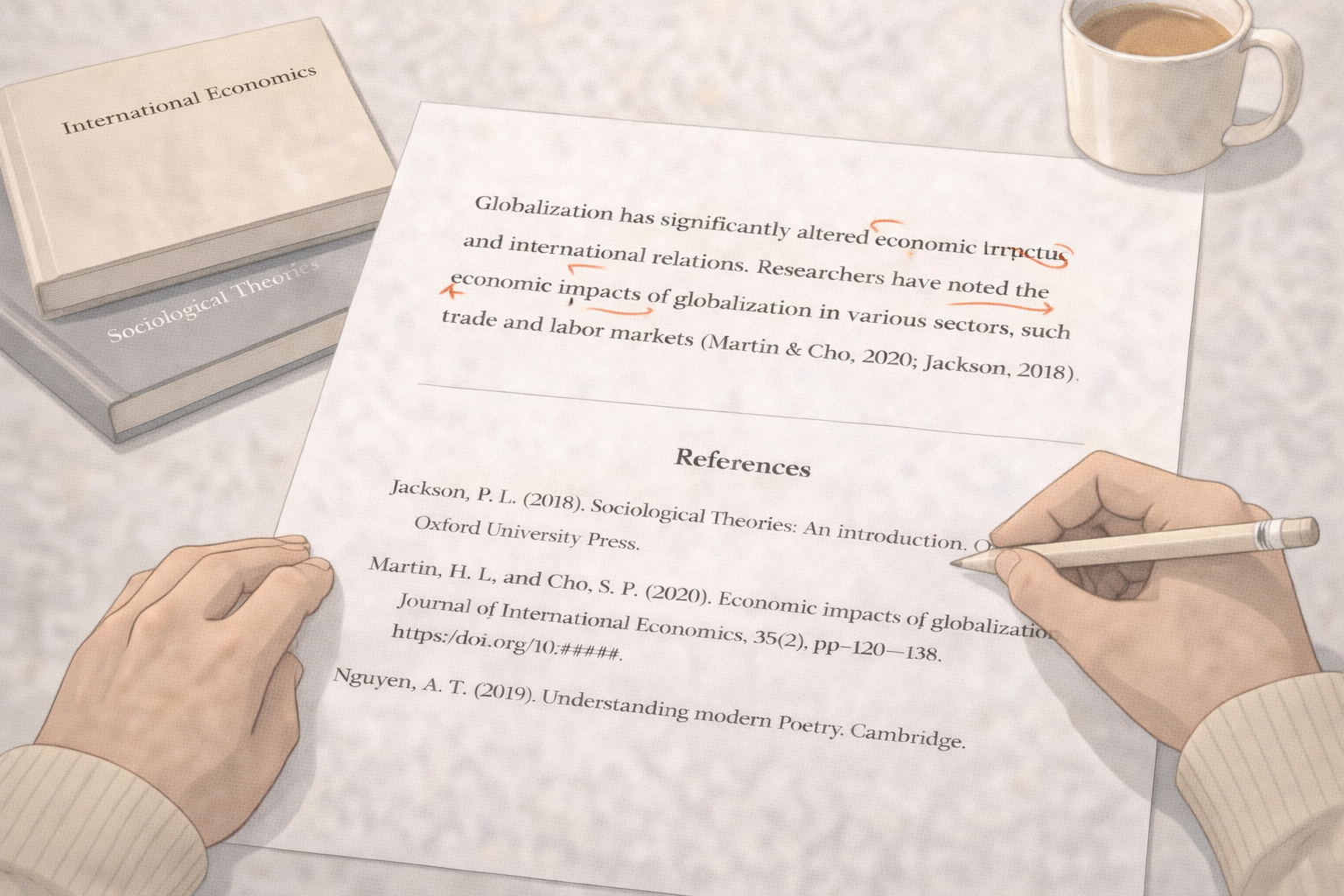
Academic referencing is one of the most visible markers of university-level writing. It signals that a student understands how knowledge is produced, evaluated, and shared within a discipline. Beyond formatting rules, referencing reflects intellectual honesty, critical engagement with sources, and respect for existing scholarship.
Despite its importance, many students struggle with academic referencing because it appears technical, fragmented, and rule-heavy. This article provides a clear, structured explanation of academic referencing, covering its purpose, core principles, major styles, and common pitfalls, with the aim of helping students reference accurately and confidently.
What Academic Referencing Means in Higher Education
Academic referencing is the systematic practice of acknowledging the sources that inform a piece of academic work. Whenever ideas, data, theories, or direct quotations are drawn from existing literature, those sources must be clearly identified.
Referencing serves both ethical and scholarly purposes. Ethically, it prevents plagiarism by distinguishing a student’s original contribution from existing work. Scholarly, it allows readers to trace ideas, verify evidence, and engage critically with the academic conversation.
In university contexts, referencing is not optional or decorative; it is a core academic requirement.
Key academic rule: Any idea, data, or wording that is not your own intellectual creation must be referenced.
Why Academic Referencing Is Taken Seriously by Examiners
Markers use referencing to assess more than technical accuracy. Correct referencing demonstrates that a student has engaged with appropriate sources and understands how to integrate evidence into an argument.
Weak or inconsistent referencing often signals superficial research, poor source evaluation, or rushed work. Even strong arguments can lose marks if referencing standards are not met.
In severe cases, incorrect or missing references may raise concerns about academic misconduct.
The Core Purposes of Academic Referencing
Although referencing rules vary by style, the underlying purposes remain consistent across disciplines.
- To acknowledge intellectual ownership
- To support claims with credible evidence
- To allow readers to locate original sources
- To demonstrate research depth and relevance
- To distinguish analysis from description
Effective referencing strengthens both the ethical standing and analytical quality of academic writing.
In-Text Citations and Reference Lists Explained
Academic referencing usually consists of two interconnected elements: in-text citations and a full reference list or bibliography.
In-text citations appear within the body of the work and indicate where external material is used. The reference list provides complete publication details so that readers can locate the source.
Both elements must correspond exactly; inconsistencies are a common source of lost marks.
What Counts as a Source That Needs Referencing
Students often underestimate what requires a reference. Referencing is not limited to direct quotations.
Paraphrased ideas, theories, statistics, images, tables, and methodological frameworks also require acknowledgement.
General knowledge may not need referencing, but what qualifies as “general” varies by discipline and academic level.
Major Academic Referencing Styles Used at University
Different disciplines adopt different referencing styles based on how knowledge is constructed and communicated. Understanding which style applies is essential.
Students are expected to follow the style specified by their department or module, not to choose freely.
| Referencing Style | Typical Disciplines | In-Text Citation Format |
|---|---|---|
| Harvard | Social sciences, business | (Author, Year) |
| APA | Psychology, education | (Author, Year) |
| MLA | Humanities, literature | (Author Page) |
| Chicago | History, some social sciences | Footnotes or (Author Year) |
| OSCOLA | Law | Footnotes |
Each style has detailed rules governing punctuation, ordering, and formatting.
Harvard Referencing: Structure and Common Issues
Harvard referencing is one of the most widely used systems. It relies on brief author–date citations in the text and a detailed alphabetical reference list.
Common student errors include inconsistent use of “et al.”, incorrect capitalisation, and missing page numbers for direct quotations.
Precision matters because small formatting errors accumulate quickly.
APA Referencing and Its Emphasis on Dates
APA referencing places particular emphasis on publication year, reflecting the importance of recent research in scientific fields.
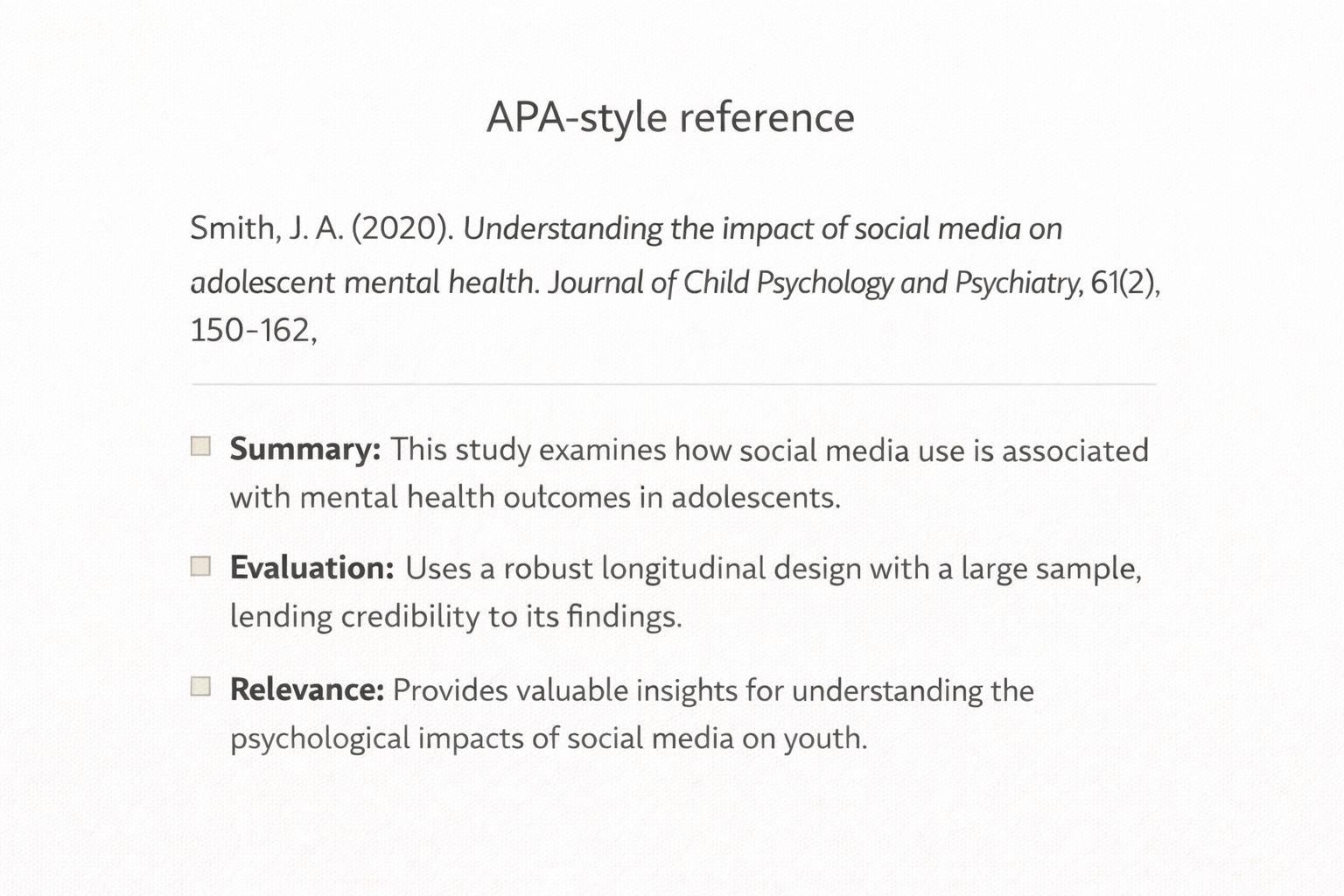
Students must pay close attention to formatting details such as italics, sentence case, and DOI presentation.
Failure to follow APA conventions can make otherwise sound work appear careless.
Footnote-Based Referencing Systems
Chicago (notes and bibliography) and OSCOLA rely on footnotes rather than parenthetical citations. These systems allow for fuller source discussion within notes.
They are common in disciplines where detailed source commentary is valued.
Footnote systems require careful consistency to avoid confusion.
Academic Referencing and Paraphrasing
Paraphrasing does not remove the need for referencing. Changing wording without acknowledging the source is still plagiarism.
Effective paraphrasing involves rewriting ideas in a new structure while preserving original meaning.
Referencing signals that the intellectual debt has been recognised.
Critical warning: Paraphrasing without a citation is treated as plagiarism in academic assessment.
Secondary Referencing and When to Avoid It
Secondary referencing occurs when a student cites a source that they have not read directly but which is quoted in another work.
While sometimes unavoidable, secondary referencing should be used sparingly.
Where possible, students are expected to consult original sources.
Referencing Digital and Online Sources
Academic work increasingly draws on online journals, datasets, and institutional reports.
Students must ensure that digital sources are credible, stable, and appropriately formatted according to the chosen style.
URLs alone are rarely sufficient; publication details still matter.
Common Academic Referencing Mistakes
Referencing errors are among the most frequent issues identified in feedback.
- Mismatch between in-text citations and reference list
- Inconsistent formatting
- Missing publication details
- Incorrect use of quotation marks
- Over-reliance on a single source
Many of these errors are preventable through careful checking.
Academic Referencing and Assessment Criteria
Referencing often appears explicitly in marking rubrics under categories such as “use of sources” or “academic conventions.”
Even when not stated explicitly, it influences perceptions of academic rigour.
Accurate referencing supports higher grades by strengthening credibility.
Using Reference Management Tools Responsibly
Reference management software can help organise sources, but it does not replace understanding.
Automatically generated references must always be checked against official style guides.
Students remain responsible for accuracy.
Checking and Proofreading References
Referencing should be reviewed as carefully as content and structure.
Proofreading references involves checking consistency, completeness, and compliance with the required style.
This final step often separates competent work from high-quality submissions.
Academic Referencing as a Learning Process
Referencing improves with practice. Early mistakes are common and part of academic development.
Seeking feedback and consulting official style guides accelerates improvement.
Confidence grows as conventions become familiar.
Referencing Across Different Levels of Study
Expectations for referencing increase with academic level. Undergraduate work focuses on accuracy and relevance.
Postgraduate work demands precision, breadth, and critical engagement with sources.
Doctoral research treats referencing as part of scholarly contribution.
Academic Integrity and Referencing
Referencing is central to academic integrity. It makes the boundary between original thought and existing knowledge transparent.
Universities treat breaches seriously because they undermine trust in scholarship.
Good referencing protects both students and institutions.
Developing Confidence in Academic Referencing
Academic referencing may appear complex, but it is governed by clear principles.
By understanding why references matter, how styles function, and where errors arise, students can approach referencing with confidence rather than anxiety.
Ultimately, accurate referencing is not merely a technical skill but a sign of academic maturity.


Comments