An annotated bibliography in APA style is a common academic assignment that tests both referencing accuracy and critical reading skills. While many students are familiar with APA reference lists, they often struggle to adapt those rules to annotated bibliographies, particularly when balancing correct formatting with analytical annotation writing.
Marks are frequently lost not because sources are weak, but because annotations lack evaluation, APA formatting is inconsistent, or the purpose of the annotation is misunderstood. These issues usually arise when students rely on reference-list examples without understanding how annotations function academically.
This article provides a clear annotated bibliography APA example alongside detailed guidance on structure, formatting, and examiner expectations. It is designed to help students produce accurate, analytical, and assessment-ready annotated bibliographies in APA style.
What an Annotated Bibliography in APA Style Requires
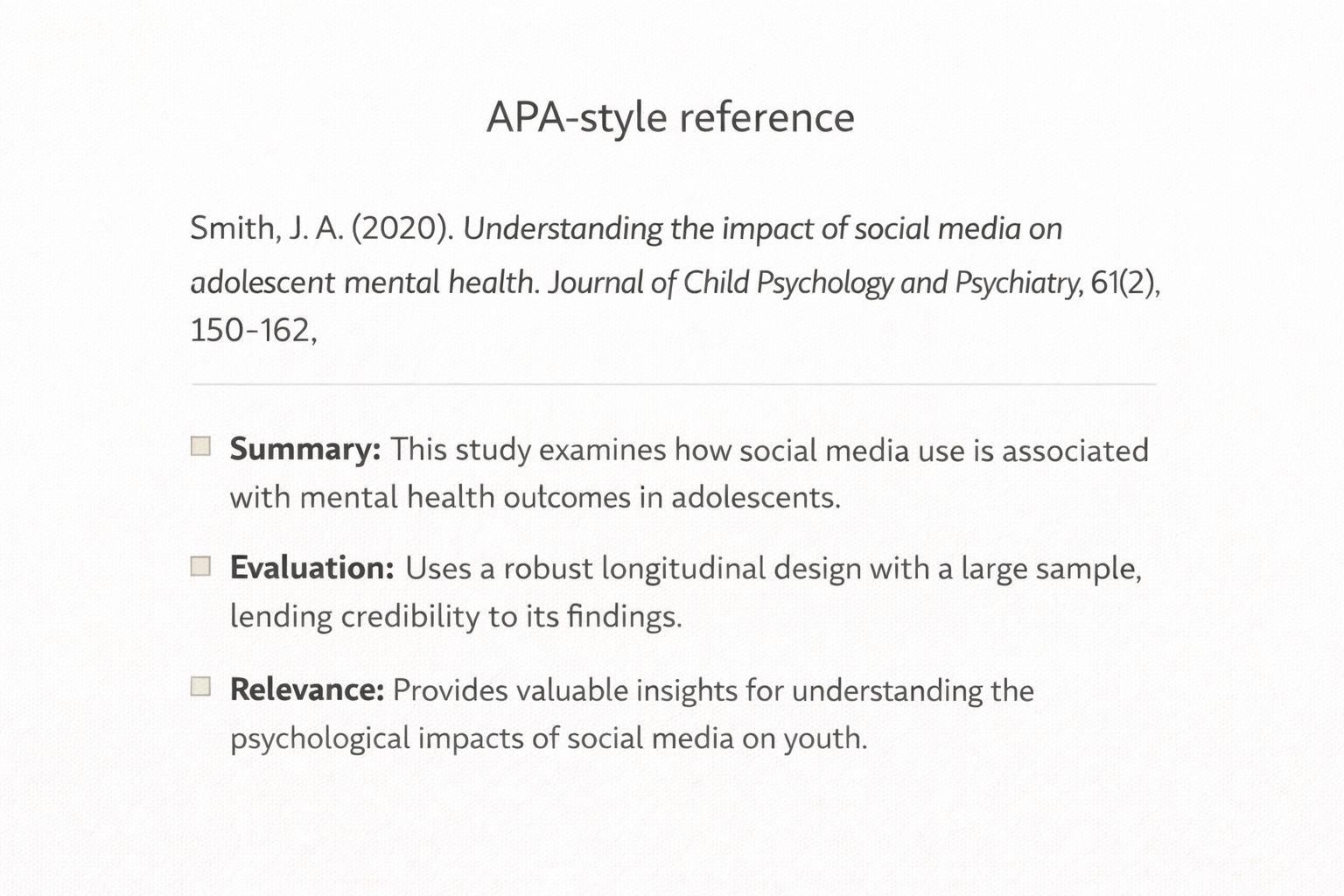
An APA annotated bibliography consists of two essential components: an APA-formatted reference entry and an accompanying annotation. The reference follows standard APA guidelines, while the annotation explains, evaluates, and contextualises the source.
Unlike a simple reference list, an annotated bibliography demonstrates engagement with the literature. It shows that the student has read the source critically and understands its relevance to a research topic.
In APA style, formatting accuracy and analytical annotation quality are assessed together.
Both components must be correct for the entry to meet academic standards.
When APA Annotated Bibliographies Are Used
APA annotated bibliographies are most common in social sciences, education, psychology, business, and health-related disciplines. They are often assigned early in the research process.
Lecturers use them to assess source selection, comprehension, and preliminary critical thinking. For students, the task functions as structured preparation for literature reviews and research proposals.
Understanding this purpose helps shape the depth and tone of annotations.
APA Reference Formatting in Annotated Bibliographies
The reference entry in an APA annotated bibliography must follow the same rules as an APA reference list. This includes author formatting, year of publication, italicisation, and punctuation.
References are arranged alphabetically by the first author’s surname. Each annotation begins on a new line below its corresponding reference.
Errors in APA formatting often reduce marks even when annotations are strong.
Basic APA Reference Structure
Although formats vary by source type, most journal articles follow a consistent pattern.
- Author surname, initials
- Year of publication in parentheses
- Title of the article in sentence case
- Title of the journal in italics
- Volume and issue number
- Page range
- DOI or URL if required
Students should always follow the version of APA specified by their institution.
Structure of an APA Annotation
An APA annotation is written as a single paragraph beneath the reference. It is usually indented in line with APA formatting conventions.
Most annotations are between 100 and 200 words, depending on assignment instructions. Conciseness and clarity are essential.
Effective annotations integrate summary, evaluation, and relevance.
Key Elements Examiners Expect in APA Annotations
Although phrasing may vary, most APA annotations address three core elements.
- A brief summary of the source’s purpose and key findings
- An evaluation of credibility, methodology, or limitations
- An explanation of relevance to the research topic
Omitting any of these elements weakens the annotation.
Annotated Bibliography APA Example (Journal Article)
The example below demonstrates an APA-formatted reference followed by a complete evaluative annotation. This is an illustrative academic example.
Illustrative annotated bibliography APA example:
Brown, L. M., & Davis, R. T. (2020). Teacher feedback and student motivation in higher education. Journal of Educational Psychology, 112(4), 765–780. https://doi.org/10.1037/edu0000412
This article investigates the relationship between teacher feedback and student motivation in university settings using a quantitative survey design. Brown and Davis report that timely, specific feedback is positively associated with intrinsic motivation among undergraduate students. The study’s strength lies in its large sample size and validated measurement instruments, although its reliance on self-reported data may limit causal interpretation. This source is particularly relevant to the current research because it provides empirical evidence supporting feedback-based motivational theories, which inform the conceptual framework of the study.
This example demonstrates APA formatting accuracy and balanced evaluation.
Annotated Bibliography APA Example (Book Source)
Books follow a different APA reference format but use the same annotation principles.
Illustrative book annotation:
Smith, J. A. (2019). Research methods in education (3rd ed.). Academic Press.
This book provides a comprehensive overview of qualitative and quantitative research methods commonly used in educational research. Smith presents methodological concepts clearly and supports them with practical examples. While the text is broad rather than deeply specialised, its strength lies in its accessibility and clear explanation of core research principles. This source is useful for establishing methodological foundations in the present study, particularly in clarifying research design choices.
This annotation emphasises scope and usefulness rather than empirical findings.
Descriptive vs Evaluative APA Annotations
APA annotated bibliographies at higher academic levels typically require evaluative annotations rather than purely descriptive ones.
The table below highlights the difference.
| Aspect | Descriptive Annotation | Evaluative Annotation |
|---|---|---|
| Main function | Summarise content | Summarise and critically assess |
| Critical judgement | Minimal | Explicit and justified |
| Typical academic level | Introductory undergraduate | Advanced undergraduate and postgraduate |
| Relevance explanation | Implicit | Clearly articulated |
Most university assignments expect evaluative annotations.
Common APA Formatting Errors in Annotated Bibliographies
One common error is treating the annotated bibliography like a standard reference list and neglecting indentation or spacing conventions.
Another frequent issue is inconsistent use of italics, capitalisation, or punctuation in APA references.
APA formatting errors can significantly reduce marks, even when annotations are strong.
Careful proofreading is essential.
Academic Tone and Voice in APA Annotations
APA annotations should maintain a formal academic tone. Informal language or unsupported opinions weaken credibility.
First-person language is usually avoided unless the assignment explicitly allows reflective annotations.
Objectivity and clarity are valued in APA-style academic writing.
Ordering Entries in an APA Annotated Bibliography
Entries are typically ordered alphabetically by author surname, following APA reference list conventions.
Each entry begins with the reference, followed immediately by the annotation.
Students should not rearrange entries thematically unless instructed to do so.
How APA Annotated Bibliographies Support Research Writing
Writing an annotated bibliography in APA style helps students evaluate sources systematically before drafting a literature review.
Strong annotations make it easier to identify key themes, methodological trends, and research gaps.
This preparation improves coherence and depth in later writing stages.
APA Annotated Bibliographies and Academic Integrity
Even though annotations summarise sources, all ideas must be clearly attributed. Paraphrasing without citation is unacceptable.
APA style requires accurate author and date identification to maintain transparency.
Maintaining integrity is essential for academic credibility.
Planning an APA Annotated Bibliography Efficiently
Effective APA annotated bibliographies are planned in advance. Selecting high-quality, peer-reviewed sources improves annotation quality.
Active reading and note-taking reduce repetition and improve analytical focus.
Good preparation saves time and improves clarity.
Applying APA Annotated Bibliography Skills with Confidence
An annotated bibliography APA example illustrates more than formatting rules. It demonstrates research literacy, critical evaluation, and academic discipline.
By combining accurate APA references with concise, evaluative annotations, students can meet university expectations confidently.
Mastering APA annotated bibliographies strengthens research skills that extend into literature reviews, proposals, and dissertations.

Comments