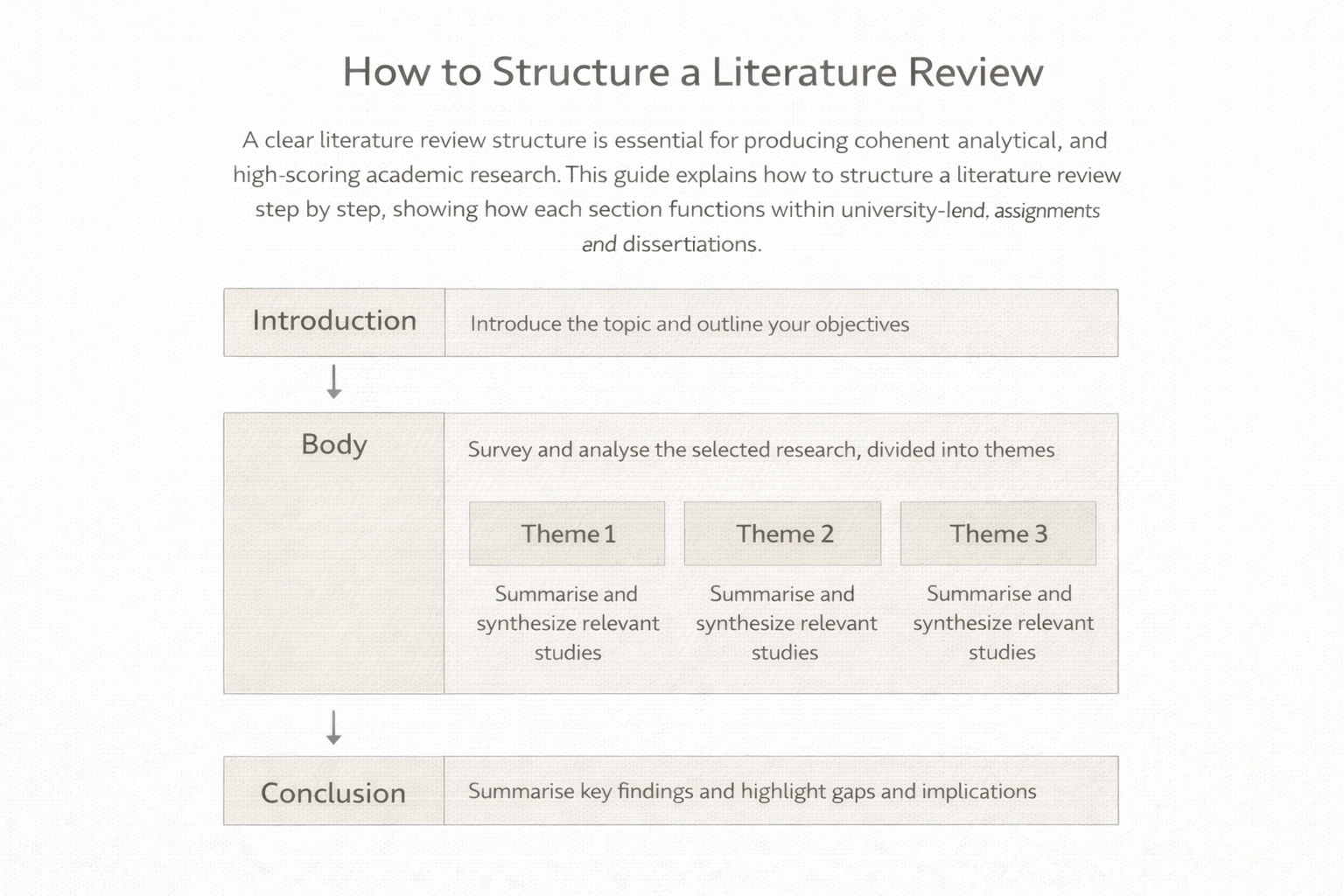
The literature review is one of the most structurally demanding sections of academic research writing. Unlike descriptive assignments, it requires students to organise existing scholarship into a logical, analytical framework that supports their research focus. A weak or poorly structured literature review often signals limited academic understanding, regardless of how many sources are included.
Many students struggle not because they lack sources, but because they do not know how to organise them effectively. Common issues include listing studies without connection, jumping between themes without transitions, or failing to show how the reviewed literature leads to the research question. These problems are fundamentally structural rather than linguistic.
This article explains literature review structure in detail. It provides a clear academic framework, explains the function of each structural component, and shows how students can organise their review to meet examiner expectations across undergraduate and postgraduate levels.
What Examiners Expect from Literature Review Structure
Examiners assess literature reviews as evidence of research competence. A well-structured review demonstrates that the student can identify relevant scholarship, evaluate it critically, and organise it into a coherent academic argument. Structure is therefore inseparable from assessment criteria.
Rather than looking for a fixed template, examiners look for logical progression. Each section should build on the previous one, guiding the reader from general context to specific research gaps. Disorganised reviews, even when well written, are often marked down for lack of clarity.
A strong literature review structure shows how the research conversation develops, not just what has been written.
Understanding this expectation helps students prioritise structure as an academic skill rather than a formatting task.
The Core Components of Literature Review Structure
Although literature reviews vary by discipline and assignment type, most effective reviews share a common structural logic. This logic reflects the purpose of the review: to situate the current research within existing knowledge.
At a minimum, a literature review should include contextual framing, thematic or conceptual discussion, methodological evaluation where relevant, and a clear identification of research gaps. These components work together to justify the study.
The table below outlines the core components and their academic function.
| Structural Component | Main Purpose | Academic Value |
|---|---|---|
| Contextual overview | Introduce the research field | Establishes relevance and scope |
| Thematic discussion | Compare and evaluate key ideas | Demonstrates synthesis |
| Methodological analysis | Assess research approaches | Shows critical awareness |
| Research gap | Identify limitations or omissions | Justifies the current study |
These components should not appear as isolated sections but as an integrated academic narrative.
Structuring the Opening Section of a Literature Review
The opening of a literature review sets the intellectual boundaries of the research. Its purpose is to introduce the broader field and narrow the reader’s focus toward the specific topic under investigation.
This section typically outlines key concepts, theoretical traditions, or historical developments relevant to the research area. It provides context without excessive detail, allowing the reader to understand why the topic matters academically.
Effective openings avoid summarising individual studies. Instead, they establish themes and debates that will be explored in depth later.
Organising the Main Body Using Thematic Structure
The main body of a literature review is most commonly organised thematically. This means grouping studies by shared concepts, variables, or perspectives rather than by author or chronology.
Thematic organisation encourages comparison and synthesis. By discussing multiple sources within the same paragraph or section, students can highlight agreements, contradictions, and patterns across the literature.
Organising by author is descriptive, not analytical.
Thematic structure is especially important at postgraduate level, where analytical depth is a core assessment criterion.
Using Conceptual Themes to Drive Structure
Conceptual themes focus on ideas, theories, or constructs rather than empirical findings alone. This approach is common in theoretical, qualitative, or interdisciplinary research.
For example, a literature review on leadership might be structured around transformational leadership, transactional leadership, and ethical leadership, rather than around individual studies.
This structure helps demonstrate theoretical understanding and intellectual control.
Using Empirical Themes to Organise Evidence
Empirical themes group studies according to findings, outcomes, or variables. This approach is common in quantitative and applied research.
Studies may be organised by outcomes, populations, or contexts, allowing similarities and differences to be analysed systematically.
Empirical thematic structure supports evidence-based argumentation.
Integrating Methodological Discussion into the Structure
Many literature reviews include explicit methodological evaluation. This involves examining how previous studies were conducted and assessing the strengths and limitations of their approaches.
Methodological discussion may be integrated within thematic sections or presented as a distinct subsection, depending on assignment requirements. Its purpose is to demonstrate research literacy rather than technical mastery.
Commenting on methods also helps justify the methodological choices of the current study.
Maintaining Logical Flow Between Sections
Strong literature review structure depends on smooth transitions between sections. Each paragraph and section should connect logically to the next, guiding the reader through the academic conversation.
Transitions can be achieved by summarising key points at the end of a section and previewing the focus of the next. This creates cohesion and prevents the review from feeling fragmented.
Logical flow signals careful planning and enhances readability.
Balancing Breadth and Depth Within the Structure
One of the main challenges in structuring a literature review is balancing coverage with analysis. Including too many sources can result in superficial discussion, while focusing too narrowly may limit context.
Effective structure prioritises depth over breadth. Key studies and debates receive detailed analysis, while less central sources are referenced more briefly.
This balance reflects academic judgement and strengthens critical engagement.
Structuring the Ending of a Literature Review
The ending of a literature review is structurally significant. It should not merely summarise what has been discussed but synthesise insights to highlight gaps, inconsistencies, or unresolved questions.
This section explicitly links the reviewed literature to the current research. It explains how existing studies fall short and how the present study addresses those limitations.
The literature review should end by making the research necessary.
A clearly articulated research gap strengthens the transition to methodology or research design.
How Literature Review Structure Differs by Academic Level
At undergraduate level, literature review structure tends to be simpler, with fewer themes and less extensive synthesis. However, logical organisation and critical engagement are still expected.
At postgraduate level, structure becomes more complex. Reviews are longer, more analytical, and more explicitly linked to theoretical and methodological frameworks.
Doctoral literature reviews demand sustained synthesis and original positioning within the field.
Common Structural Errors to Avoid
One common error is mixing multiple themes within a single paragraph without clear focus. This weakens coherence and confuses the reader.
Another frequent issue is ending the literature review without a clear research gap. Without this structural closure, the purpose of the review remains unclear.
Avoiding these errors requires careful outlining before writing.
Planning a Literature Review Structure Before Writing
Effective literature reviews are planned before drafting begins. Creating an outline based on themes and research objectives helps maintain structure throughout the writing process.
Outlining also prevents repetition and ensures balanced coverage across sections. Students should revisit the outline as their understanding of the literature deepens.
Structural planning saves time and improves academic clarity.
Using Literature Review Structure as a Research Tool
Literature review structure is not just a writing framework but a research tool. It helps students clarify their thinking, refine research questions, and identify gaps systematically.
By organising literature strategically, students gain deeper insight into their field and position their work more confidently.
Strong structure transforms the literature review from a requirement into a foundation for original research.
Applying Literature Review Structure with Academic Confidence
Mastering literature review structure is essential for producing high-quality academic research. Clear organisation, thematic synthesis, and logical progression demonstrate research competence.
By understanding the purpose of each structural component and applying it deliberately, students can produce literature reviews that meet and exceed university expectations.
When structure is strong, analysis becomes clearer, arguments more persuasive, and research more credible.


Comments