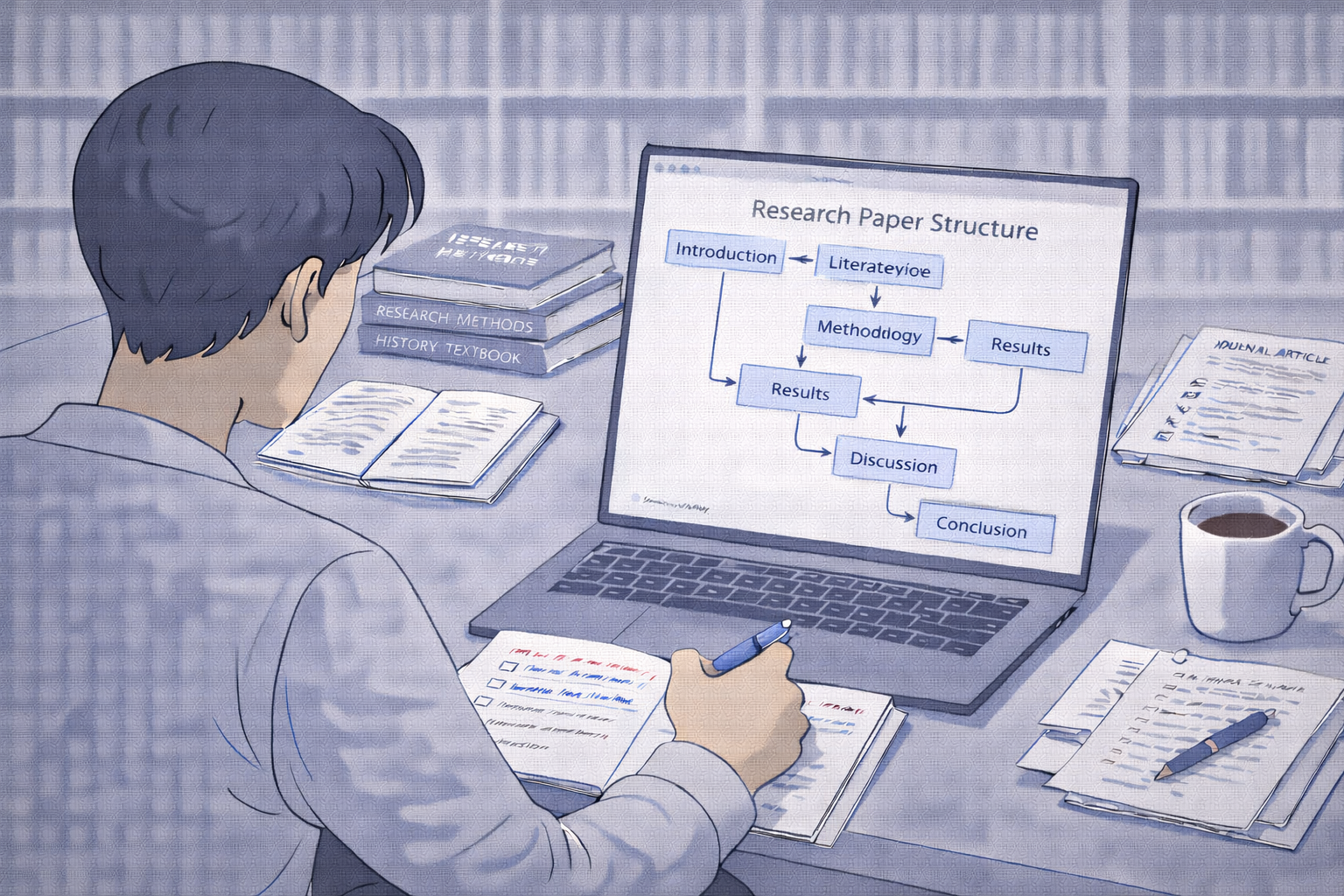
Research paper structure is one of the most decisive factors in academic assessment, yet it is often misunderstood or treated as a secondary concern. Universities use research papers to evaluate not only subject knowledge, but also a student’s ability to organise complex ideas, guide a reader logically, and sustain a coherent academic argument. Even strong research can be undermined if the structure fails to support clarity and progression.
Students commonly struggle with research paper structure because expectations are rarely stated in simple terms. Questions about what belongs in each section, how ideas should flow, and how much emphasis to give different parts of the paper can lead to confusion and uneven writing. This article provides a comprehensive, student-focused explanation of research paper structure, showing how each section functions academically and how structure influences examiner judgement.
Why Research Paper Structure Matters in Academic Assessment
Research paper structure exists to make academic reasoning transparent. Examiners are not searching for information; they are evaluating how effectively a student constructs, supports, and develops an argument. A clear structure allows examiners to locate key components quickly and assess them against marking criteria.
From an academic perspective, structure reflects intellectual control. A well-structured paper signals that the writer understands the research problem, can manage complexity, and can guide a reader through layered reasoning. Conversely, weak or inconsistent structure often suggests unclear thinking, even when the underlying ideas are sound.
These expectations are reinforced in broader academic guidance such as research paper structure and format guidance, where structure is treated as inseparable from argument quality.
The Core Components of Research Paper Structure
Although research paper structures vary slightly by discipline, most university assignments follow a recognisable academic framework. This framework ensures that the reader is oriented, the argument is developed logically, and conclusions are justified by evidence.
At a minimum, a research paper includes an opening section that establishes context and purpose, a series of body sections that develop the argument, and a closing section that synthesises findings. Each component has a distinct academic role and should not be treated interchangeably.
Understanding the function of each structural element helps students avoid common mistakes, such as repeating background information throughout the paper or presenting analysis without sufficient context.
Structuring the Opening Section for Academic Clarity
The opening section of a research paper sets the intellectual direction of the entire assignment. Its purpose is to introduce the research context, narrow focus to a specific problem, and clarify the aim or argument of the paper. Examiners expect this section to demonstrate relevance, not to provide exhaustive background.
Effective openings follow a funnel logic, moving from broader academic context to the specific research focus. This progression helps readers understand why the topic matters and how the paper contributes to existing scholarship.
A common structural weakness at this stage is overloading the opening with literature review material. Instead, key sources should be signposted briefly, with detailed engagement reserved for later sections.
Examiner expectation: The opening section should make the research purpose unmistakably clear within the first few pages.
Organising the Main Body of the Research Paper
The main body is where research paper structure becomes most visible. This section contains the core argument and is typically divided into thematically organised subsections. Each subsection should develop a distinct aspect of the argument while contributing to the overall research objective.
Logical sequencing is critical. Ideas should build upon one another rather than appear as isolated points. Clear topic sentences and transitional phrases help guide the reader and reinforce argumentative flow.
Students often weaken structure by treating body sections as independent mini-essays. Instead, each section should respond directly to the research question and link explicitly to preceding and subsequent discussion.
Balancing Literature, Analysis, and Evidence
Within the main body, research paper structure must balance engagement with existing literature and original analysis. Literature should be integrated where it supports or challenges the argument, not presented as a standalone summary.
Analysis should dominate. Examiners look for interpretation, evaluation, and synthesis rather than descriptive reporting. Evidence, whether theoretical or empirical, must be contextualised and explained.
This balance allows structure to function as a scaffold for critical thinking rather than a container for information.
Using Headings to Strengthen Research Paper Structure
Headings play a crucial role in research paper structure by signalling shifts in focus and clarifying organisation. Effective headings are descriptive and content-driven, helping readers anticipate what each section will address.
Generic headings provide little academic value and can obscure the logic of the argument. Instead, headings should reflect the analytical function of the section within the broader paper.
Consistency in heading hierarchy is essential. Visual inconsistency, such as irregular formatting or unclear levels, disrupts structural clarity and may be interpreted as poor academic discipline.
Structuring Methodology and Analytical Sections
In empirical research papers, methodology sections form a critical part of the structure. Their purpose is to explain how data were generated or selected, allowing readers to evaluate validity and reliability.
Methodological structure should be logical and transparent. Decisions about data sources, sampling, and analytical approaches should be explained clearly, without unnecessary technical detail.
Analytical sections that follow should be structured to mirror the research questions or hypotheses, reinforcing coherence between design and findings.
Presenting Results and Supporting Material Clearly
Where results or findings are presented, research paper structure must support clarity and interpretation. Results should be organised thematically or logically rather than reported as unstructured data.
The table below illustrates how structured presentation supports academic evaluation.
| Section | Primary Purpose | Structural Contribution |
|---|---|---|
| Opening section | Establish context and focus | Orient reader and define scope |
| Main body | Develop argument | Demonstrate analytical progression |
| Results/analysis | Present and interpret evidence | Support claims with data |
| Closing section | Synthesise insights | Reinforce academic contribution |
This structured approach allows examiners to assess not just what was found, but how effectively findings are communicated.
Structuring the Closing Section Effectively
The closing section of a research paper synthesises the argument rather than repeating it. Its purpose is to draw together key findings, reflect on their implications, and reaffirm the paper’s contribution to the research question.
Effective closings revisit the research aim and show how it has been addressed through the paper’s structure and analysis. They should not introduce new evidence or arguments, as this disrupts structural coherence.
A strong closing leaves the examiner with a clear understanding of the paper’s academic value and internal logic.
Common Research Paper Structure Mistakes
Several structural errors recur in student research papers. These mistakes often arise from poor planning or misunderstanding of academic expectations.
- Overly long opening sections that delay the argument.
- Body sections that lack clear thematic focus.
- Analysis presented without structural signposting.
- Closings that summarise content without synthesis.
While individually minor, these issues collectively weaken academic clarity and reduce the effectiveness of the research paper.
Critical reminder: Research paper structure is assessed as part of academic reasoning, not merely presentation.
Research Paper Structure in Dissertations and Major Projects
In dissertations and extended research projects, research paper structure operates at multiple levels. Chapters function as structured arguments that must align with an overarching research design.
Consistency across chapters is essential. Structural weaknesses in early chapters can undermine later analysis and affect overall evaluation.
Students working on large-scale projects often benefit from structured academic support such as dissertation writing guidance, where research structure is addressed holistically.
Applying Research Paper Structure with Academic Confidence
Mastering research paper structure allows students to present complex ideas with clarity and authority. Structure should guide the reader naturally, making the argument easy to follow and evaluate.
By planning carefully, using headings strategically, and maintaining logical progression, students transform structure into a strength rather than a constraint. Strong research paper structure demonstrates intellectual control, academic maturity, and respect for scholarly conventions.
When applied consistently, research paper structure becomes the framework through which strong research is recognised and rewarded.


Comments