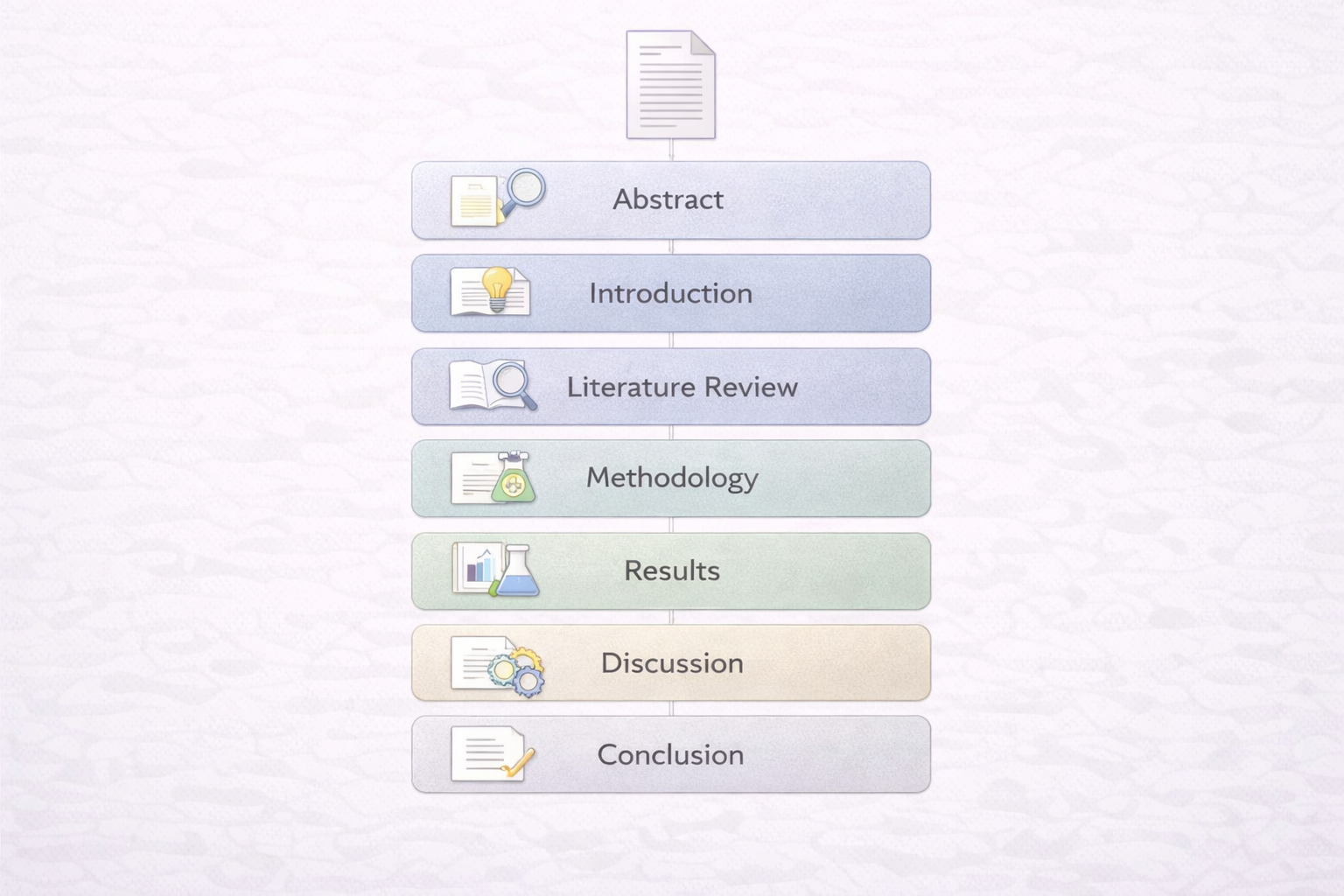
Research paper structure is not a stylistic preference but an academic convention developed to support clarity, evaluation, and knowledge transmission. Universities expect students to follow recognised structural patterns because these patterns allow examiners to assess logic, methodological rigour, and intellectual contribution efficiently. When structure is weak or inconsistent, even strong ideas are often penalised.
Many students mistakenly treat structure as a formatting exercise rather than an intellectual framework. In reality, structure governs how arguments unfold, how evidence is interpreted, and how conclusions are justified. This article explains research paper structure as an academic system, not a template, and shows how correct formatting directly influences grades.
Why Research Papers Follow a Standardised Structure
The standard structure of a research paper exists to create predictability in academic reading. Examiners, supervisors, and peer reviewers rely on familiar section sequencing to evaluate work efficiently and fairly. When a paper follows expected structural conventions, the reader can focus on argument quality rather than searching for information.
From an academic perspective, structure enforces intellectual discipline. It prevents students from presenting conclusions before evidence, methods before questions, or discussion without analysis. Each section performs a specific epistemic function, contributing to the credibility of the research as a whole.
Failure to follow recognised structure is rarely interpreted as originality. Instead, it is usually seen as misunderstanding of academic conventions, especially at undergraduate and postgraduate levels.
Examiner expectation: A well-structured research paper demonstrates control, planning, and understanding of disciplinary norms before originality is even considered.
The Title Page and Preliminary Material
The title page and preliminary elements frame the research before the main argument begins. While often overlooked, these components communicate professionalism, compliance, and attention to institutional requirements. Errors at this stage can immediately weaken examiner confidence.
The title should be precise, informative, and proportionate to the scope of the study. Overly broad titles suggest unfocused research, while overly technical titles often misrepresent undergraduate or taught postgraduate work. Formatting elements such as student details, module codes, and word counts must strictly follow institutional guidelines.
Preliminary sections such as abstracts, acknowledgements, and tables of contents are assessed indirectly. While they may not carry marks individually, inconsistencies between these sections and the main paper frequently attract penalties.
The Abstract as a Structural Overview
The abstract functions as a compressed version of the entire paper’s structure. It mirrors the logic of the full study by presenting context, objectives, methods, findings, and significance in a highly condensed form. Structurally, it acts as a diagnostic tool for coherence.
Examiners often use the abstract to form an initial judgement about whether the research design, analysis, and conclusions align logically. If the abstract signals confusion or imbalance, the rest of the paper is read more critically.
Structurally sound abstracts do not introduce new information. They reflect what is already present in the paper, reinforcing internal consistency.
The Introduction as an Argument-Setting Section
The introduction is not a background essay; it is the structural foundation of the research paper. Its primary function is to justify the study’s existence by moving from a broad academic context to a specific research problem.
Effective introductions establish relevance, identify a research gap, and clearly state research questions or objectives. Structurally, this section sets expectations that every subsequent section must fulfil. If the introduction promises analysis that the paper does not deliver, structural coherence collapses.
Common structural failures in introductions include excessive literature review, vague problem statements, or missing research aims. These issues often result in examiner comments about “lack of focus” or “unclear direction.”
Literature Review as Structural Positioning
The literature review situates the research within existing scholarship. Structurally, it performs a positioning function rather than a summarising one. Its role is to demonstrate awareness of what is already known and where the current study fits.
Academically strong literature reviews are organised thematically or conceptually, not chronologically. This structure allows the student to show analytical engagement rather than descriptive listing of sources.
When literature reviews lack structure, they often read as annotated bibliographies. Examiners interpret this as weak critical engagement, even when sources themselves are strong.
| Weak Structure | Strong Structure |
|---|---|
| Sources discussed one by one with no synthesis. | Sources grouped by themes, debates, or perspectives. |
| Focus on what authors say. | Focus on how studies relate to the research gap. |
The Methodology Section as a Structural Justification
Methodology explains how the research was conducted and why those choices were appropriate. Structurally, it connects the research questions to the data and analysis. This section is often decisive in marking, particularly in higher-level research.
A well-structured methodology moves logically from research design to data collection and analysis. Each methodological decision must be justified in relation to the research aims. Listing methods without justification is a structural weakness.
Examiners assess methodology structure to determine whether conclusions are credible. If methods are poorly explained or disconnected from research questions, the entire paper’s validity is questioned.
Results and Analysis as Evidence Presentation
The results or analysis section presents findings without interpretation bias. Structurally, it separates evidence from discussion to maintain academic objectivity. This separation is critical in empirical research.
Effective structure in this section involves clear subheadings, logical sequencing of findings, and consistent reference to research questions. Random or unstructured presentation of results suggests weak analytical planning.
In qualitative research, analysis often integrates results and interpretation. Even then, structural clarity remains essential to prevent descriptive drift.
The Discussion Section as Interpretive Structure
The discussion explains what the findings mean in relation to existing literature, theory, or practice. Structurally, it reconnects the paper to the introduction and literature review, completing the academic argument.
Strong discussions are organised around implications rather than results repetition. They interpret patterns, address limitations, and explain significance. Poorly structured discussions often restate findings without analysis.
Examiners expect the discussion to demonstrate intellectual maturity. Structural weakness here often leads to comments about “limited critical engagement.”
Conclusion as Structural Closure
The conclusion closes the research argument. Structurally, it synthesises rather than summarises. It revisits research aims, highlights contributions, and may suggest future research directions.
Introducing new evidence or arguments in the conclusion is a structural error. This section exists to reinforce coherence, not expand scope.
Strong conclusions leave the examiner with a clear understanding of what was achieved and why it matters academically.
Formatting Rules That Affect Academic Credibility
Formatting is not cosmetic. Margins, spacing, headings, citation style, and numbering systems support readability and standardisation. Deviations from required formats often result in avoidable mark deductions.
Consistent heading hierarchy, correct referencing style, and accurate page numbering signal academic professionalism. Inconsistent formatting suggests carelessness, regardless of content quality.
Universities expect strict adherence to formatting guidelines because they mirror professional research standards.
| Error | Impact on Assessment |
|---|---|
| Inconsistent headings | Reduced clarity and coherence |
| Incorrect citation style | Loss of credibility and marks |
| Improper spacing or margins | Perceived lack of academic discipline |
Research Paper Structure as a Marker of Academic Maturity
Ultimately, research paper structure reflects how a student thinks. Clear structure signals organised reasoning, critical awareness, and respect for academic conventions. Weak structure signals confusion, even when ideas are strong.
At advanced levels of study, structure becomes a differentiator rather than a baseline requirement. High-scoring papers do not merely follow structure; they use it strategically to guide interpretation.
Mastery of research paper structure is therefore essential for academic success across disciplines.



Comments