Essay length is not an arbitrary requirement. In higher education, word limits are used to control scope, depth, and analytical focus, ensuring that students demonstrate the appropriate level of thinking for their academic stage. Yet many students remain uncertain about how long an essay should actually be, what counts toward the word count, and how strictly length rules are enforced.
This essay length guide clarifies how universities use word limits, how length expectations change across academic levels, and how students can plan essays that meet both technical and intellectual requirements. Rather than treating length as a target to inflate or compress, this guide frames essay length as a structural tool that supports academic clarity.
Why Essay Length Matters in Academic Assessment
Essay length functions as a proxy for cognitive demand. Shorter essays typically test focused argumentation and precision, while longer essays assess synthesis, critical depth, and sustained reasoning. Markers rely on length limits to calibrate expectations fairly across cohorts.
When an essay is significantly under-length, it often signals insufficient engagement with the question or limited evidence. Conversely, over-length essays may suggest poor planning, lack of focus, or an inability to prioritise key arguments.
Understanding essay length, therefore, is not about meeting a numerical requirement but about aligning analytical depth with assessment criteria.
Examiner expectation: Word limits exist to guide depth and structure, not to be tested or ignored.
Standard Essay Lengths by University Level
Essay length expectations increase progressively across academic stages. Each level reflects a shift in analytical complexity, research independence, and disciplinary engagement.
| Academic Level | Typical Word Range | Primary Assessment Focus |
|---|---|---|
| Foundation / First Year | 800–1,200 words | Understanding concepts and basic argumentation |
| Second Year Undergraduate | 1,500–2,000 words | Critical engagement and structured analysis |
| Final Year Undergraduate | 2,000–3,000 words | Independent argument and evidence synthesis |
| Postgraduate Taught | 3,000–5,000 words | Advanced critical evaluation and theory application |
These ranges are indicative rather than universal. Specific modules and disciplines may vary.
What Counts Toward Essay Word Count
One of the most common sources of confusion concerns what is included in the word count. Universities differ slightly, but most follow similar conventions.
Generally, the main body of the essay—including the introduction, body paragraphs, and conclusion—is counted. In-text citations are usually included, while reference lists are typically excluded.
However, tables, figures, footnotes, and appendices may or may not count depending on the brief.
Critical rule: Always follow the assignment brief over general conventions.
Acceptable Word Count Tolerance
Most universities allow a small margin of variation around the stated word limit, often expressed as a percentage. A common tolerance is ±10%, though this is not guaranteed.
For example, a 2,000-word essay with a 10% allowance may be acceptable between 1,800 and 2,200 words. Exceeding this range can lead to penalties or truncated marking.
Students should never assume tolerance without confirmation from official guidance.
How Essay Length Shapes Structure
Essay length directly influences how arguments are structured. Short essays require tight focus and selective evidence, while longer essays allow for layered argument development.
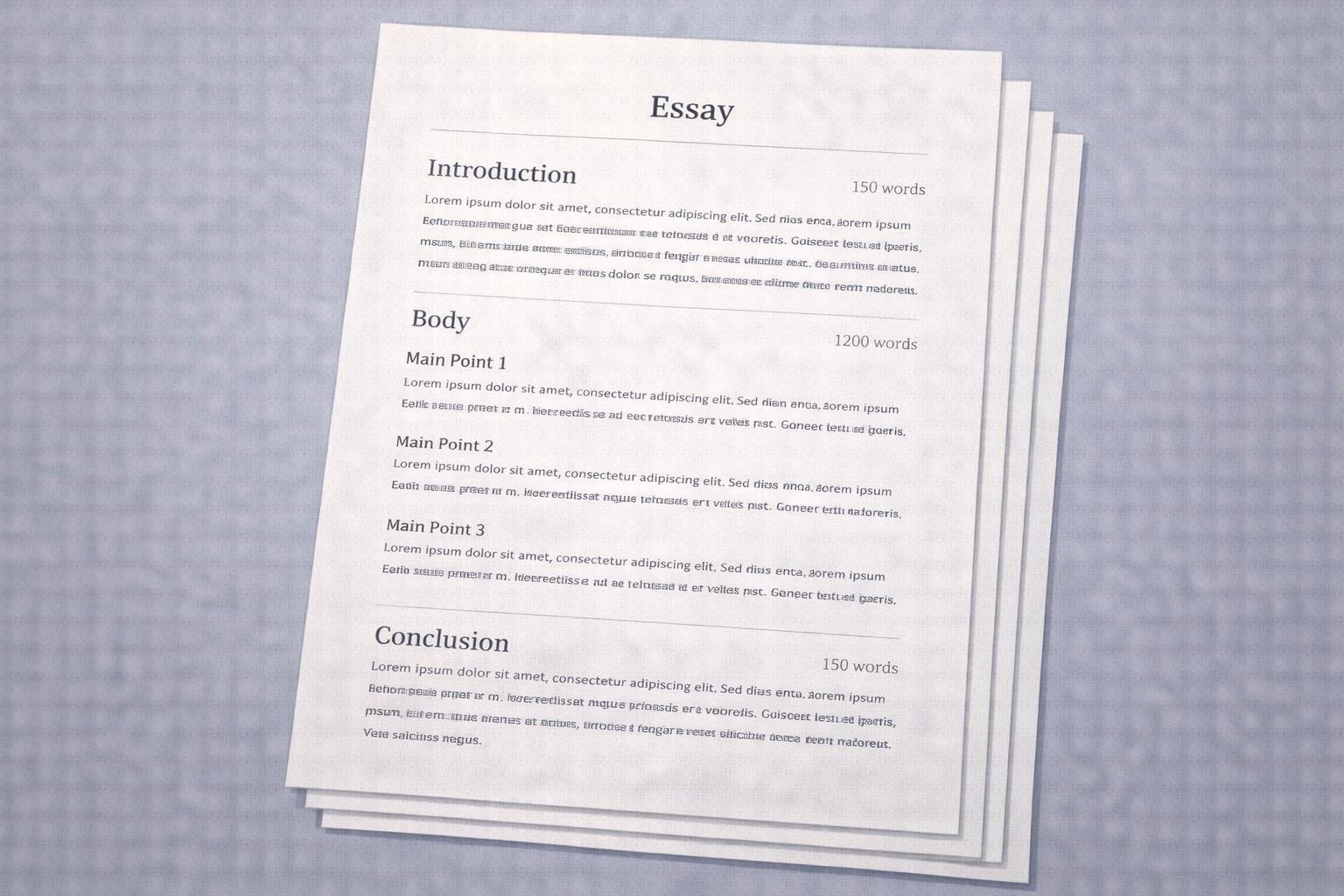
As a rough planning guide, academic essays often allocate:
- 10% of words to the introduction
- 70–80% to the main analytical body
- 10% to the conclusion
This proportional approach helps maintain balance and prevents overextended introductions or rushed conclusions.
Discipline-Specific Essay Length Variations
Different academic disciplines interpret essay length differently. Humanities essays often prioritise sustained textual analysis, while scientific or technical essays may rely on concision supported by data.
For instance, a 2,000-word literature essay may involve extensive quotation and interpretation, whereas a business essay of the same length may allocate more words to models, case studies, and evaluation.
Students should always consider disciplinary conventions alongside word limits.
Common Mistakes Students Make with Essay Length
Many students attempt to “write to the word count” rather than plan intellectually appropriate content. This often results in padded writing or superficial expansion.
Equally problematic is excessive concision, where complex ideas are compressed beyond clarity to stay under the limit.
- Adding filler sentences to increase word count
- Repeating points using different wording
- Removing necessary explanation to cut words
Both approaches undermine academic quality.
How Markers Interpret Essay Length
Markers do not assess essays mechanically by counting words alone. Length is interpreted alongside clarity, coherence, and relevance.
An essay slightly under the limit can still score highly if it demonstrates strong argumentation. However, consistently missing length expectations often correlates with limited critical depth.
Essay length is therefore a signal, not a sole determinant of quality.
Planning an Essay to Meet Length Requirements
Effective essay planning begins with breaking the word limit into manageable sections. This prevents disproportionate focus on one part of the argument.
Creating a paragraph plan with approximate word allocations encourages discipline and clarity during drafting.
Planning to exceed the word count slightly and editing down is often more effective than trying to expand a finished draft.
Editing for Length Without Losing Quality
Editing is where essay length is refined. Cutting words should focus on redundancy, not substance.
Common editing strategies include tightening topic sentences, removing duplicated explanations, and replacing verbose phrases with precise language.
Effective editing improves clarity while bringing the essay within the required range.
Essay Length and Academic Integrity
Manipulating formatting to artificially meet length requirements—such as altering spacing or font size—violates academic standards.
Universities treat such practices as academic misconduct because they misrepresent compliance.
Examiner warning: Formatting manipulation can trigger penalties even if the content is strong.
Using Essay Length as a Writing Tool
When understood properly, essay length becomes a planning ally rather than a constraint.
Word limits help writers prioritise arguments, maintain focus, and demonstrate academic discipline.
Students who internalise length expectations write with greater confidence and control.
Meeting Essay Length with Confidence
Essay length is not about hitting an exact number but about demonstrating appropriate depth within defined boundaries.
By understanding how word limits function, what they signal to examiners, and how to plan around them, students can approach academic writing with clarity rather than anxiety.
A well-structured essay that respects length guidelines communicates academic maturity, precision, and critical awareness.


Comments