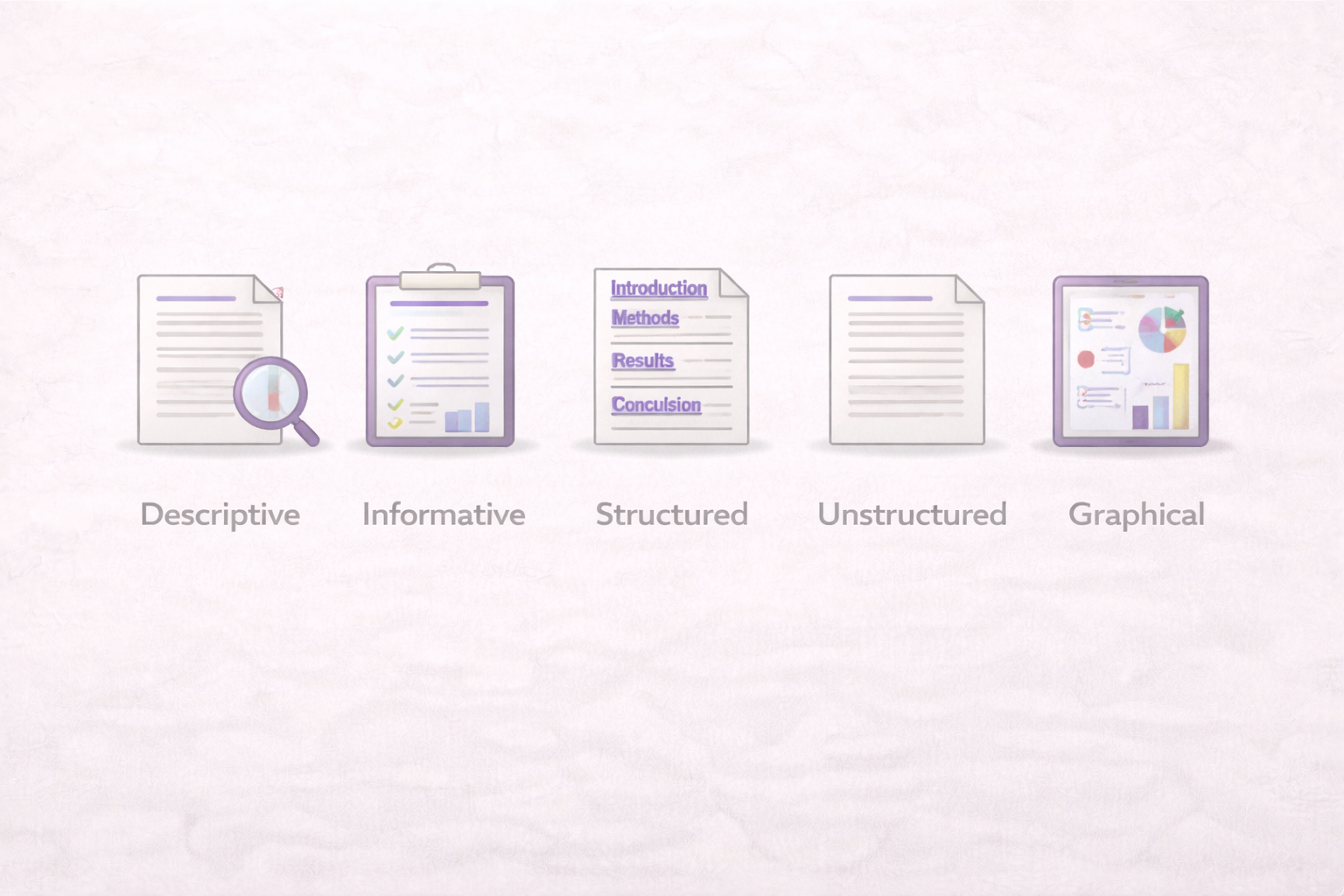
Understanding the types of abstracts is one of the simplest ways to improve academic clarity, credibility, and assessment outcomes. In most university and journal contexts, the abstract is not read as a “nice summary.” It is evaluated as a compact demonstration of your research focus, scholarly control, and ability to communicate a contribution efficiently. Students often lose marks because they use the wrong abstract type for the assignment, omit required elements, or write an abstract that does not match what the paper actually does.
This guide explains the main types of abstracts shown in the image—descriptive, informative, structured, unstructured, and graphical—using academically grounded explanations and assignment-relevant examples. Where helpful, it links to specific Epic Essay resources that strengthen closely related skills such as framing your research focus, differentiating methods from methodology, and formatting supplementary sections in long reports.

Why “abstract type” is an academic decision, not a formatting choice
Abstract conventions exist because academic readers make decisions under constraints: limited time, database indexing, and disciplinary expectations. In assessment, an abstract is often judged against criteria such as relevance to the question, coherence of argument, and methodological clarity. A well-chosen abstract type helps the reader anticipate the logic of the paper and locate essential information quickly, which directly affects perceived quality and marker confidence. This is why many journals and faculties standardise abstract formats for particular study designs.
What typically goes wrong is predictable. Students treat the abstract as an introduction, a “hook,” or a paragraph of background, then discover that their abstract contains no aims, no method, no finding, and no conclusion. Others write a strong abstract but then produce a paper that does not deliver what the abstract promises, which creates an integrity problem. If you are still refining core structure before writing an abstract, consult Essay Structure Explained for University Students to ensure your paper can be summarised accurately.
Examiners do not reward “interesting abstracts.” They reward accurate abstracts that match the research purpose, method, and contribution.
Descriptive abstracts: when the purpose is orientation, not results
A descriptive abstract is common in humanities, theoretical papers, reflective research essays, and some longer reports where the main aim is to explain scope and analytical direction rather than present empirical findings. Academically, it functions like a map: it tells the reader what the paper covers, the central focus, and how the discussion is organised. Because it often excludes results and conclusions, it must be extremely precise about topic boundaries and argument direction to avoid sounding vague or generic.
The main assessment risk is that descriptive abstracts can become empty if they rely on broad claims such as “this paper explores” without specifying what is actually analysed and how. In a literature-based assignment, a strong descriptive abstract signals the conceptual lens and the organising themes rather than listing sources. If you struggle to identify your research gap or contribution early, the logic used in How to Write an Essay Introduction can help you state focus and direction more concretely.
Informative abstracts: the standard for empirical research and most dissertations
An informative abstract is the dominant academic convention in empirical disciplines because it provides a mini-version of the whole paper: background, aim, methods, key results, and a conclusion or implication. In assessment terms, it demonstrates whether your research design is coherent and whether your findings answer the question. This is why informative abstracts are frequently required for dissertations, research proposals that include preliminary results, and research papers in social sciences, health, and STEM fields.
What commonly goes wrong is that students write an informative abstract before their analysis is settled, then forget to revise it. The abstract ends up claiming findings the paper does not support or describing a method that was never actually applied. A practical safeguard is to draft a “working abstract” early, then rewrite the final abstract after the discussion and conclusion are complete. For students working on longer research projects, Dissertations & Research Papers explains structured academic workflows that reduce these coherence failures.
Structured abstracts: why many fields require headings
A structured abstract is an informative abstract organised under labeled headings such as Background, Objective, Methods, Results, and Conclusion. Its academic purpose is readability and indexing: readers can locate essential elements instantly, and databases can process content more consistently. Many medical and health science journals, for example, expect structured formats because they reduce ambiguity and discourage overclaiming. The National Library of Medicine describes structured abstracts as abstracts with distinct, labeled sections to support rapid comprehension and standardised display in databases.
The most common student error is using headings but failing to meet the intellectual requirements of each one. “Methods” becomes a list of tools, not a defensible strategy; “Results” becomes a claim without evidence; “Conclusion” becomes a moral statement not grounded in the findings. If you are unsure what belongs in “methodology” versus “methods” when writing your abstract, read Difference Between Research Methods and Research Methodology Explained for Students and align your abstract language with that distinction.
| Abstract type | Primary academic purpose | What it typically includes (in full phrases) | Best fit contexts |
|---|---|---|---|
| Descriptive abstract | Orient the reader to scope, focus, and direction without presenting findings | Topic boundary, central focus, conceptual lens, section direction, and what the paper argues or examines | Humanities essays, theoretical papers, interpretive literature-based assignments |
| Informative abstract | Provide a mini-version of the full research paper for evaluation and indexing | Background, aim, method, key results, and a grounded conclusion or implication | Empirical research papers, dissertations, applied research reports |
| Structured abstract | Standardise comprehension by using headings that force clarity and completeness | Labeled components such as Background, Objective, Methods, Results, and Conclusion | Health sciences, psychology, clinical or experimental designs, journal submissions |
| Unstructured abstract | Summarise the study in one coherent narrative paragraph without headings | Core elements of the study expressed as a single integrated paragraph | Social sciences and humanities journals that prefer narrative flow |
| Graphical abstract | Provide a visual summary to improve discoverability and quick screening | A single visual that shows the research question, approach, and main outcome at a glance | Journals that request visual abstracts; online dissemination and interdisciplinary audiences |
Table 1 should make the key academic point clear: abstract types reflect disciplinary reading practices. If your department specifies a format, treat it as a marking instruction rather than a style preference.
Unstructured abstracts: how to write one paragraph without losing academic precision
An unstructured abstract is typically written as one coherent paragraph without subheadings, but it still contains the essential research elements. Academically, its challenge is integration: you must include aim, approach, and contribution while maintaining narrative flow. This type is common in social sciences and humanities journals, where argumentation is sometimes communicated through a more continuous rhetorical style. However, the absence of headings does not reduce expectations for clarity or completeness.
What typically goes wrong is “background inflation,” where half the abstract becomes contextual commentary and the actual study disappears. A reliable fix is to allocate sentence functions: one sentence for the problem, one for the aim, one for the method or analytical approach, one to two for results or central claims, and one for implications. If your paper is not yet disciplined enough to be summarised in one paragraph, revisit your thesis and roadmap practices using How to Start an Essay Effectively, then return to the abstract once the structure is stable.
Graphical abstracts: what they are and what they are not
A graphical abstract is a single visual designed to summarise the research in a concise pictorial form, often displayed in search results and journal contents lists rather than inside the PDF article. Publishers such as Elsevier note that journals increasingly request graphical abstracts because they support quick comprehension and improve discoverability for online audiences. In academic terms, the graphical abstract does not replace the written abstract; it complements it by making the “research story” scannable.
The common student mistake is treating a graphical abstract like a decorative infographic. Academic graphical abstracts are judged by informational integrity: does the visual accurately represent the research question, the methodological approach, and the main finding without exaggeration? If the graphical abstract suggests causal effects your study did not test, or presents a “result” that is actually an interpretation, it creates the same credibility problem as an inaccurate written abstract. Students producing research reports with extensive supplementary material should also ensure that figures, tables, and appendices are referenced correctly; Report With Appendices: Formatting Rules for Academic Submissions is useful when your work includes supporting documentation beyond the main text.
How to choose the correct abstract type for an assignment or journal
Choosing the correct abstract type begins with reading the brief like a marker. If your module handbook specifies headings (for example, Background–Methods–Results–Conclusion), you are being told to write a structured abstract. If the brief emphasises empirical reporting, informative formats are safer because they demonstrate method and findings. If the task is interpretive, conceptual, or literature-led, a descriptive or unstructured abstract may fit better—provided it still communicates a clear argument and analytical direction.
A second academic criterion is the genre of your paper. Research proposals may require an abstract that foregrounds the question, rationale, and method more than results, because results do not yet exist. Dissertations generally require informative or structured abstracts because examiners need to see design coherence and contribution quickly. For proposal-focused workflows and research planning support, Proposals & Coursework clarifies how research planning stages map onto formal academic deliverables.
What examiners look for in any abstract, regardless of type
Across disciplines, the abstract is assessed as a compact test of academic control. Examiners look for alignment between the abstract and the paper, because misalignment signals weak planning or superficial revision. They also look for conceptual specificity: terms such as “impact,” “explores,” or “discusses” are acceptable only if you specify what is being analysed and what claim is being advanced. In higher-mark bands, abstracts show disciplined scope, accurate reporting of methods, and a defensible statement of contribution.
The most frequent reason abstracts underperform is that students write them last-minute and treat them as a summary rather than a scholarly argument snapshot. A stronger approach is to treat the abstract as a “verification paragraph”: if you cannot state the question, approach, and contribution clearly in the abstract, the paper itself usually needs structural refinement. If you want a clear model for synthesising rather than repeating content, How to Write a Conclusion Paragraph for University Essays reinforces the same discipline of synthesis that high-quality abstracts require.
| Academic quality check | Why it matters for marking and credibility | What to do if it fails |
|---|---|---|
| The abstract matches the paper’s actual question, method, and claim | Misalignment suggests weak planning and undermines trust in the research narrative | Rewrite the abstract after finalising the discussion and conclusion, not before |
| The abstract includes the required elements for its type | Missing results in an informative abstract, or missing focus in a descriptive one, reduces academic completeness | Use a sentence-function plan (problem, aim, method, result/claim, implication) and revise for completeness |
| The abstract uses specific academic language rather than vague placeholders | Specificity demonstrates conceptual control and improves readability for examiners | Replace “explores” with what is analysed, how it is analysed, and what is concluded |
| The abstract avoids overclaiming and stays proportional to evidence | Overclaiming is treated as poor scholarship and may trigger critical examiner scrutiny | Report what you found, then interpret carefully; separate findings from implications |
Table 2 should be used as your final abstract revision tool. If you can satisfy every row, your abstract is unlikely to be flagged for vagueness, mismatch, or weak academic positioning.
Types of abstracts in practice: a brief, assignment-relevant example
Consider a student writing a small empirical study on how study-time tracking affects first-year student performance. A descriptive abstract would state the topic, scope, and analytical direction, but would not present results. An informative abstract would include the study aim, method (for example, a survey plus grade analysis), key findings (such as a measured association), and a cautious implication. A structured abstract would present these same elements under headings, ensuring the method and results are visible at a glance. If the paper is interpretive—such as analysing policy discourse—an unstructured abstract may be preferable, but it still needs a clear claim and a clear analytical approach.
This is why abstract type is not cosmetic: it governs what the reader is entitled to expect. If you are developing research questions that aim for publication-readiness and stronger academic contribution, What Makes a Research Question Publishable? Key Criteria Explained can help you sharpen the “so what” element that strong abstracts communicate efficiently.
Writing strong abstracts that meet university standards
The core message is simple: the best abstract is the one that matches the academic genre, disciplinary norms, and assignment instructions while remaining faithful to what the paper actually does. Descriptive abstracts prioritise scope and direction; informative abstracts prioritise complete mini-reporting; structured abstracts prioritise standardised clarity; unstructured abstracts prioritise integrated narrative coherence; graphical abstracts prioritise visual discoverability without distorting the research. When students understand these types of abstracts as academic conventions rather than formatting options, their abstracts become more accurate, more credible, and more assessment-aligned.
If you are working on a high-stakes research paper and want support that strengthens structure, coherence, and academic presentation rather than replacing your learning, explore Essays & Assignments for structured writing support or Dissertations & Research Papers for research-focused projects. The strongest abstracts come from well-designed papers, and well-designed papers come from disciplined planning, accurate methods, and careful synthesis.

Comments