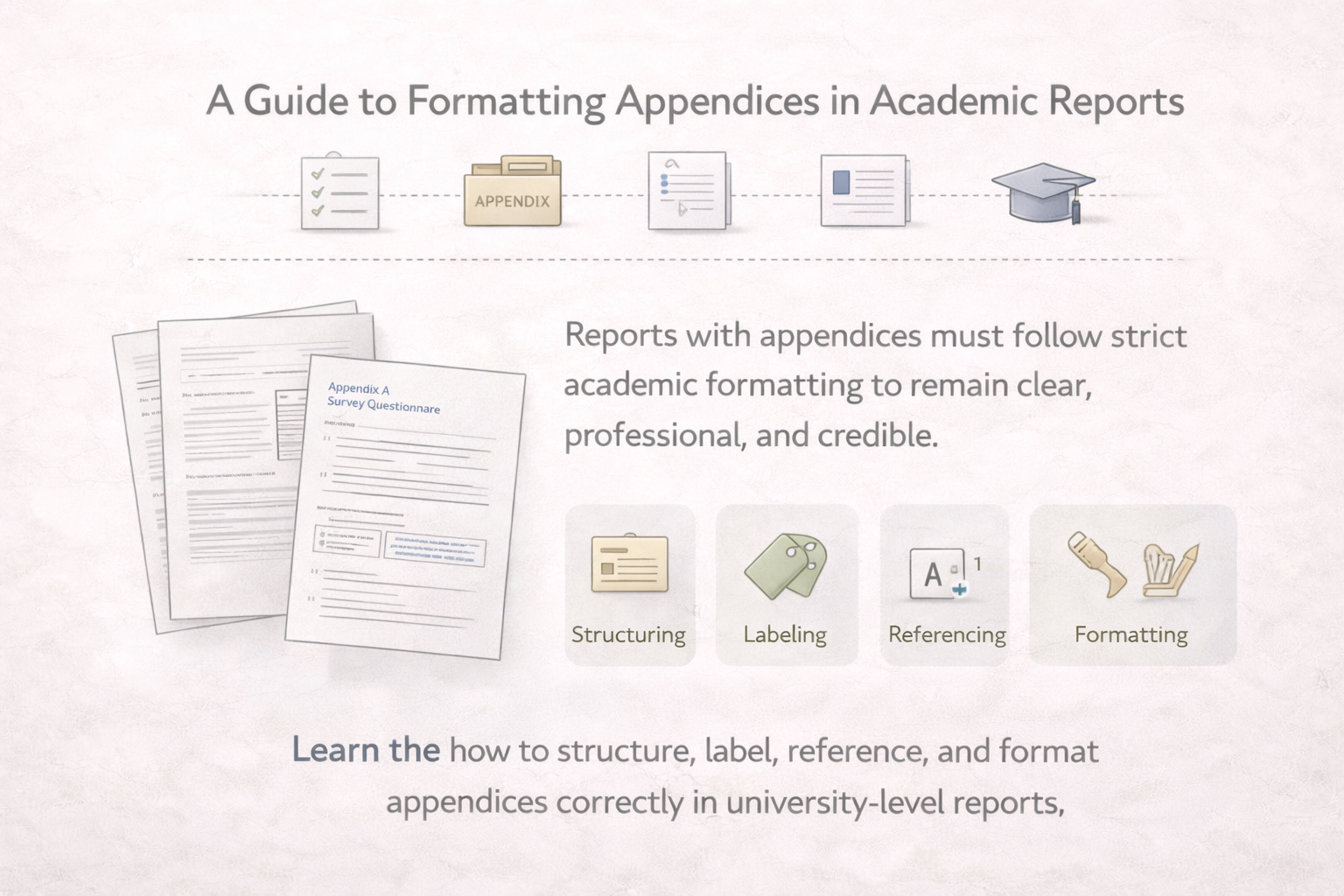
Academic reports often rely on evidence that is too detailed or extensive to be included directly in the main body of the text. Data tables, technical calculations, instruments, or supporting documentation are necessary for transparency, yet they can overwhelm the core discussion if placed incorrectly. Appendices solve this problem by allowing writers to separate essential analysis from supporting material.
Despite their routine use in higher education, appendices are frequently misunderstood. Students often struggle with where appendices belong, how they should be formatted, and how examiners expect them to be referenced. Poorly formatted appendices can reduce clarity and, in some cases, result in lost marks.
This article explains the formatting rules for reports with appendices, focusing on academic best practice rather than discipline-specific variations. It is designed to help university students present appendices confidently, consistently, and in line with examiner expectations.
What appendices are in academic reports
An appendix is a supplementary section placed after the main report and reference list. Its function is to store material that supports the report but is not essential to the reader’s immediate understanding of the argument or findings.
Appendices are commonly used in laboratory reports, business reports, research projects, and technical assignments. They allow writers to demonstrate methodological rigour while keeping the report concise and readable.
An appendix supports the report but must never replace explanation or analysis in the main text.
What content belongs in report appendices
Only specific types of material are appropriate for appendices. Content must be directly relevant to the report and clearly linked to sections in the main body. Appendices should never be used to hide weak analysis or bypass word limits.
Common appendix materials include the following:
- Raw data tables or extended datasets
- Survey instruments or interview questions
- Technical calculations or formulas
- Policy documents or regulatory extracts
- Supplementary charts or diagrams
Every appendix item must be referenced explicitly in the report text.
Where appendices appear in a report
Appendices are always placed at the end of a report. The correct order is the main body of the report, followed by the reference list, and then the appendices. Appendices should never interrupt the flow of the main discussion.
If a report contains multiple appendices, each one begins on a new page. This separation improves readability and ensures that examiners can locate information quickly.
Appendices come after the reference list, not before it.
How to label appendices correctly
Appendices are labelled alphabetically using capital letters. The first appendix is Appendix A, followed by Appendix B, Appendix C, and so on. Each appendix must include a clear and descriptive title.
The title should explain what the appendix contains without ambiguity. Vague titles reduce academic clarity and make referencing more difficult.
| Clear Labelling | Unclear Labelling |
|---|---|
| Appendix A: Customer Survey Questionnaire | Appendix A |
| Appendix B: Regression Output Tables | Extra Data |
Clear labelling improves examiner comprehension and demonstrates attention to academic detail.
Referencing appendices within the report
Appendices must always be referenced in the main text. Readers should know exactly when and why they might consult an appendix. Unreferenced appendices are often ignored and may be viewed as irrelevant.
References to appendices are typically brief and functional. For example, a report may direct the reader to Appendix A for a full questionnaire or to Appendix C for detailed calculations.
If an appendix is never mentioned in the report, it should not be included.
Formatting tables and figures inside appendices
Tables and figures within appendices must still follow academic formatting standards. They should be clearly labelled, numbered, and titled. Numbering usually restarts within each appendix.
For example, tables in Appendix A may be labelled Table A1, Table A2, and so on. This system prevents confusion between tables in the main body and those in appendices.
| Location | Correct Numbering Example |
|---|---|
| Main Report | Table 3 |
| Appendix A | Table A1 |
Consistent numbering reinforces structural clarity and academic professionalism.
Common formatting mistakes in reports with appendices
Many appendix-related errors are avoidable and stem from misunderstanding the academic purpose rather than the technical difficulty. These mistakes can negatively affect clarity and assessment outcomes.
- Placing appendices before the reference list
- Including analysis or discussion in appendices
- Using appendices to exceed word limits
- Failing to label or reference appendices properly
If the report cannot be understood without reading the appendix, the appendix has been misused.
Discipline-specific variations to be aware of
While general appendix rules apply across disciplines, some fields impose additional requirements. Engineering, psychology, and business departments may specify unique formatting or content expectations.
Students should always consult departmental guidelines or assignment briefs. When in doubt, prioritising clarity, consistency, and relevance is the safest academic approach.
Final checks before submitting a report with appendices
A final review helps ensure that appendices enhance rather than weaken a report. Writers should confirm that formatting rules have been applied consistently throughout the document.
- Are all appendices labelled and titled clearly?
- Is each appendix referenced in the main text?
- Does the report remain understandable without the appendices?
- Are tables and figures formatted consistently?
Completing these checks signals academic maturity and attention to detail.
Using appendices to strengthen academic reports
Appendices are not optional extras but strategic academic tools. When formatted correctly, they demonstrate rigour, transparency, and respect for scholarly conventions.
By following established formatting rules, students can ensure that appendices support their reports effectively while preserving clarity and coherence. Well-managed appendices reflect disciplined academic writing and contribute positively to assessment outcomes.
For further academic writing guidance and structured support, consult the resources available at Epic Essay academic writing support.



Comments