Formulating a strong research question is one of the most critical steps in academic research. Regardless of discipline, examiners, supervisors, and journal reviewers evaluate a study first and foremost by the quality of the question it seeks to answer. A poorly framed question leads to weak methodology, unclear findings, and limited scholarly value.
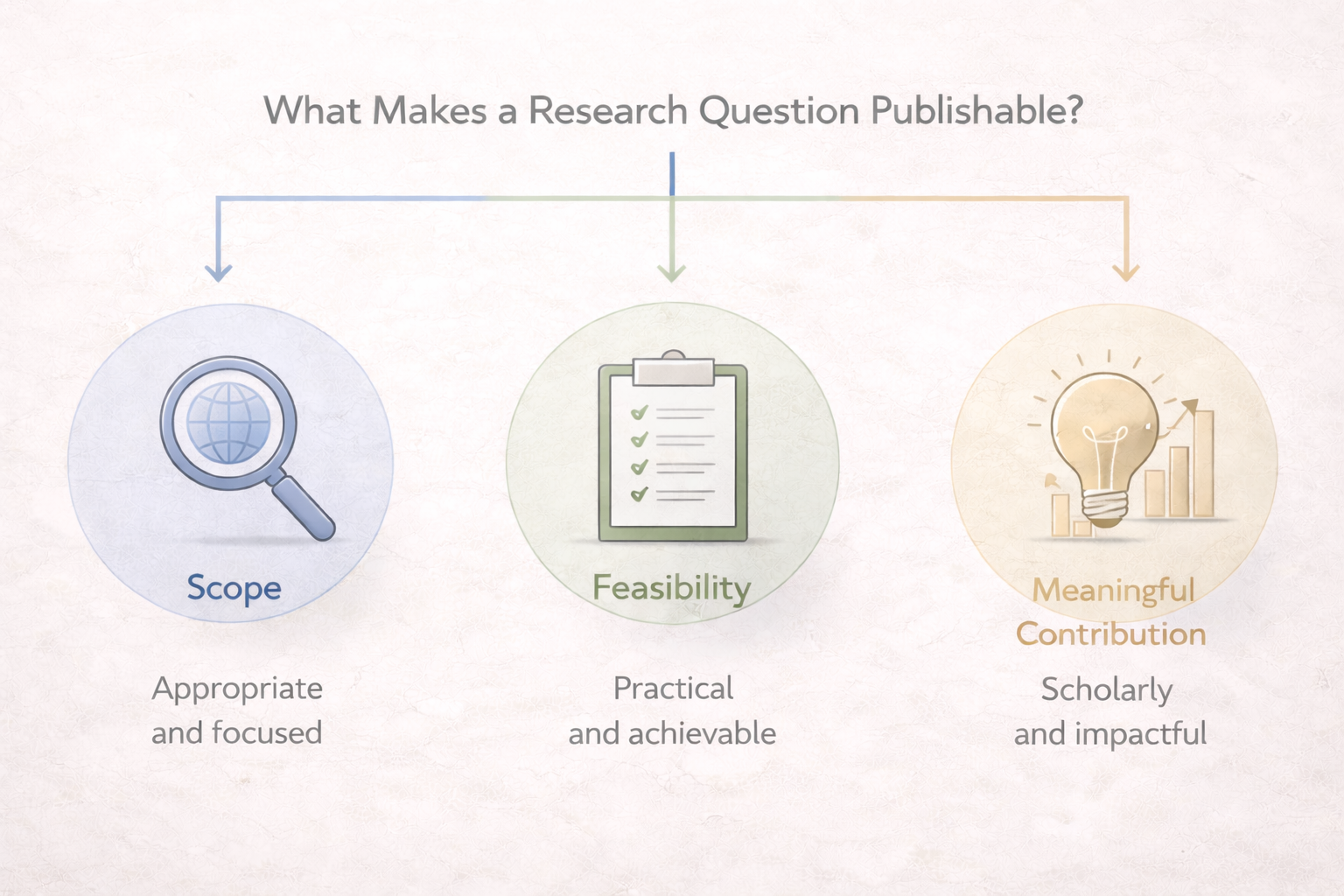
The image provided highlights the foundational elements that make a research question publishable. These elements are not arbitrary; they reflect long-established academic standards used across undergraduate projects, postgraduate theses, and peer-reviewed journal submissions.
This article explains each of those elements in detail, showing how they work together to produce research that is methodologically sound, practically feasible, and academically meaningful.

Why Research Questions Determine Publication Quality
A research question defines the scope, direction, and intellectual contribution of a study. It determines what data are collected, which methods are appropriate, and how results are interpreted. In academic publishing, reviewers often reject manuscripts not because of poor writing, but because the research question lacks focus or significance.
Strong research questions demonstrate intellectual discipline. They show that the researcher understands the literature, identifies a specific problem, and proposes a manageable way to investigate it. This clarity is essential for producing credible and publishable research.
Strong publications begin with well-framed research questions.
Without a clear research question, even technically correct analysis fails to achieve academic impact.
Clear and Focused Scope as a Foundation
A publishable research question must have a clearly defined scope. This means the question is specific rather than broad, and focused rather than exploratory without direction. Overly ambitious questions often collapse under their own complexity, making it difficult to design appropriate methods or reach meaningful conclusions.
Clarity of scope allows the researcher to define key variables, delimit the population or context, and avoid unnecessary digressions. It also signals to examiners and reviewers that the study is intellectually controlled and methodologically realistic.
| Broad Question | Focused, Publishable Question |
|---|---|
| How does technology affect education? | How does mobile learning influence study habits among first-year university students? |
| What causes climate change? | How do urban transport policies affect carbon emissions in major European cities? |
A focused scope makes it possible to design rigorous methods and draw defensible conclusions.
Feasible Data and Appropriate Methods
Feasibility is a central requirement for publishable research. A strong question must be answerable using realistic data sources and valid methodologies within the constraints of time, access, and resources. Questions that rely on unavailable data or impractical methods are rarely accepted in academic contexts.
Feasibility also involves methodological alignment. The research question should naturally suggest appropriate qualitative, quantitative, or mixed methods. When there is a mismatch between the question and the method, reviewers quickly identify conceptual weaknesses.
A good research question is not only interesting; it is answerable.
Students often lose marks by proposing questions that are theoretically appealing but operationally impossible.
Meaningful Contribution to Knowledge
A publishable research question must contribute meaningfully to existing knowledge. This does not require revolutionary discoveries, but it does require engagement with the literature and identification of a genuine gap, limitation, or unresolved issue.
Meaningful contribution can take several forms. It may refine existing theories, test them in new contexts, apply known concepts to emerging problems, or generate evidence that informs practice or policy.
- Addressing an under-researched population or context
- Re-examining established theories with new data
- Responding to recent social, technological, or policy changes
Research questions that merely repeat what is already known rarely progress to publication.
Aligning Research Questions With Academic Standards
Academic research operates within shared standards of rigour and relevance. A strong research question aligns with these standards by being precise, justified by literature, and framed in scholarly language. Ambiguous wording or casual phrasing weakens perceived credibility.
Clear alignment also involves ethical and disciplinary considerations. Questions must respect ethical boundaries and conform to disciplinary norms regarding evidence, analysis, and interpretation.
| Weak Question | Strong Question |
|---|---|
| Vague and general | Specific and well defined |
| Difficult to measure | Operationally clear |
| No clear contribution | Addresses a literature gap |
These distinctions are central to examiner and reviewer evaluation.
Common Student Errors in Framing Research Questions
Many students struggle not because they lack ideas, but because they fail to translate those ideas into structured research questions. Common mistakes include combining multiple questions into one, using unclear terminology, or proposing aims that exceed available resources.
Another frequent issue is confusing research topics with research questions. A topic identifies an area of interest, whereas a research question defines a specific problem within that area.
A topic describes an area of study; a research question defines a problem to be investigated.
Understanding this distinction significantly improves academic performance.
From Research Question to Strong Publication
A well-framed research question acts as a blueprint for the entire research process. It guides literature review, informs methodology, structures analysis, and shapes conclusions. For this reason, experienced researchers often refine their research questions repeatedly before finalising a study.
By ensuring clarity, feasibility, and meaningful contribution, students and researchers increase their chances of producing work that meets academic standards and achieves publication or high assessment grades.
Developing Research Questions With Confidence
Developing a publishable research question is a skill that improves with practice and critical reflection. Engaging deeply with the literature, seeking feedback, and testing feasibility early all contribute to stronger outcomes.
When researchers invest time in refining their questions, they lay the foundation for rigorous, impactful, and credible academic work.
Comments