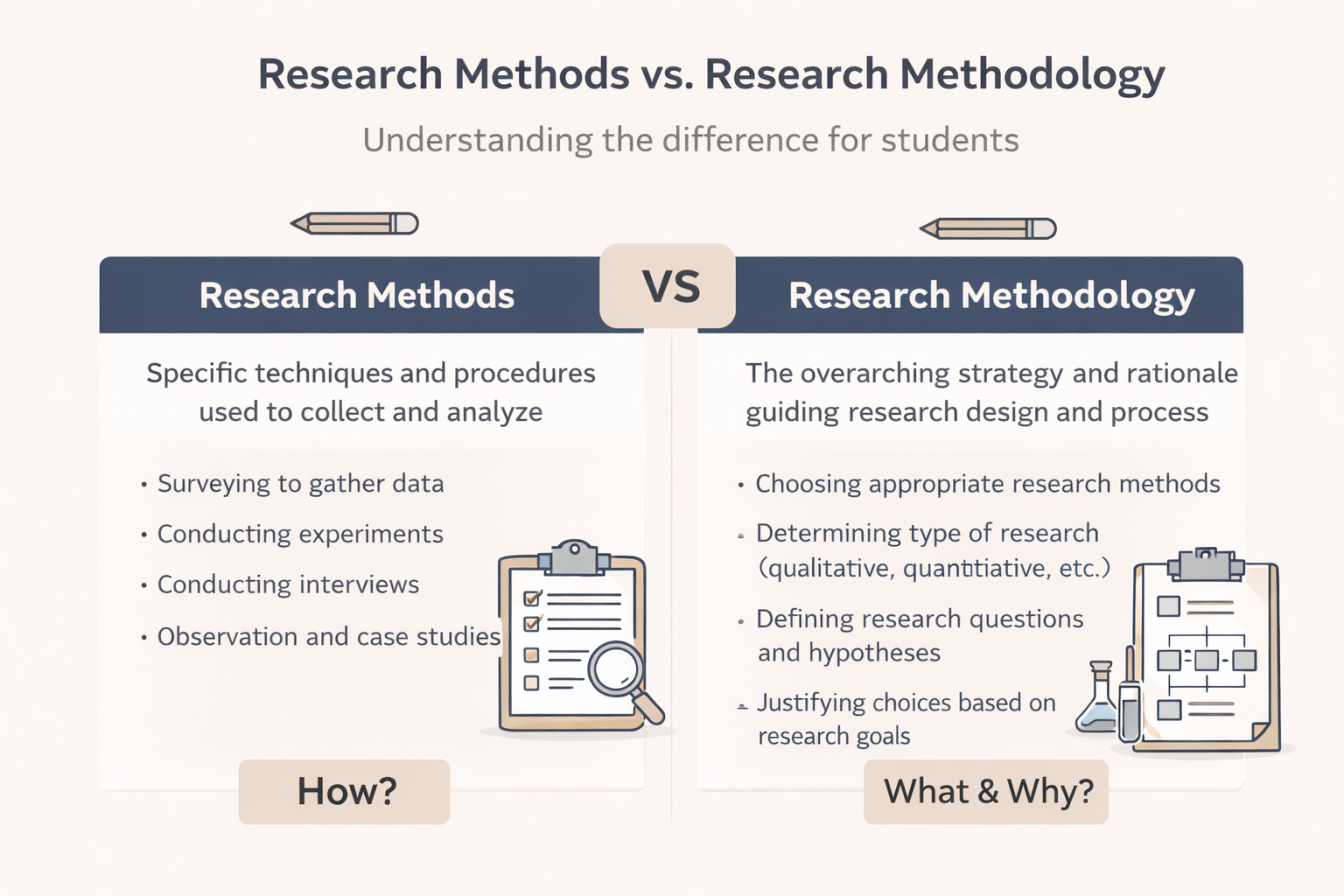
One of the most common sources of confusion in academic research is the difference between research methods and research methodology. Although the terms are often used interchangeably by beginners, they refer to distinct aspects of the research process and serve different academic purposes.
The image provided presents a structured comparison between research methods and research methodology, highlighting their meanings, scope, focus, and practical application. Understanding this distinction is essential for writing strong research proposals, theses, dissertations, and journal articles.
This article explains the difference in depth, translating the visual comparison into clear academic language and practical guidance for university and postgraduate students.

Why Students Confuse Research Methods and Research Methodology
The confusion between research methods and research methodology arises because both concepts are closely connected within the same research project. Students often encounter these terms simultaneously when writing proposals or methodology chapters, which leads to the assumption that they mean the same thing.
In reality, research methods focus on what the researcher does to collect data, while research methodology explains why those methods are chosen and how they fit into the overall research design. Examiners and supervisors expect students to demonstrate awareness of this distinction.
Research methods answer “how data is collected,” while research methodology answers “why a particular approach is chosen.”
Failing to separate these ideas often results in poorly structured methodology sections and loss of academic marks.
What Are Research Methods?
Research methods refer to the specific tools, techniques, or procedures used to collect data during a study. They are practical, hands-on activities that directly generate empirical evidence. In other words, research methods represent the operational side of research.
Methods are chosen based on the research question, available resources, and the type of data required. They focus on execution rather than justification, describing what the researcher does during the data collection stage.
Characteristics of Research Methods
Research methods are concrete and action-oriented. They involve measurable steps that can be replicated or evaluated by others. Because of this, they are often described briefly and precisely in academic writing.
- Focused on data collection
- Practical and procedural
- Limited to specific techniques
- Used during the research process
Examples include surveys, interviews, laboratory experiments, observations, and questionnaires.
What Is Research Methodology?
Research methodology refers to the overall strategy, logic, and philosophical foundation of a research study. It explains why particular research methods are appropriate and how they align with the research objectives, theoretical framework, and epistemological assumptions.
Unlike methods, methodology is concerned with planning rather than execution. It justifies research choices and demonstrates that the study is systematic, coherent, and academically sound.
Research methodology provides the reasoning that makes research choices credible and defensible.
In academic assessment, methodology sections are often evaluated more critically than methods because they reflect the researcher’s conceptual understanding.
Characteristics of Research Methodology
Research methodology is broader in scope and more abstract than research methods. It situates the study within a logical framework and explains how knowledge is generated.
- Focused on research design and logic
- Theoretical and planning-based
- Covers the entire research process
- Established before data collection begins
Methodology often includes discussions of qualitative versus quantitative approaches, sampling logic, and analytical strategies.
Core Differences Between Research Methods and Research Methodology
The distinction between research methods and research methodology becomes clearer when examined across multiple academic dimensions. The table below translates the visual comparison from the image into structured academic form.
| Aspect | Research Methods | Research Methodology |
|---|---|---|
| Meaning | Tools or techniques used to collect data | Overall plan and logic of the research |
| Purpose | To obtain data and results | To justify why specific methods are suitable |
| Focus | Doing the research work | Planning the research work |
| Nature | Practical and hands-on | Logical and conceptual |
| Scope | Limited to techniques | Covers the entire research process |
This distinction is critical when structuring academic chapters, particularly in theses and dissertations.
Main Questions Addressed by Each Concept
Another way to understand the difference is by examining the core questions each concept answers. Research methods and methodology address fundamentally different academic concerns.
| Concept | Main Question Answered |
|---|---|
| Research Methods | How is data collected? |
| Research Methodology | Why is this method chosen? |
Examiners expect students to address both questions explicitly in well-written research papers.
Examples to Clarify the Difference
Concrete examples help clarify how research methods and methodology operate together in practice. Consider a study examining the effect of solar pumps on farmers.
The research methods might include surveys and interviews conducted with farmers to collect data. These methods describe what is done to gather evidence.
The research methodology would explain why surveys are appropriate, why interviews complement them, and why this combination suits the research context better than experimental designs.
Methods describe actions; methodology explains reasoning.
Both elements are necessary for academic credibility.
When Research Methods and Methodology Are Used
Research methodology is typically developed before data collection begins. It shapes the research design and determines which methods are suitable. Research methods, by contrast, are applied during the data collection stage.
This sequence explains why methodology sections often appear before methods sections in academic writing. The methodology sets the intellectual foundation upon which methods are built.
Who Should Understand This Distinction
The distinction between research methods and research methodology is relevant to learners at all academic levels. Undergraduate students encounter it in project work, postgraduate students in theses, and doctoral candidates in proposal defenses.
Clear understanding of these concepts improves research design, strengthens academic writing, and increases the likelihood of approval by supervisors and examiners.
Developing Strong Research Through Conceptual Clarity
Strong research depends not only on collecting data but on justifying how and why that data is collected. Understanding the difference between research methods and research methodology allows researchers to communicate their work with clarity and precision.
By applying these distinctions consistently, students can produce research that is systematic, defensible, and aligned with academic expectations.
Comments