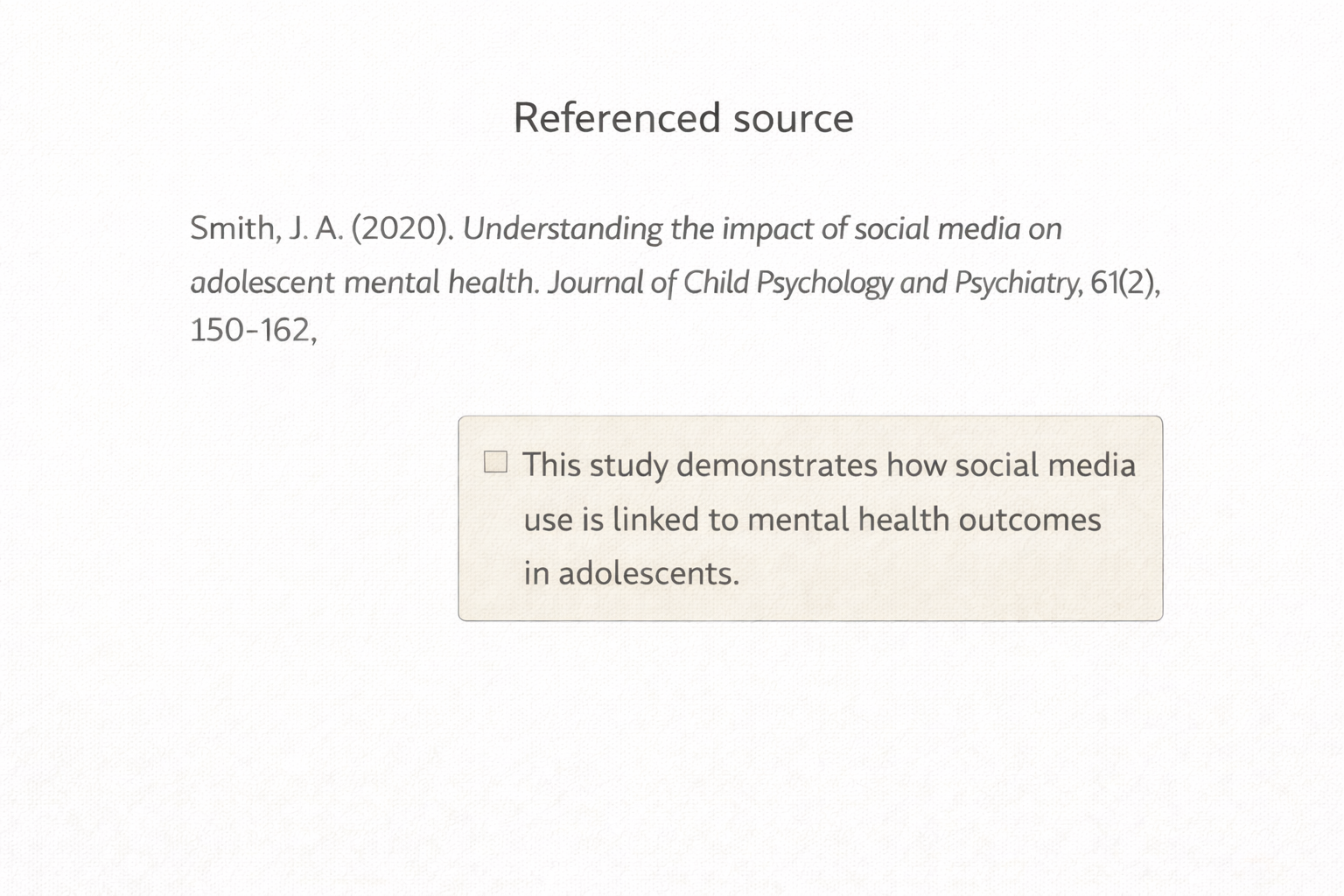
An annotated bibliography is a foundational academic task that often causes confusion for university students. Although it appears similar to a reference list, it serves a very different purpose. Instead of merely listing sources, an annotated bibliography requires students to describe, evaluate, and reflect on the relevance of each source to a specific research topic.
Students frequently lose marks because they misunderstand what an annotation should include or how analytical it should be. Common issues include writing summaries that are too short, omitting evaluation, or failing to link sources to the research question. These problems usually stem from a lack of clear examples and guidance.
This article explains annotated bibliography requirements in detail and provides structured annotated bibliography examples. It clarifies what examiners expect, how annotations should be written, and how this task supports stronger research writing.
What an Annotated Bibliography Is in Academic Writing
An annotated bibliography is a list of academic sources, each followed by a brief explanatory paragraph called an annotation. The annotation typically summarises the source, evaluates its quality, and explains its relevance to a research topic.
Unlike a reference list, which is purely descriptive, an annotated bibliography demonstrates engagement with sources. It shows that the student has read, understood, and critically assessed the literature.
An annotated bibliography demonstrates how sources contribute to a research project, not just where they were found.
This distinction is central to understanding why annotations are assessed separately from referencing accuracy.
Why Universities Use Annotated Bibliographies
Annotated bibliographies are used to assess research skills early in the academic writing process. They allow instructors to evaluate source selection, reading comprehension, and critical thinking before a full essay or dissertation is written.
For students, the task functions as a research planning tool. Writing annotations helps clarify which sources are most useful and how they relate to each other.
Because of this dual purpose, both content and analytical depth matter.
Typical Components of an Annotation
Although requirements vary by discipline, most annotated bibliographies expect three core elements: summary, evaluation, and relevance.
The summary briefly explains the source’s main argument or findings. The evaluation assesses credibility, strengths, or limitations. The relevance explains how the source supports the student’s research focus.
Balanced annotations address all three components clearly and concisely.
How an Annotated Bibliography Differs from a Literature Review
An annotated bibliography presents sources individually, whereas a literature review synthesises sources thematically. The two tasks serve different academic purposes.
Annotations are source-focused and self-contained. Literature reviews integrate sources into a unified analytical narrative.
Understanding this distinction prevents students from writing overly synthesised annotations or overly descriptive literature reviews.
Structure of a High-Quality Annotated Bibliography Entry
Each annotated bibliography entry begins with a correctly formatted reference, followed by the annotation itself. Formatting style depends on the required citation system, but annotation content remains broadly consistent.
The annotation is written in paragraph form and usually ranges from 100 to 200 words, depending on assignment instructions.
Clear structure improves readability and academic clarity.
Annotated Bibliography Example (Illustrative)
The example below demonstrates a complete annotation combining summary, evaluation, and relevance. This example is illustrative and uses generic placeholder referencing to focus on annotation quality.
Illustrative annotated bibliography example:
Smith, J. (2021). Student engagement in online learning environments. Academic Journal of Education, 15(2), 45–62.
This article examines factors influencing student engagement in online higher education through a mixed-methods study involving surveys and interviews. Smith argues that instructor presence and structured interaction significantly improve engagement levels. The study’s strength lies in its combination of quantitative data with qualitative insights, although the sample is limited to one institution, which may affect generalisability. This source is relevant to the current research because it provides empirical evidence supporting the importance of instructional design in online learning, directly informing the study’s theoretical framework.
This annotation goes beyond summary by evaluating methodology and explaining relevance.
Types of Annotated Bibliographies
Annotated bibliographies can be descriptive, evaluative, or reflective, depending on academic level and discipline.
Descriptive annotations focus mainly on summarising content. Evaluative annotations assess credibility and usefulness. Reflective annotations include the student’s learning process or evolving understanding.
Most university assignments expect evaluative annotations.
Descriptive vs Evaluative Annotations
The table below compares descriptive and evaluative annotations to clarify expectations.
| Feature | Descriptive Annotation | Evaluative Annotation |
|---|---|---|
| Main focus | Summary of content | Summary plus critical assessment |
| Critical judgement | Minimal | Explicit and developed |
| Typical level | Introductory undergraduate | Upper undergraduate and postgraduate |
| Research relevance | Implicit | Clearly explained |
Understanding this distinction helps students match annotation depth to assessment criteria.
How Long an Annotation Should Be
Annotation length varies by assignment but is typically specified in the brief. Common ranges include 100–150 words or 150–200 words per source.
Writing significantly shorter annotations often indicates superficial engagement. Overly long annotations may suggest a lack of focus.
Students should aim for precision rather than volume.
Academic Tone and Style in Annotations
Annotations should be written in a formal academic tone. Informal language, personal opinions without justification, and unsupported claims weaken credibility.
While first-person language may be allowed in reflective annotations, evaluative annotations typically remain objective and analytical.
Consistency in tone supports academic professionalism.
Common Mistakes in Annotated Bibliography Writing
One common mistake is writing annotations that simply repeat abstracts. This demonstrates minimal engagement and is often penalised.
Another frequent error is failing to explain relevance. Even strong summaries lose marks if the source’s role in the research is unclear.
An annotation without evaluation is incomplete.
Awareness of these pitfalls helps improve annotation quality.
Using Annotated Bibliographies to Strengthen Research Projects
An annotated bibliography is not an isolated task. It often forms the foundation of a literature review or research proposal.
Well-written annotations make it easier to identify key themes, methodological patterns, and gaps in the literature.
This preparation reduces repetition and improves coherence in later writing stages.
Discipline-Specific Expectations
Different disciplines emphasise different aspects of annotation. In social sciences, methodological evaluation is often central. In humanities, theoretical contribution may receive greater attention.
Health and applied sciences may prioritise study design and evidence quality.
Students should always align annotations with disciplinary norms.
Referencing Accuracy in Annotated Bibliographies
Correct referencing remains essential. Errors in citation style can undermine otherwise strong annotations.
Students should follow the required referencing system consistently across all entries.
Accuracy signals attention to detail and academic integrity.
Ordering Sources in an Annotated Bibliography
Most annotated bibliographies are ordered alphabetically by author surname, following standard referencing conventions.
Some assignments may require thematic or chronological ordering, but this must be explicitly stated.
Students should not assume flexibility without confirmation.
Using Annotations to Demonstrate Critical Thinking
Critical thinking in annotations appears through evaluation, comparison, and relevance explanation.
Students demonstrate insight by commenting on limitations, methodological choices, or theoretical implications.
This analytical layer distinguishes high-scoring work.
Planning an Annotated Bibliography Efficiently
Effective annotated bibliographies are planned, not written source by source without strategy. Selecting high-quality, relevant sources is the first step.
Reading actively and taking analytical notes reduces rewriting and improves annotation coherence.
Time invested in preparation improves final quality.
Annotated Bibliographies and Academic Integrity
All ideas must be accurately attributed. Even though annotations summarise sources, paraphrasing without citation is unacceptable.
Annotations should reflect original understanding while acknowledging intellectual ownership.
Maintaining integrity protects academic credibility.
Applying Annotated Bibliography Skills with Confidence
Annotated bibliographies are more than referencing exercises. They are assessments of research literacy, critical thinking, and academic judgement.
By combining accurate summary, thoughtful evaluation, and clear relevance, students can produce annotations that meet and exceed university expectations.
Mastering annotated bibliography writing strengthens research skills that carry forward into literature reviews, dissertations, and independent academic work.


Comments