In academic writing, clarity and focus are essential. University essays, reports, and dissertations are assessed primarily on the strength of their argument, analysis, and use of evidence. However, many assignments also require the inclusion of additional material that supports the work but does not belong in the main body. This is where the appendix becomes academically significant.
An appendix in academic writing serves a specific and limited purpose. It allows students to present supplementary information that enhances transparency and credibility without interrupting the logical flow of the discussion. When used correctly, an appendix strengthens an academic submission; when used incorrectly, it can confuse readers or signal poor academic judgement.
This article explains what an appendix is, when it should be used, how it should be structured, and how examiners typically interpret appendix material in university-level assessment.
What Is an Appendix in Academic Writing?
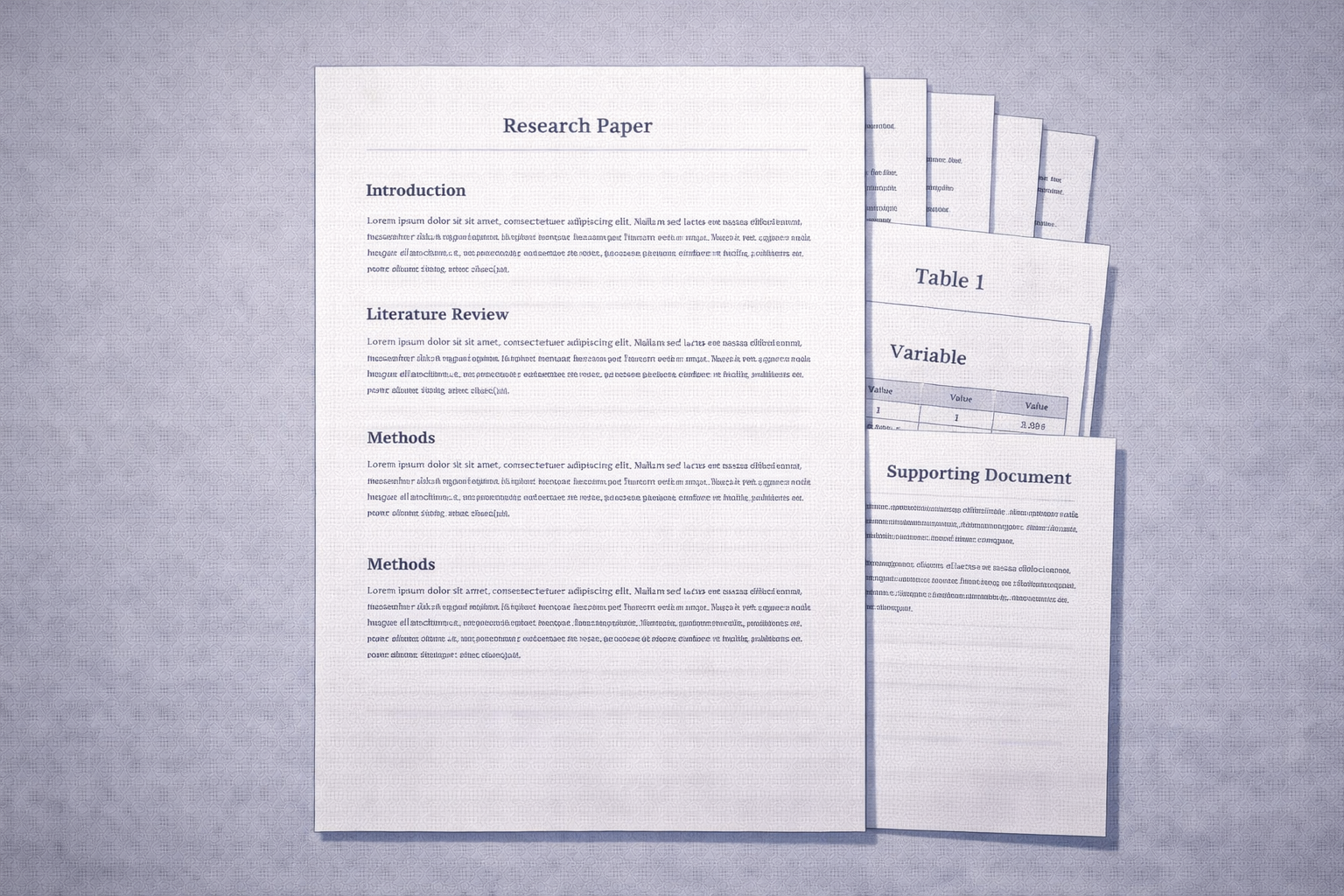
An appendix is a section placed after the main body of an academic paper that contains supplementary material referenced in the text but not essential to read line-by-line to understand the argument.
The key principle is relevance without intrusion. Appendix material should support the claims made in the essay or report, but it should not carry the core argument itself.
In academic writing, appendices are commonly used in research-based assignments, technical reports, dissertations, and empirical essays.
Academic rule: An appendix may support an argument, but it must never replace analysis that belongs in the main body.
Why Appendices Are Used in University Assignments
The primary reason for using an appendix in academic writing is to preserve coherence. Long tables, raw data, questionnaires, or extended documents can overwhelm the reader if placed directly in the essay.
Appendices allow examiners to verify methods, data, or processes without forcing them to navigate unnecessary detail while reading the argument.
From an assessment perspective, a well-used appendix demonstrates methodological transparency and academic discipline.
What Belongs in an Appendix (and What Does Not)
One of the most common student errors is misunderstanding what is appropriate appendix material. Not everything that feels “extra” qualifies for inclusion.
Appendices should contain material that is relevant, referenced, and clearly connected to the discussion.
They should never be used as a storage space for unfinished ideas or poorly integrated content.
Common Types of Appendix Material
The following types of material are typically appropriate for an appendix in academic writing.
- Survey questionnaires or interview schedules
- Raw or supplementary data tables
- Extended statistical outputs
- Ethical approval documents
- Technical specifications or formulas
- Supporting case documents
Each item included must be explicitly referenced in the main text.
What Should Never Be Placed in an Appendix
Students often misuse appendices to bypass word-count limits or avoid integrating analysis properly.
The following should not appear in an appendix.
- Core arguments or conclusions
- Unreferenced background reading
- Draft paragraphs or notes
- Content the marker is expected to assess directly
If the material is essential for understanding the argument, it belongs in the main body.
How to Reference an Appendix Correctly in the Main Text
An appendix in academic writing has no value unless it is clearly signposted in the main text. Examiners do not search appendices independently.
Every appendix item must be referenced at the point where it becomes relevant to the discussion.
This referencing should be concise and functional.
Example of Proper Appendix Referencing
A correct reference might read: “The full survey instrument is provided in Appendix A.”
This tells the reader why the appendix exists and where to find it.
Vague references such as “see appendix” should be avoided.
Structuring an Appendix in Academic Writing
Appendices follow formal structural conventions. These conventions are consistent across most universities, although minor variations may exist.
Each appendix should be clearly labelled, logically ordered, and easy to navigate.
Poorly structured appendices undermine academic professionalism.
Labelling and Numbering Appendices
Appendices are usually labelled alphabetically (Appendix A, Appendix B, etc.), though numbering may be used in some disciplines.
Each appendix should have a clear title that describes its contents.
If multiple appendices are used, consistency is essential.
Placement of Appendices
Appendices appear after the conclusion and reference list.
They should not interrupt the flow of the main text.
Each appendix typically begins on a new page.
Table: Appropriate Use of Appendices in Academic Writing
The table below clarifies how different types of material should be handled in academic assignments.
| Material Type | Main Text | Appendix |
|---|---|---|
| Core argument analysis | Yes | No |
| Survey questionnaire | No | Yes |
| Summary statistics | Yes | No |
| Full statistical output | No | Yes |
| Ethical approval letter | No | Yes |
This distinction is critical for maintaining academic integrity.
How Examiners Evaluate Appendix Material
One of the most misunderstood aspects of appendices is how they are marked.
In most cases, appendix content is not marked directly. Instead, it is used to verify claims made in the main text.
If an argument depends on appendix material that is not properly integrated, the main text will be penalised.
Examiner expectation: If it matters to the grade, it must appear in the main body, not only in the appendix.
Appendices and Word Count Regulations
Appendices are usually excluded from the word count, but this does not grant permission to relocate essential content.
Universities expect appendices to contain supplementary material only.
Attempting to bypass word limits through appendices can result in penalties.
Discipline-Specific Use of Appendices
The role of an appendix in academic writing varies by discipline.
In quantitative fields, appendices often contain data sets or statistical outputs. In qualitative research, they may include interview schedules or coding frameworks.
Humanities essays, by contrast, use appendices sparingly.
Academic Support for Structuring Appendices
Students often seek guidance when unsure whether material belongs in an appendix or the main body.
Structured academic writing support, such as essay writing assistance, helps students make these decisions early.
For extended research projects, dissertation support often includes guidance on appendix structure and placement.
Before submission, clarity and formatting can be refined through professional editing and proofreading.
Using Appendices with Academic Precision
An appendix in academic writing is a tool, not a shortcut. When used correctly, it enhances transparency, credibility, and professionalism.
Effective use of appendices reflects careful planning and respect for academic conventions.
Students who understand the purpose and limits of appendices demonstrate stronger academic judgement and produce clearer, more coherent work.

Comments