Across universities worldwide, examiners consistently identify weak or flawed thesis statements as a primary reason for low essay and research paper marks. Although students often invest significant effort in research and drafting, many struggle to articulate a precise, defensible central argument. Understanding common thesis statement mistakes is therefore essential for producing academically credible writing that meets university assessment criteria.
This article examines the most frequent errors students make when formulating thesis statements, explains why these mistakes weaken academic work, and demonstrates how each issue can be corrected. The discussion applies to essays, research papers, and dissertations across disciplines, offering practical guidance grounded in higher-education writing standards.
Why Thesis Statement Accuracy Matters in Academic Writing
A thesis statement functions as the intellectual backbone of an academic paper. It communicates the writer’s position, defines the scope of the argument, and guides both the reader and the writer through the structure of the discussion. When a thesis statement is unclear or flawed, the entire paper risks becoming descriptive, unfocused, or incoherent.
Examiners use the thesis statement to assess whether a student understands the assignment task and can engage critically with a topic. Even well-researched content may be marked down if the central claim is vague, contradictory, or unsupported. For this reason, thesis statement accuracy is not a stylistic preference but a core academic requirement.
A thesis statement must present a clear, specific, and arguable claim that the entire paper is designed to support.
Being Too Vague or Overly Broad
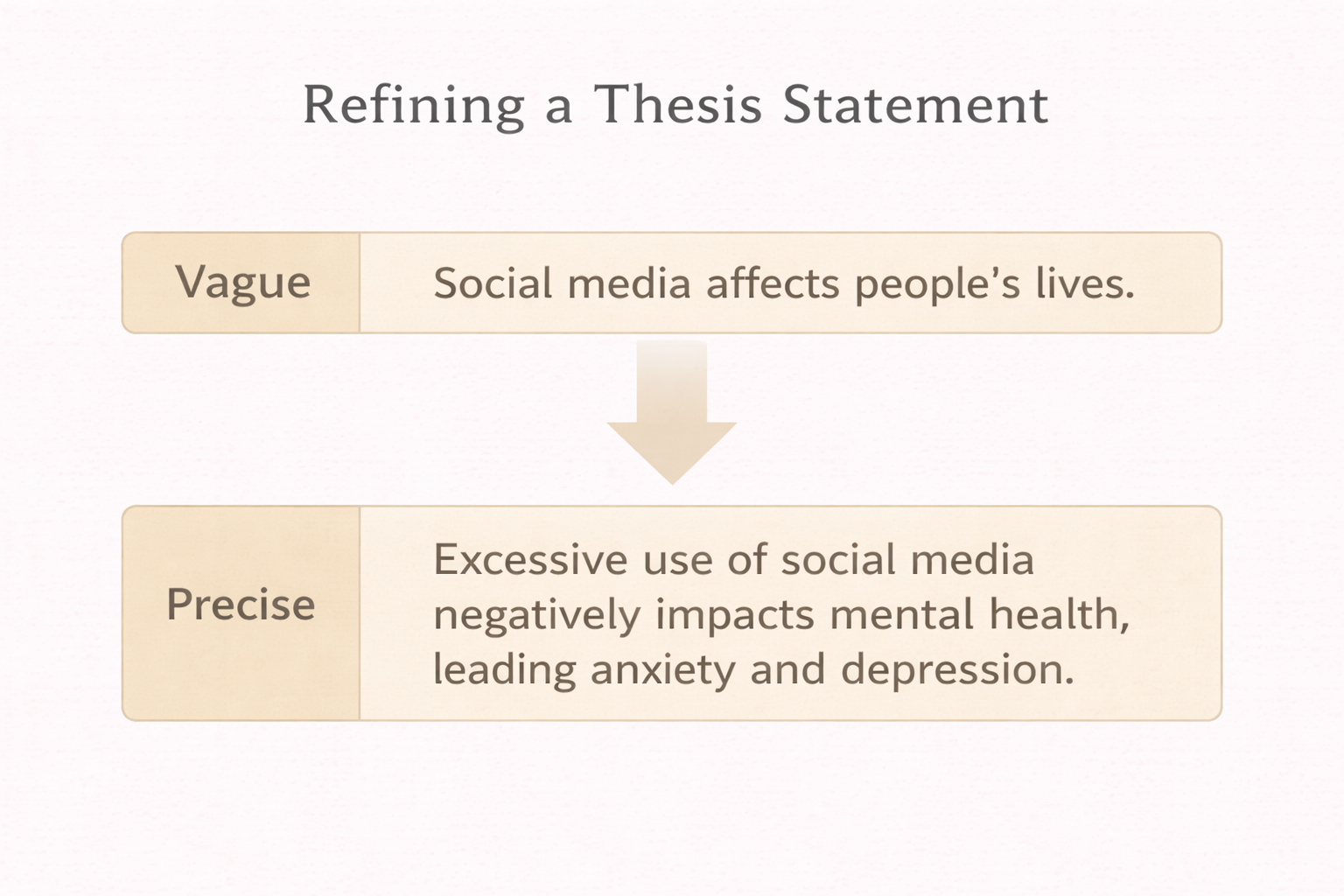
One of the most common thesis statement mistakes is excessive generality. Students often write statements that describe a topic rather than articulate a position. While such statements may introduce a subject area, they fail to establish an argument that can be developed through evidence and analysis.
Broad thesis statements also create structural problems. When the central claim lacks specificity, body paragraphs tend to drift into loosely related observations rather than focused analytical points. This results in essays that appear disorganised or superficial, even when relevant sources are cited.
How to Fix an Overly Broad Thesis
Refining a broad thesis requires narrowing the scope and clarifying the angle of analysis. A strong thesis identifies not only the topic but also the writer’s evaluative stance or analytical focus.
- Limit the discussion to a specific context, time period, or perspective.
- Replace general language with precise academic terminology.
- Ensure the claim can be reasonably supported within the word count.
By introducing clear boundaries, the thesis becomes manageable and analytically meaningful.
Presenting a Statement of Fact Instead of an Argument
Another frequent error occurs when students confuse factual statements with argumentative claims. A thesis statement that merely reports information leaves no room for critical engagement, which is central to university-level assessment.
Factual theses are particularly problematic in argumentative and analytical assignments. They prevent the writer from demonstrating independent reasoning, synthesis of sources, or evaluative judgment, all of which are essential for higher marks.
| Type | Example | Academic Limitation |
|---|---|---|
| Factual | Climate change affects global temperatures. | Cannot be debated or critically examined |
| Argumentative | Government inaction remains the primary driver of ineffective climate change mitigation. | Invites evidence-based analysis and debate |
The argumentative version establishes a position that requires justification, making it suitable for academic discussion.
Making the Thesis Too Complex or Overloaded
In an attempt to sound sophisticated, some students construct thesis statements that combine multiple arguments into a single sentence. While complexity is not inherently negative, excessive density often results in unclear or contradictory claims.
An overloaded thesis can confuse readers and make it difficult to structure body paragraphs logically. Examiners may interpret such statements as evidence of weak conceptual planning rather than advanced thinking.
Structuring a Focused Thesis Statement
An effective thesis typically expresses one central argument supported by clearly implied sub-points. These supporting ideas should emerge naturally in the body of the paper rather than being crammed into the thesis itself.
- Identify the single most important claim your paper will defend.
- Ensure supporting arguments logically flow from that claim.
- Reserve detailed explanations for topic sentences and analysis.
This approach promotes clarity and improves argumentative coherence.
Using Value Judgments Without Academic Justification
Another common thesis statement mistake involves unsupported value judgments. Statements that rely on subjective language such as “good,” “bad,” or “important” without academic framing weaken analytical credibility.
University-level writing requires that evaluative claims be grounded in theoretical frameworks, empirical evidence, or scholarly debate. Without this foundation, thesis statements appear opinion-based rather than academically defensible.
Avoid subjective language unless it is clearly anchored in scholarly criteria or evidence.
Misalignment Between Thesis and Body Paragraphs
Even when a thesis statement is well written, it may still fail if the body of the paper does not consistently support it. Misalignment often occurs when students revise their argument during drafting but neglect to update the thesis accordingly.
This disconnect creates logical gaps that examiners quickly identify. Paragraphs may appear relevant individually but fail to contribute meaningfully to the central argument, reducing overall coherence.
Ensuring Structural Alignment
Before submission, students should systematically compare each body paragraph against the thesis statement.
- Confirm that every paragraph advances the central claim.
- Revise the thesis if the argument evolves during writing.
- Remove or refocus content that does not serve the thesis.
This alignment process strengthens both clarity and academic rigor.
Placing the Thesis Incorrectly Within the Paper
Improper thesis placement is a subtle but impactful mistake. In most academic essays, the thesis should appear near the end of the introduction, after sufficient contextual framing has been provided.
When the thesis appears too early, readers may lack the necessary background to understand its significance. When it appears too late, the introduction may feel unfocused or incomplete.
Academic Expectations Across Essay Types
Thesis statement requirements vary slightly depending on the type of assignment. Analytical, argumentative, and research-based papers demand different levels of specificity and methodological framing.
| Assignment Type | Thesis Focus | Common Pitfall |
|---|---|---|
| Argumentative Essay | Clear position supported by reasoning | Overly descriptive claims |
| Research Paper | Evidence-driven analytical claim | Fact-based thesis |
| Dissertation | Original contribution to knowledge | Overly broad scope |
Understanding these distinctions helps students tailor their thesis statements appropriately.
Final Guidance on Avoiding Thesis Statement Errors
Most thesis statement mistakes stem from unclear thinking rather than weak language skills. By focusing on precision, argumentation, and alignment, students can dramatically improve the quality of their academic writing.
Effective thesis statements are concise, arguable, and strategically positioned. They evolve through drafting and revision, reflecting a deepening understanding of the topic rather than a fixed starting point.
When in doubt, students benefit from structured academic feedback, such as professional essay writing support, editing and proofreading services, or advanced guidance for long-form projects like dissertations. With careful attention and informed revision, thesis statement errors can be transformed into analytical strengths.


Comments