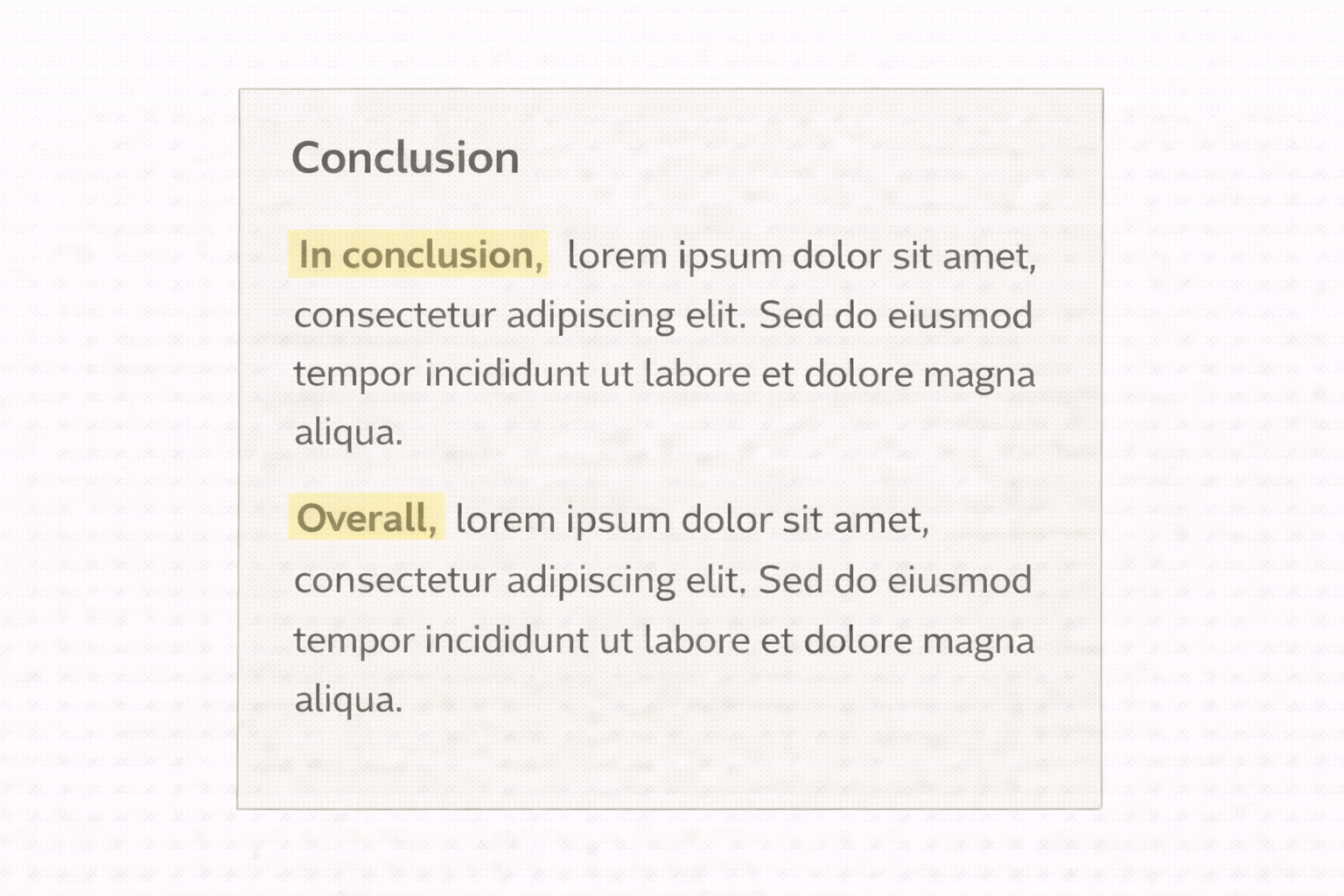
In academic writing, how an essay ends is almost as important as how it begins. Even when students develop strong arguments and well-structured body paragraphs, weak or awkward concluding sentences can leave examiners unconvinced. This is where conclusion sentence starters for academic essays play a valuable role.
Used correctly, sentence starters help writers transition smoothly into synthesis, reinforce argument control, and maintain an appropriately formal tone. This article explains when and how to use conclusion sentence starters, provides academically appropriate examples, and clarifies how examiners interpret essay endings at university level.
What Are Conclusion Sentence Starters in Academic Writing?
Conclusion sentence starters are phrases or clauses that signal to the reader that the essay is drawing to a close. They help frame synthesis, reflection, and final evaluation without sounding abrupt or informal.
In academic contexts, these starters are not fillers. Instead, they function as structural cues that guide the reader toward closure while maintaining analytical focus. When chosen carefully, they enhance coherence rather than weaken originality.
Conclusion sentence starters should guide synthesis, not replace critical thinking.
Why Conclusion Sentence Starters Matter at University Level
University marking criteria often assess clarity, coherence, and argument integration. These qualities are most visible in the conclusion, where students must demonstrate control over the entire essay.
Appropriate sentence starters help ensure the final paragraph sounds deliberate and academically confident rather than rushed or uncertain. They also reduce the risk of informal language, which examiners commonly penalise.
An effective conclusion sounds intentional, not improvised.
When to Use Conclusion Sentence Starters
Sentence starters are particularly useful at key moments in the conclusion. These include restating the thesis, synthesising main points, and highlighting significance.
They are not meant to appear before every sentence. Overuse can make writing mechanical. Instead, they should be used selectively to support flow and clarity.
Academic Tone and Word Choice in Conclusions
Academic conclusions require a formal, precise tone. Sentence starters must reflect this by avoiding conversational language or emotional emphasis.
Phrases such as “in my opinion” or “I believe” are usually discouraged unless the discipline explicitly allows first-person voice. Strong academic starters focus on argument, evidence, and implications.
Sentence Starters for Restating the Central Argument
The first function of many conclusions is to reaffirm the thesis in refined language. The goal is not repetition but reinforcement.
| Sentence Starter | Academic Purpose |
|---|---|
| Overall, this essay has demonstrated that… | Signals a comprehensive argument review |
| This analysis confirms that… | Emphasises evidence-based reasoning |
| The discussion above establishes that… | Links conclusion to prior analysis |
| Taken together, the findings suggest that… | Highlights synthesis of key points |
These starters allow students to restate claims with authority rather than repetition.
Sentence Starters for Synthesising Key Points
Synthesis is central to strong academic conclusions. It shows how individual arguments work together rather than standing alone.
Effective sentence starters help writers connect themes, patterns, or logical progression across the essay.
| Sentence Starter | Function |
|---|---|
| In synthesising these arguments… | Signals integrative thinking |
| Collectively, these points indicate that… | Reinforces coherence |
| When considered together… | Encourages holistic interpretation |
| The evidence presented throughout suggests… | Maintains analytical tone |
These phrases help conclusions sound structured and deliberate rather than summarised.
Sentence Starters for Highlighting Significance
High-scoring conclusions often explain why the argument matters. This may involve theoretical relevance, practical implications, or broader academic contribution.
Sentence starters that signal significance help students move beyond summary into evaluation.
- Therefore, this analysis contributes to an understanding of…
- The implications of this argument extend to…
- This discussion is significant because…
- These findings have important implications for…
Such phrases demonstrate awareness of academic purpose and disciplinary context.
Sentence Starters for Critical Reflection
In some disciplines, particularly humanities and social sciences, conclusions may include cautious reflection on limitations or future research.
Sentence starters allow this to be done without undermining the argument.
| Starter | Use Case |
|---|---|
| While this essay has focused on… | Acknowledges scope |
| Further research may build upon… | Suggests academic continuation |
| Nonetheless, the argument remains that… | Maintains confidence |
Reflection should enhance credibility, not introduce doubt.
Sentence Starters to Avoid in Academic Conclusions
Not all sentence starters are appropriate for university essays. Informal or vague phrases weaken academic tone.
Avoid conversational phrases that sound more like speech than scholarship.
- In conclusion, I think…
- To sum up everything…
- As you can see…
- At the end of the day…
Replacing these with discipline-appropriate alternatives improves clarity and professionalism.
How Many Sentence Starters Should a Conclusion Use?
Most academic conclusions require only one or two sentence starters. Overuse can make writing sound formulaic.
The goal is to support flow, not to rely on templates. Strong conclusions balance structure with original synthesis.
Revising Conclusions for Clarity and Precision
Effective revision involves checking whether sentence starters genuinely support meaning. Removing them temporarily can help test whether ideas stand independently.
Many students refine their conclusions further through academic editing and proofreading, ensuring tone, clarity, and structure align with university standards.
How Conclusion Sentence Starters Improve Essay Quality
Well-chosen sentence starters enhance coherence, signal confidence, and demonstrate academic awareness. They help examiners see the logic and significance of the argument clearly.
When combined with strong synthesis and disciplined language, they contribute to higher marks across structure, argumentation, and clarity criteria.
Using Conclusion Sentence Starters with Academic Confidence
Conclusion sentence starters for academic essays are tools, not shortcuts. When used selectively and strategically, they support clarity, synthesis, and academic tone.
By understanding their function and limitations, university students can end essays with authority, coherence, and a lasting academic impression.


Comments