Critical reflection is a core academic skill in many university disciplines, particularly in health sciences, education, social work, and professional practice programmes. Among the most widely used frameworks for structured reflection is Gibbs’ Reflective Cycle. While many students are familiar with the name of the model, far fewer understand how to apply it critically in assessed writing.
The phrase “critical reflection model Gibbs example” often signals a practical need: students are not only looking for an explanation of the model but also for guidance on how each stage should be written in an academic assignment. This article provides a structured, assignment-focused explanation of Gibbs’ Reflective Cycle and demonstrates how it can be used to produce a coherent, critical reflection that meets university marking criteria.
Understanding Gibbs’ Reflective Cycle in Academic Context
Gibbs’ Reflective Cycle was developed to help learners think systematically about experiences and transform them into learning. In academic settings, the model is valued because it provides a clear sequence that moves reflection beyond description towards evaluation, analysis, and action planning.
At university level, Gibbs’ model is not assessed as a checklist but as a thinking framework. Markers expect students to use the stages flexibly, showing depth of insight, critical engagement, and awareness of context rather than mechanically labelling each section.
Gibbs’ Reflective Cycle is a framework for critical thinking, not a template for storytelling.
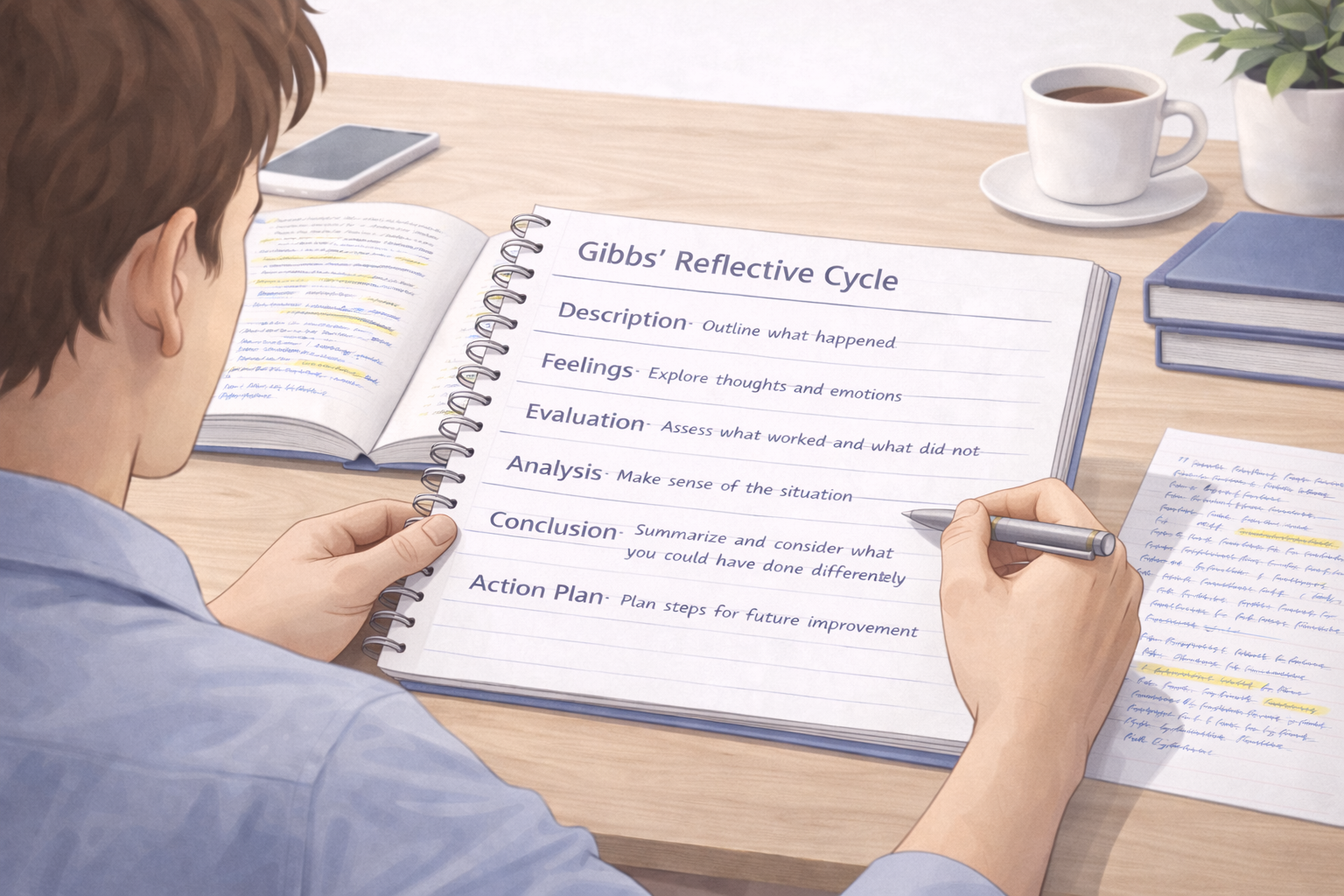
The Six Stages of Gibbs’ Reflective Cycle Explained
Gibbs’ model consists of six interconnected stages. Each stage contributes to a deeper level of reflection when applied critically and supported by academic reasoning.
Description: Establishing Context Without Excess Detail
The description stage outlines what happened, who was involved, and where the experience took place. In academic reflection, this section should be concise and factual, providing just enough context for the reader to understand the situation.
Over-describing events is a common mistake. University markers do not reward lengthy narratives; instead, they expect the description to serve as a foundation for later analysis. A strong description is neutral, focused, and directly relevant to the learning outcomes of the assignment.
Feelings: Acknowledging Perspective Without Becoming Personal
This stage explores the thoughts and emotions experienced during the event. In academic reflection, feelings should be acknowledged but not indulged. The purpose is to show awareness of how emotions influenced perception, behaviour, or decision-making.
Rather than simply stating emotions, students should interpret their significance. For example, feeling uncertain may indicate gaps in knowledge, while confidence may reveal prior learning or assumptions.
Evaluation: Judging What Worked and What Did Not
Evaluation requires students to assess the positive and negative aspects of the experience. This is where reflection begins to shift from personal response to critical judgement.
Effective evaluation considers multiple perspectives. Students should ask why certain elements were effective and why others were not, rather than making surface-level judgments.
Analysis: Connecting Experience to Theory
The analysis stage is the intellectual core of Gibbs’ Reflective Cycle. Here, students link experience to academic concepts, research, or professional standards. This stage demonstrates critical thinking and distinguishes high-quality reflection from descriptive accounts.
Analysis might involve applying theory to explain behaviour, using literature to interpret outcomes, or critiquing assumptions that shaped the experience. This is typically the most heavily weighted section in assessed reflection.
Conclusion: Articulating Learning
The conclusion stage summarises what has been learned from the experience. It focuses on insight rather than repetition, drawing together the key points identified through evaluation and analysis.
Academic conclusions in reflective writing should demonstrate growth in understanding, skills, or awareness, clearly showing how the experience has contributed to learning.
Action Plan: Planning for Future Practice
The final stage translates reflection into future action. Students outline what they would do differently if a similar situation arose again and how they plan to develop relevant skills or knowledge.
This stage reinforces the purpose of reflection as a tool for continuous improvement, which is central to professional and academic development.
Worked Critical Reflection Model Gibbs Example
The table below illustrates how each stage of Gibbs’ Reflective Cycle can be applied in a university-level reflective assignment. The example is intentionally generic so it can be adapted across disciplines.
| Stage | Focus | Example of Academic Application |
|---|---|---|
| Description | Context | Briefly outlines a group project presentation in a seminar setting |
| Feelings | Perspective | Recognises initial anxiety and how it affected participation |
| Evaluation | Judgement | Identifies strengths in collaboration and weaknesses in communication |
| Analysis | Theory | Links group dynamics to teamwork models and communication theory |
| Conclusion | Learning | Explains improved understanding of effective group roles |
| Action Plan | Future change | Plans strategies for clearer communication in future group work |
This example shows how Gibbs’ model supports structured, critical reflection when each stage is used purposefully.
Common Errors When Using Gibbs’ Reflective Model
One frequent mistake is treating Gibbs’ Cycle as a rigid structure with equal word counts for each stage. In reality, analysis and evaluation should dominate reflective writing, while description and feelings remain brief.
Another issue is failing to integrate academic sources in the analysis stage. Without theory or evidence, reflection remains personal rather than academic, which limits its value in university assessment.
Reflection that lacks analysis and theory is descriptive, not critical, and will be marked accordingly.
Adapting Gibbs’ Model to Different Assignments
Although Gibbs’ Reflective Cycle is widely used, its application should always align with the assignment brief. Some tasks may emphasise professional standards, while others focus on personal development or ethical reasoning.
Students should view Gibbs’ model as a flexible guide rather than a formula. When used thoughtfully, it supports deep reflection, academic coherence, and clear demonstration of learning.
Using Gibbs’ Reflective Cycle to Strengthen Academic Writing
When applied critically, Gibbs’ model helps students organise reflective essays, maintain focus, and demonstrate intellectual growth. Its structured progression mirrors the expectations of higher education, making it particularly effective for assessed reflection.
By understanding not just the stages but the purpose behind each one, students can move beyond surface reflection and produce work that is analytical, coherent, and academically persuasive.



Comments