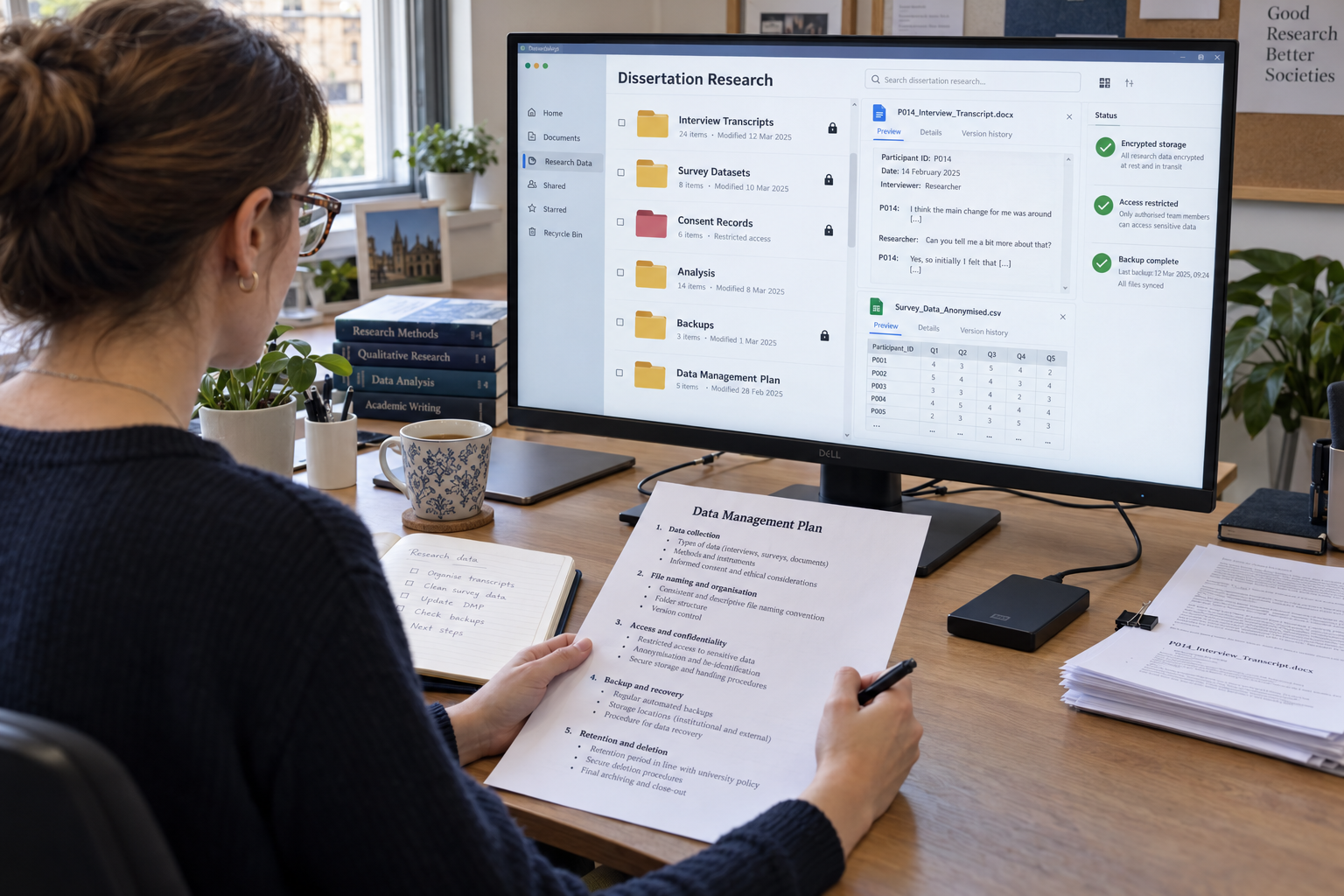
Dissertation research can produce far more data than students initially expect. Interview recordings become transcripts and coded files, questionnaires generate raw and cleaned datasets, experiments create measurements and analysis outputs, and secondary research may involve downloaded datasets, documentation, scripts, spreadsheets, and derived variables. Without a clear system for managing these materials, even a well-designed study can become difficult to organise, verify, protect, and analyse.
A data management plan for a dissertation provides that system. Often abbreviated as a DMP, it explains what research data will be created or obtained, how files will be organised and documented, where information will be stored, who can access it, how backups will be maintained, how confidential or personal information will be protected, and what will happen to the data after the project ends. The plan therefore connects practical research organisation with ethics, transparency, security, and research integrity.
Students sometimes assume that data management means writing a sentence such as "all data will be stored securely." A defensible plan requires considerably more precision. The appropriate arrangements depend on the type of data, sensitivity of the information, institutional rules, consent arrangements, analytical methods, and whether data can eventually be retained or shared. This guide explains each component and provides dissertation-focused examples that can be adapted to a university's own requirements.
What Is a Data Management Plan in Dissertation Research?
A data management plan is a structured description of how research data will be handled throughout the research lifecycle. The University of Oxford's guidance on data management plans describes a DMP as covering decisions about data, its management during active research, and longer-term questions such as preservation and sharing. Importantly, a plan can be revised as a project develops rather than being treated as a document written once and forgotten.
For a dissertation, the DMP translates broad principles into practical decisions. A student conducting interviews may need to manage consent records, audio files, transcripts, pseudonymisation information, coding files, and analytical notes. A quantitative researcher may instead manage questionnaire exports, raw datasets, cleaned datasets, syntax or scripts, statistical outputs, and variable documentation.
Data management is therefore closely connected to methodology. Epic Essay's guide to the dissertation methodology chapter emphasises that researchers should explain how data were collected, analysed, and protected. A DMP extends this transparency by documenting what happens to research information before, during, and after analysis.
A data management plan should answer a practical question: if someone asked how your research data move from collection to final analysis and eventual retention or disposal, could you explain every important stage clearly?
Why Does a Dissertation Need a Data Management Plan?
The first benefit of a DMP is practical organisation. Research projects evolve rapidly, and files can multiply after only a few weeks of data collection. Without consistent naming, version control, folder structures, and documentation, researchers can accidentally analyse the wrong spreadsheet, overwrite cleaned data, lose links between participant codes and transcripts, or become unable to reconstruct earlier analytical decisions.
The second reason is data protection. Research involving people may contain names, contact information, voices, demographic details, sensitive experiences, organisational information, or combinations of variables that make participants identifiable. Planning where such information will be stored and who can access it reduces avoidable confidentiality and security risks.
A third reason is research integrity. Good data management makes the path from raw evidence to reported results more transparent. If a student retains an untouched raw dataset alongside documented cleaning decisions and analysis files, it becomes easier to understand how the final results were produced. This is especially valuable when supervisors ask questions about data transformations or when analysis needs to be repeated.
Finally, universities, ethics committees, research groups, or funders may require formal data-management arrangements. Even where a separate DMP is not mandatory, planning these issues early can prevent conflicts between consent documents, ethics applications, data collection, and the final dissertation.
What Should a Dissertation Data Management Plan Include?
The exact structure varies across institutions and disciplines. The UK Research and Innovation guidance on data management plans emphasises that plans should be clear, concise, and proportionate to the scale and type of data. This principle is particularly useful for dissertations because a small student project does not need the infrastructure of a multinational research programme, but it still needs appropriate controls.
Most dissertation DMPs need to address several connected areas. The table below provides a practical structure that can be adapted to the university's required template.
| DMP Component | Main Question | Example Considerations |
|---|---|---|
| Data creation or acquisition | What data will the project use or generate? | Interviews, survey responses, experimental measurements, secondary datasets |
| File formats | In what formats will data exist? | Audio, text documents, CSV files, spreadsheets, statistical files |
| Organisation and documentation | How will files and variables remain understandable? | Folder structure, filenames, codebooks, metadata, data dictionaries |
| Storage | Where will working data be kept? | Approved university storage or other authorised systems |
| Backup | How will accidental loss be prevented? | Institutional backup arrangements or approved backup procedures |
| Security and access | Who can access different types of information? | Access restrictions, encryption where required, separation of identifiers |
| Ethics and confidentiality | How will participant information be protected? | Consent, pseudonymisation, de-identification, disclosure controls |
| Version control | How will raw and modified files be distinguished? | Separate raw, cleaned, analysis, and output files |
| Retention and disposal | What happens when the project ends? | Institutional retention periods and secure disposal procedures |
| Sharing and preservation | Can any data be preserved or reused? | Consent, repository requirements, licensing, confidentiality constraints |
These elements are connected. A decision to collect identifiable interview recordings affects storage, security, consent, access, retention, and possible sharing. A strong DMP therefore treats data management as an integrated research process rather than a collection of unrelated administrative statements.
Step 1: Identify Every Type of Research Data You Will Use
The first stage is to define what counts as data in the project. Students sometimes think only of the final spreadsheet or transcript, overlooking raw recordings, consent records, field notes, coding files, data-cleaning logs, statistical syntax, or derived variables. A complete inventory helps determine which files need different levels of protection.
For a qualitative dissertation, data could include digital interview recordings, verbatim transcripts, field notes, participant demographic information, coding frameworks, NVivo project files, and analytical memos. Some of these may contain direct identifiers while others may become pseudonymised during processing.
A quantitative project might generate survey exports, participant information, raw numerical data, cleaned datasets, derived variables, SPSS or R files, statistical syntax, charts, and output tables. Secondary-data research may generate fewer original observations but still create cleaned subsets, transformed variables, analytical code, and derived datasets.
Epic Essay's guide to dissertation research methods explains that research design determines how data are collected and analysed. Data management should therefore be designed around the actual methodological workflow rather than added after data collection begins.
Step 2: Choose Appropriate File Formats
File format affects how easily research data can be opened, analysed, preserved, and transferred. During active research, students may need specialised formats associated with software such as SPSS, NVivo, R, or other analytical applications. These formats can be entirely appropriate for working analysis.
However, longer-term preservation may sometimes benefit from widely supported or non-proprietary formats where conversion does not destroy important information. A spreadsheet might, for example, have an exportable tabular version, while textual documentation can be retained in accessible formats. The appropriate choice depends on the data and institutional requirements.
Researchers should also preserve important contextual information during conversion. Exporting a statistical dataset without its variable labels, value definitions, missing-value conventions, or transformation notes can make the file difficult to understand later. The format is only one part of usability; documentation is equally important.
The DMP does not need to list every possible extension unless the institution requests it. It should demonstrate that the researcher knows what formats will be generated and whether those formats remain suitable for analysis, backup, transfer, and any required preservation.
Step 3: Create a Logical Folder and File-Naming System
Consistent file organisation prevents many ordinary research errors. Filenames such as "data final.xlsx," "data final2.xlsx," and "data final REAL.xlsx" provide little information about which file contains raw data, cleaning changes, or final analysis. A naming convention should make important differences visible.
A quantitative project might distinguish files using names such as raw survey export, cleaned dataset, analysis dataset, and final output. Dates or version numbers can be included where useful, but the system should remain consistent. The researcher should never need to open six similarly named files simply to discover which one was used for the dissertation results.
Folder structure can separate raw data from working copies, analysis, outputs, documentation, and administrative records. Identifiable information may require a separate protected location rather than being stored beside de-identified analytical files. The exact structure should reflect institutional security requirements.
Never overwrite your only copy of raw research data while cleaning or transforming it. Preserve an appropriate original version and conduct cleaning or transformation on controlled working copies so that analytical changes remain traceable.
Step 4: Document the Data So It Remains Understandable
A dataset can be technically intact yet practically unusable if nobody remembers what its variables, codes, abbreviations, or transformations mean. Documentation preserves the context necessary to interpret data correctly. For student research, this can be relatively simple while still being systematic.
A quantitative researcher may create a data dictionary describing variable names, labels, coding rules, units, missing values, calculated variables, and relevant transformations. If gender categories are coded numerically or a composite scale is created from questionnaire items, the meaning and procedure should be recorded rather than left to memory.
Qualitative documentation can include participant-code conventions, transcription rules, codebook definitions, analytic memos, and notes explaining changes to the coding framework. These records help the researcher distinguish between original participant material and later analytical interpretation.
| Research Design | Research Data | Useful Documentation |
|---|---|---|
| Interview study | Recordings and transcripts | Participant-code key, transcription conventions, codebook, analytical memos |
| Questionnaire study | Survey dataset | Questionnaire, variable dictionary, coding rules, missing-value definitions |
| Experiment | Measurements and observations | Protocol, units, equipment details, variable definitions |
| Secondary-data analysis | Existing dataset and derived files | Source documentation, version information, transformation log, analytical code |
| Mixed methods | Numerical and qualitative data | Documentation for each strand plus records explaining integration |
Good documentation is particularly valuable when several months separate data collection from final writing. What seems obvious during data collection may be surprisingly difficult to reconstruct later.
Step 5: Decide Where Dissertation Data Will Be Stored
Storage decisions should be made before collecting sensitive or irreplaceable data. Universities often provide approved research storage systems with particular security, access, and backup arrangements. Students should consult their institution's requirements instead of assuming that any personal cloud account, email inbox, USB drive, or laptop folder is acceptable.
Different data may require different storage arrangements. Identifiable participant information can require stronger restrictions than a publicly available secondary dataset. Consent documentation may also need to be stored separately from research data so that analytical files do not unnecessarily expose participant identities.
Students should consider where temporary files are created as well. Audio recorders, survey platforms, transcription tools, mobile devices, and data-analysis software can create local copies or exports. A DMP should account for the actual route data take through the research process rather than only describing their final destination.
A statement such as "data will be stored on my laptop" is usually incomplete because it does not address access, backup, device loss, or institutional approval. The appropriate storage system should follow the university's current research-data and information-security guidance.
Step 6: Plan Backups Before Data Collection Starts
Research data can be lost through hardware failure, accidental deletion, corruption, theft, or user error. Some material may be impossible to recreate. A lost interview recording cannot simply be reconstructed from memory, and participants may not be available or willing to repeat an interview.
Backup planning should therefore distinguish backup from ordinary storage. Keeping a file in only one location is not a backup strategy. Where the university provides managed storage with institutional backup, researchers should understand what protection is already provided and what additional procedures, if any, are expected.
Version control also interacts with backup. A backup of a mistakenly overwritten dataset may not solve the problem if previous versions cannot be recovered. Preserving appropriate raw data and maintaining controlled working versions can reduce this risk.
The DMP should state the actual approved arrangement rather than promising a generic schedule that the researcher will not follow. A realistic, institutionally supported process is stronger than an elaborate backup claim that exists only in the written proposal.
Step 7: Protect Confidential and Personal Research Data
Data security becomes particularly important when a dissertation involves human participants. Names, email addresses, voices, photographs, job titles, health information, demographic combinations, or detailed quotations may identify individuals directly or indirectly. Researchers should determine which information is genuinely necessary for the research.
Pseudonymisation can reduce exposure by replacing direct identifiers with codes, but pseudonymised data are not automatically anonymous. If a separate key allows P07 to be linked back to a named participant, that key needs appropriate protection and separation from analytical files.
Epic Essay's research methodology guide identifies confidentiality and data protection as important ethical responsibilities. The DMP operationalises those principles by specifying how sensitive information is stored, separated, accessed, retained, and ultimately disposed of.
Do not describe research data as anonymous merely because participant names have been replaced with codes. Consider whether the remaining information or a separate identification key could still permit re-identification.
Step 8: Define Who Can Access the Data
A data management plan should identify who needs access to each category of research information. In a student dissertation, this may primarily be the researcher, although supervisors, research-team members, authorised technical staff, or examiners may have defined roles depending on institutional arrangements.
Access should follow research need rather than convenience. Someone who needs to review an anonymised analytical dataset may not need access to participant contact details or signed consent forms. Separating access in this way reduces unnecessary exposure of sensitive information.
Collaborative projects require particular attention because data may move between people or institutions. Researchers need approved methods for transferring information rather than sending sensitive material through convenient but unauthorised channels. Roles and responsibilities should be clear before sharing begins.
Access arrangements should also change when a project ends. A student may lose access to institutional systems after graduation, so retention and handover requirements should be understood before the dissertation is completed.
Step 9: Keep Raw, Cleaned, and Analysed Data Distinct
Quantitative research frequently involves cleaning, recoding, excluding observations, calculating composite variables, handling missing values, and transforming data before analysis. If these changes occur directly in the only raw file, the original evidence can be lost and mistakes become difficult to trace.
A better workflow preserves an appropriate raw version and creates controlled derivative files. Researchers can then document how the cleaned dataset was produced and which version was used for statistical analysis. Syntax or scripts can further improve transparency when transformations can be reproduced programmatically.
Qualitative studies also benefit from distinguishing stages. An original transcript, corrected transcript, pseudonymised analytical version, coded project, and selected quotations serve different purposes. Clear filenames and documentation prevent these materials from becoming confused.
| Version | Purpose | Typical Rule |
|---|---|---|
| Raw data | Preserves data as originally collected or acquired | Protect from accidental modification |
| Cleaned data | Corrects or standardises data for analysis | Document significant cleaning decisions |
| Derived data | Contains calculated or transformed variables | Record how derived variables were created |
| Analysis data | Dataset actually used for statistical or qualitative analysis | Link clearly to analytical procedures |
| Outputs | Tables, figures, models, themes, or other results | Keep traceable to the analysis that produced them |
The goal is traceability. A researcher should be able to explain how the information used in the final results developed from the original research material.
Step 10: Plan Data Retention and Secure Disposal
Research data should not automatically be retained forever or deleted immediately after submission. Universities and disciplines may specify retention periods, while ethics approvals, consent arrangements, funder rules, or legal requirements may create additional obligations. Students need to identify the rules that apply to their project.
Retention decisions should distinguish between different materials. Identifiable participant contact details may not need to be retained for the same period as an appropriately de-identified research dataset. Consent documentation may also have separate institutional requirements because it provides evidence of the conditions under which data were collected.
Secure disposal means more than moving files into a computer's ordinary recycle bin if the data are sensitive. The appropriate process depends on the storage medium and institutional guidance. Physical records may also require confidential disposal rather than ordinary waste.
The DMP should therefore state what will be retained, for how long, under whose responsibility, and what disposal process will apply. If the university specifies the retention period, use that requirement rather than inventing an arbitrary number of years.
Step 11: Decide Whether Dissertation Data Can Be Shared or Preserved
Research-data sharing can support transparency and future scholarship, but not every dissertation dataset can or should be made public. Personal information, confidential organisational records, commercially restricted material, third-party datasets, and sensitive qualitative interviews may carry ethical, legal, contractual, or consent-based restrictions.
The University of Oxford's DMP guidance treats preservation and sharing as issues that should be considered across the research lifecycle rather than only when a project ends. Thinking about them early allows consent and data-management decisions to support any legitimate future use.
Where sharing is appropriate, the researcher may need to consider de-identification, documentation, file formats, repository selection, licensing, and access conditions. Where open sharing is inappropriate, restricted access or non-sharing may be ethically justified. The DMP should explain the reason rather than automatically promising open data.
Do not promise participants confidentiality and later upload identifiable or inadequately de-identified research data to a public repository. Data sharing must remain consistent with consent, ethics approval, institutional rules, and applicable restrictions.
Data Management for Qualitative Dissertations
Qualitative data management presents particular challenges because interviews, focus groups, observations, photographs, and field notes can contain rich contextual information that remains identifying even after names are removed. A participant may be recognisable from their position, location, experiences, or distinctive quotation.
Researchers should plan how recordings become transcripts and when identifying information will be removed or replaced. If an identification key is needed, it should be separated and protected appropriately. Researchers also need to decide how original recordings, transcripts, coded data, and selected quotations will be retained.
Qualitative analysis produces additional research records. Codebooks, thematic maps, analytical memos, reflexive notes, and software project files can document how interpretations developed. These materials should be organised so that the researcher can connect final themes back to supporting evidence.
A DMP for qualitative research should therefore consider both participant protection and analytical traceability. Protecting confidentiality does not mean stripping away so much context that the data become analytically meaningless; the researcher must balance analytical usefulness with appropriate disclosure controls.
Data Management for Quantitative Dissertations
Quantitative projects often appear easier to manage because the data are arranged in rows and columns, but spreadsheets can hide substantial complexity. Researchers need consistent variable names, coding rules, missing-value conventions, units of measurement, scale calculations, exclusions, and transformation procedures.
A data dictionary is particularly valuable. It can state what each variable represents, permitted values, coding decisions, units, source questionnaire items, and how derived measures were calculated. Without this documentation, a value of "2" may become impossible to interpret several months later.
Raw survey exports should normally remain distinguishable from cleaned analytical files. If responses are excluded because participants fail eligibility criteria or if missing data are handled using a particular procedure, those decisions should be documented. This strengthens both analysis and later methodology reporting.
Where statistical software is used, syntax, scripts, or other reproducible analysis instructions can also form part of the managed research record. They provide a clearer account of how results were generated than relying solely on manual recollection of menu selections.
Data Management for Secondary Data Dissertations
A dissertation based on existing data still needs a DMP. The researcher may not control how the original dataset was created, but they are responsible for obtaining it appropriately, complying with its conditions of use, documenting the version used, protecting restricted information, and recording transformations made during analysis.
The plan should identify where the data originated and whether access is public, licensed, restricted, or subject to an agreement. If the dataset is updated periodically, recording the exact version or download date may be necessary to understand which observations were analysed.
Researchers should retain relevant source documentation, including variable definitions, methodological notes, weighting information, and other metadata needed for correct interpretation. A dataset without its accompanying documentation can easily be misanalysed.
Derived datasets should also be distinguished from the original source. If variables are recoded, observations filtered, datasets merged, or new indicators calculated, those transformations should be recorded so that the analytical pathway remains transparent.
How Data Management Connects to Research Ethics and Informed Consent
Data management and research ethics cannot be planned independently when participants are involved. Consent materials may tell participants how their information will be stored, who can access it, how long it will be retained, whether quotations will be used, and whether data may be shared or reused. The DMP needs to make those promises operationally possible.
For example, a consent form cannot promise that only the researcher will access identifiable recordings while the practical workflow involves uploading those recordings to an unauthorised third-party service. Similarly, researchers should not promise immediate destruction of data if institutional policy requires an approved retention period.
This is why ethical planning should occur before collection. Epic Essay's dissertation methodology example highlights participant consent, confidentiality, data protection, and ethics approval as connected parts of responsible research design. A DMP provides the detailed operational framework needed to support those commitments.
Students should therefore compare the DMP with the ethics application, participant information sheet, consent form, recruitment materials, and methodology. Contradictions among these documents should be resolved before participants are recruited.
Example Data Management Plan for an Interview-Based Dissertation
Consider a master's dissertation investigating international students' experiences of academic feedback through semi-structured interviews. The project produces participant contact details, consent documentation, audio recordings, transcripts, demographic information, coded qualitative data, and analytical memos. The DMP needs to distinguish these materials because they do not carry identical risks.
| Data | Management Approach |
|---|---|
| Participant contact information | Stored separately from analytical research files using the institution's approved secure system |
| Consent records | Retained securely according to institutional and ethics requirements |
| Interview recordings | Transferred to approved storage and accessed only by authorised persons |
| Transcripts | Pseudonymised for analysis, with unnecessary identifying details removed where appropriate |
| Identification key | Stored separately with restricted access |
| Coding and memos | Organised using consistent participant codes and documented analytical procedures |
| Retention and disposal | Handled according to the approved ethics protocol and university retention requirements |
This example is intentionally general because the exact storage platform, retention period, encryption requirement, and disposal procedure must come from the student's own institution and approved research plan. A publishable DMP should never invent those details.
Example Data Management Plan for a Survey Dissertation
Consider a quantitative dissertation examining the relationship between social media use and academic engagement using an online questionnaire. The project may produce consent records or electronic consent indicators, survey responses, demographic variables, a raw export, a cleaned dataset, calculated scale scores, analysis files, and statistical outputs.
The researcher could preserve the raw survey export unchanged and create a separate cleaned dataset for analysis. A data dictionary could document variable names, response coding, missing values, reverse-scored items, and composite measures. Statistical syntax or a clear transformation log could record how the analysis dataset was produced.
If the questionnaire is described as anonymous, the researcher should verify whether the survey platform collects IP addresses, login information, email addresses, or other identifiers. Data-management claims must reflect the platform's actual configuration rather than assumptions about how online surveys work.
At project completion, the student would follow the university's requirements for retention or disposal. Whether an anonymised analytical dataset can be preserved or shared depends on consent, ethics, institutional rules, and any restrictions associated with the data.
How to Write a Data Management Plan for a Dissertation Proposal
A proposal describes planned data-management procedures before the study begins. The DMP should therefore use future-oriented language and demonstrate that the researcher has considered the complete data lifecycle. Reviewers should be able to see that the proposed study is both methodologically feasible and responsibly organised.
A concise proposal statement might explain that raw and processed research files will be stored using university-approved systems, identifiable information will be separated from analytical data where appropriate, files will use consistent naming and version-control procedures, access will be restricted to authorised individuals, and retention or disposal will follow institutional requirements.
The statement should become more specific where the project requires it. If interviews are recorded, explain how recordings enter the approved storage workflow. If secondary restricted data are used, identify the applicable access conditions. If data will be shared, explain how consent and confidentiality permit that sharing.
Epic Essay's guide to writing a dissertation proposal emphasises that methodology should demonstrate feasibility and address ethical risks such as confidentiality breaches. A well-designed DMP provides concrete evidence that these issues have been considered before collection starts.
How to Describe Data Management in a Completed Dissertation
The final dissertation should report what actually happened rather than reproducing the proposal unchanged. If data were stored differently after ethics review, if the survey platform changed, or if the final dataset required additional processing, the methodology should reflect the procedures genuinely used.
Researchers do not necessarily need to reproduce an entire formal DMP inside the methodology chapter. Instead, they can explain the data-management decisions relevant to understanding the research, such as secure storage, pseudonymisation, separation of identifiers, version control, data cleaning, and approved retention procedures.
The amount of detail should be proportionate to methodological relevance. A dissertation involving sensitive qualitative interviews may require more explanation of confidentiality and storage than a project analysing a public aggregate dataset. Both, however, should provide enough information to make the research process transparent.
This aligns with Epic Essay's guide to what dissertation examiners expect, which emphasises methodological transparency and clear justification of how research is conducted. Data management contributes directly to that transparency.
Common Data Management Plan Mistakes Students Should Avoid
One common mistake is treating the DMP as a generic cybersecurity statement. Writing that data will be "secure and confidential" does not explain what data exist, where they are stored, who has access, how versions are managed, or what happens when the project ends. Security is important, but it is only one part of data management.
A second mistake is ignoring research data that do not appear in the final dissertation. Raw recordings, incomplete survey exports, cleaning files, consent records, codebooks, scripts, and analysis logs may all require management even if readers never see them. The DMP should follow the actual data lifecycle rather than only the polished final dataset.
Students may also promise arrangements they have not verified, such as a specific retention period, automatic encryption, anonymous survey collection, or public data sharing. These claims should come from the approved system and institutional requirements rather than assumptions.
A data management plan must describe procedures you can actually implement. Do not invent storage systems, retention periods, security controls, repository plans, or data-sharing permissions simply because they sound methodologically sophisticated.
A Dissertation Data Management Plan Checklist
Before data collection begins, researchers should compare their DMP with their methodology, ethics documentation, consent materials, and analytical plan. Each document should describe compatible procedures and should not make conflicting promises about storage, access, confidentiality, retention, or reuse.
Use the following checklist:
- Identify every important type of data the dissertation will create, collect, obtain, or derive.
- Record the expected file formats and specialist software requirements.
- Create a consistent folder structure and file-naming convention.
- Preserve appropriate raw data separately from cleaned or transformed versions.
- Create documentation such as a codebook, data dictionary, or transformation log.
- Use institutionally approved storage for research data where required.
- Establish an appropriate backup arrangement before collecting irreplaceable data.
- Identify personal, confidential, sensitive, or commercially restricted information.
- Separate identifying information from analytical data where appropriate.
- Define who is authorised to access each category of data.
- Document important data-cleaning and transformation decisions.
- Check that the DMP matches participant information and consent arrangements.
- Identify the applicable institutional retention requirements.
- Plan secure disposal where data should not be retained.
- Decide whether any data can be preserved or shared and under what conditions.
- Review and update the DMP if the research design or data workflow changes.
The checklist is most useful before research begins, but data management should remain active throughout the dissertation. A plan that no longer reflects the actual project should be revised rather than followed mechanically.
Building a Dissertation Data Management Plan That Actually Works
A data management plan for a dissertation is ultimately a practical framework for keeping research evidence organised, understandable, secure, and traceable. It identifies the data the project will create or obtain and establishes how those materials will be named, documented, stored, backed up, protected, processed, retained, and, where appropriate, preserved or shared.
The strongest DMPs are specific without becoming unnecessarily complicated. A qualitative interview project, quantitative survey, experiment, mixed methods study, and secondary-data dissertation will require different arrangements because they generate different data and risks. Institutional requirements, ethics approval, consent commitments, and the research methodology should guide those decisions.
Students should therefore create the plan before important data are collected and revisit it as the dissertation develops. Good data management reduces preventable data loss and confusion while strengthening ethical practice and methodological transparency. When every important research file has a clear purpose, location, version, access rule, and eventual destination, the researcher can concentrate on analysis with greater confidence that the evidence supporting the dissertation remains organised and defensible.

Comments