A PhD thesis or dissertation represents the highest level of academic writing undertaken within the university system. Unlike coursework essays or taught master’s dissertations, a PhD thesis is not assessed primarily on presentation or effort, but on its contribution to knowledge. It is the document through which candidates demonstrate intellectual independence, methodological competence, and the ability to sustain a complex scholarly argument over an extended length.
Despite its importance, many doctoral candidates begin writing without a clear understanding of what a PhD thesis is meant to achieve, how it is evaluated, or why its structure takes the form it does. This guide explains the PhD thesis and dissertation from an academic perspective: its purpose, typical length and format, core chapters, and the criteria examiners apply when deciding whether the work merits the award of a doctorate.

What a PhD thesis is meant to demonstrate academically
At its core, a PhD thesis is evidence of original research capability. Examiners are not simply asking whether the topic is interesting or whether the writing is polished. They are asking whether the candidate has identified a genuine research problem, situated it within existing scholarship, and addressed it using appropriate and defensible methods. The thesis must therefore demonstrate originality, coherence, and intellectual ownership.
Academically, originality does not necessarily mean discovering something revolutionary. More often, it involves extending theory, refining methodology, applying existing frameworks to new contexts, or producing robust empirical evidence where gaps previously existed. A successful PhD thesis shows that the candidate understands their field well enough to contribute to it meaningfully and independently.
A PhD thesis is where you prove you understand your topic better than anyone else in the room, including your supervisors.
Typical length and formatting expectations for a PhD thesis
While requirements vary by institution and discipline, most PhD theses fall within a broad range of 60,000 to 100,000 words. This length exists for a reason. Doctoral research must show depth, theoretical engagement, and sustained argumentation that cannot be compressed into shorter formats without losing scholarly substance.
Formatting requirements—such as font type, font size, spacing, and margin settings—are often treated by students as bureaucratic details. In reality, they exist to ensure readability, consistency, and professional presentation during examination. Ignoring or delaying formatting until the final stages frequently creates avoidable stress and revision work.
Why PhD theses follow a conventional chapter structure
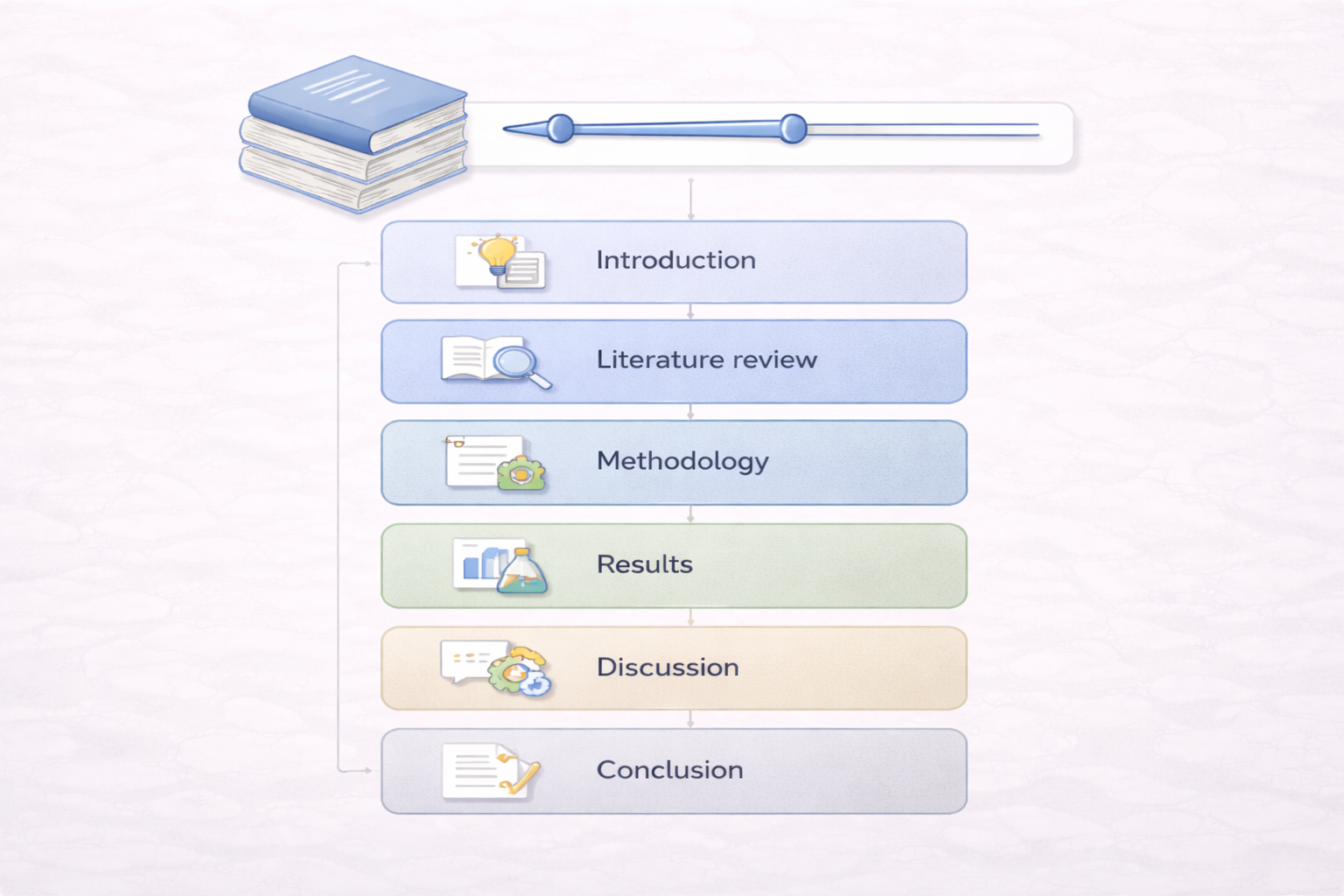
Most PhD theses follow a recognisable structure: introduction, literature review, methodology, findings or analysis, discussion, and conclusion. This structure is not arbitrary. Each chapter performs a distinct academic function, and together they allow examiners to trace the logic of the research from conception to contribution.
Problems arise when candidates treat this structure mechanically, filling chapters with content without understanding their purpose. Examiners do not assess chapters in isolation; they evaluate how effectively each section supports the central research argument. Understanding why each chapter exists is therefore essential for coherent doctoral writing.
The introduction: positioning your research academically
The introduction of a PhD thesis does far more than outline the topic. Its primary academic function is to justify the research. This involves explaining the context of the study, identifying the research problem, articulating research questions or objectives, and clarifying the significance of the work.
A weak introduction often reads like an extended background section, full of description but lacking analytical focus. A strong introduction, by contrast, makes an explicit case for why the research matters, who it is for, and what gap it addresses. Examiners expect the introduction to function as a roadmap for the entire thesis.
The literature review: demonstrating scholarly authority
The literature review is one of the most heavily scrutinised sections of a PhD thesis. Its purpose is not to summarise everything that has been written on a topic, but to demonstrate critical engagement with existing scholarship. Examiners look for evidence that the candidate understands key debates, theoretical frameworks, and methodological traditions within the field.
Common mistakes include treating the literature review as a descriptive catalogue or failing to connect sources back to the research problem. A strong literature review is selective, analytical, and purposeful. It should culminate in a clear articulation of the research gap that the thesis addresses.
The methodology: justifying how knowledge is produced
The methodology chapter explains how the research was conducted and, crucially, why those choices were appropriate. This includes research design, data collection methods, sampling strategies, analytical techniques, and ethical considerations. At doctoral level, methodological decisions must be justified theoretically, not just practically.
Examiners are particularly alert to methodological weaknesses because they undermine the credibility of the findings. Vague descriptions, missing justifications, or unacknowledged limitations often signal insufficient research training. A strong methodology chapter demonstrates reflexivity, transparency, and awareness of alternative approaches.
Findings, analysis, and discussion: where contribution emerges
The findings or analysis chapters present the empirical or analytical core of the thesis. Their structure varies by discipline, but their purpose remains consistent: to present evidence in a way that directly addresses the research questions. Examiners expect clarity, rigour, and logical organisation.
The discussion element—whether integrated or presented as a separate chapter—is where candidates interpret their findings in relation to the literature. This is often where the thesis succeeds or fails. Describing results without engaging theoretically does not constitute contribution. Discussion must explain what the findings mean for the field.
The conclusion: articulating contribution and future directions
The conclusion of a PhD thesis is not a summary of chapters. Its academic role is to synthesise the research and articulate its contribution explicitly. Examiners look for a clear statement of what the thesis adds to knowledge, how it advances understanding, and why it matters.
Effective conclusions also acknowledge limitations and suggest directions for future research. This demonstrates scholarly maturity and an understanding that research is ongoing rather than definitive. Introducing new data or arguments at this stage, however, is a common and serious error.
Abstracts, acknowledgements, and supplementary sections
Although often written last, the abstract is frequently the first section examiners read. It must concisely communicate the research problem, methodology, key findings, and contribution. Writing an abstract that is either too vague or overly detailed can misrepresent the thesis as a whole.
Acknowledgements, while not assessed academically, reflect professional norms and ethical awareness. They recognise intellectual, institutional, and personal support without undermining the candidate’s ownership of the work.
The PhD viva and how the thesis is examined
Submission of the thesis leads to the viva voce examination, where candidates defend their work orally. The thesis is the primary basis for this examination. Examiners assess whether the candidate can explain, justify, and reflect critically on the research choices made.
Importantly, examiners do not expect a flawless thesis. They expect a defensible one. Understanding the rationale behind decisions, acknowledging limitations, and demonstrating command of the field matter more than perfection.
Common misconceptions that weaken PhD theses
One persistent misconception is that length alone signals quality. Examiners are not impressed by unnecessary verbosity. Every section must earn its place by contributing to the central argument. Another common error is over-reliance on supervisors to “fix” structural or conceptual problems late in the process.
Doctoral research demands ownership. Candidates who treat the thesis as a supervised assignment rather than an independent scholarly project often struggle at examination. Recognising this shift in responsibility is essential for successful completion.
| Aspect | Coursework Dissertation | PhD Thesis |
|---|---|---|
| Purpose | Demonstrate understanding of existing knowledge | Contribute original knowledge to the field |
| Length | Typically 10,000–20,000 words | Typically 60,000–100,000 words |
| Supervision | Highly guided | Increasingly independent |
| Assessment | Marked against taught criteria | Examined by independent experts |
This comparison highlights why doctoral writing requires a different mindset. Applying undergraduate or taught postgraduate habits to a PhD thesis is one of the most common causes of difficulty.
Writing the PhD thesis as a long-term research project
Successful PhD theses are rarely written quickly or linearly. They emerge through cycles of drafting, feedback, revision, and conceptual refinement. Viewing the thesis as a long-term research project rather than a single writing task helps manage both quality and stress.
Students who plan their writing alongside research activities—rather than postponing writing until “everything is finished”—tend to produce more coherent theses. Early drafting clarifies thinking and exposes gaps that can still be addressed during data collection or analysis.
Understanding institutional expectations and support
Every university publishes doctoral regulations outlining formatting, submission, and examination procedures. Familiarity with these requirements is not optional. Administrative errors can delay submission or complicate examination, regardless of research quality.
Where candidates need structured guidance on thesis development, revision, or presentation, targeted academic support—such as dissertation planning or editorial review—can help ensure the work meets institutional and disciplinary standards without compromising academic integrity.
Why clarity, not complexity, impresses examiners
A final misconception is that complexity equals sophistication. In reality, examiners value clarity, coherence, and precision. Complex ideas must be explained clearly, not obscured by jargon or excessive abstraction. The strongest theses are often those that communicate difficult concepts with disciplined simplicity.
Writing clearly at doctoral level is not a sign of weakness; it is evidence of mastery. Candidates who prioritise clarity enable examiners to focus on the intellectual contribution rather than decoding the text.
Seeing the PhD thesis as scholarly identity formation
Beyond assessment, the PhD thesis marks a transition from student to scholar. It is often the foundation for future publications, grant applications, and academic positions. The habits developed during thesis writing—critical reading, rigorous argumentation, and methodological reflexivity—shape long-term research practice.
Approaching the thesis with this perspective encourages higher standards and greater intellectual confidence. It becomes not just a requirement to complete, but a platform from which to participate fully in academic discourse.



Comments