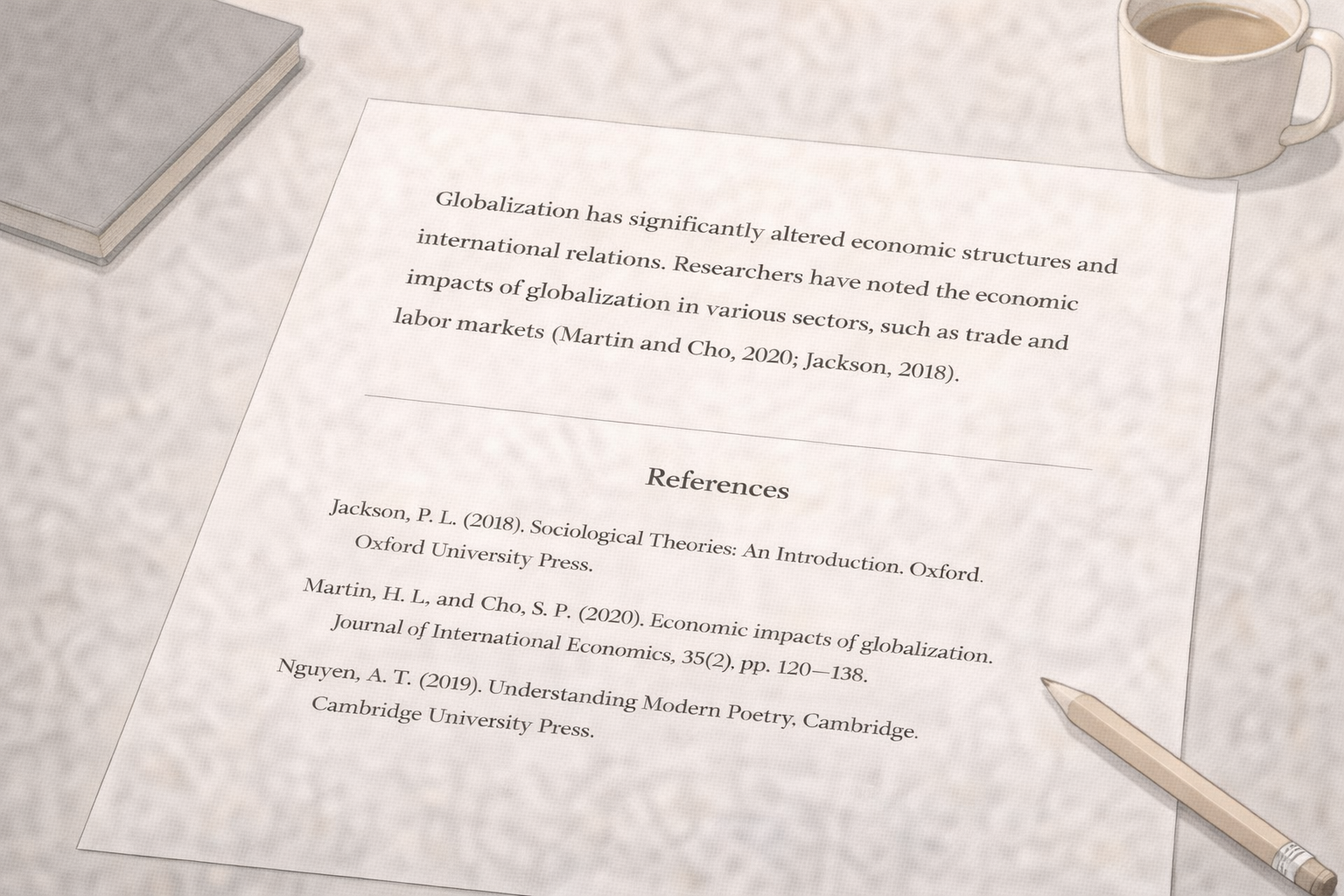
Harvard referencing is a foundational academic skill across a wide range of disciplines, including business, humanities, social sciences, health, and education. Although often described as “author–date referencing,” Harvard style involves more than placing names and years in brackets. It reflects how universities expect students to engage with sources, acknowledge intellectual ownership, and demonstrate academic credibility.
Many students struggle with Harvard referencing not because it is conceptually difficult, but because it is applied inconsistently and varies slightly between institutions. This guide explains Harvard referencing in a clear, structured way, focusing on principles that remain consistent across universities while highlighting areas where local guidance may apply.
What Harvard Referencing Is and Why It Matters
Harvard referencing is a citation system that identifies sources using the author’s surname and year of publication within the text, with full details provided in a reference list. Its primary purpose is to make sources transparent and traceable while allowing academic arguments to flow without excessive footnotes.
Universities use Harvard referencing to maintain consistency across disciplines and to reinforce academic integrity. Correct use shows that a student understands how knowledge is constructed, debated, and built upon within scholarly communities.
Referencing is therefore not a cosmetic requirement but a core academic convention tied to assessment criteria.
Academic expectation: Harvard referencing demonstrates respect for intellectual property and evidence-based argumentation.
The Two Essential Parts of Harvard Referencing
Harvard referencing always consists of two connected elements: in-text citations and a reference list. These elements function as a single system and must correspond exactly.
In-text citations briefly identify the source at the point where it is used. The reference list provides full bibliographic details so the reader can locate the source independently.
Any mismatch between these two components is treated as a referencing error.
Harvard In-Text Citations Explained
Harvard in-text citations use the author’s surname and year of publication, usually enclosed in parentheses. Page numbers are included when quoting directly or when required by institutional guidelines.
The placement of citations depends on sentence structure, but clarity and consistency are essential.
Common Harvard In-Text Citation Formats
- Paraphrase: (Brown, 2022)
- Direct quotation: (Brown, 2022, p. 18)
- Narrative citation: Brown (2022) suggests that…
In Harvard style, punctuation and spacing are not optional details but part of formal accuracy.
Using Multiple Authors in Harvard Referencing
The way authors are presented in Harvard referencing depends on how many authors a source has. These rules are broadly consistent across institutions, though wording may vary slightly.
For sources with two or three authors, all surnames are usually included in the in-text citation. For sources with four or more authors, “et al.” is commonly used.
| Number of Authors | In-Text Citation Example |
|---|---|
| One author | (Green, 2021) |
| Two authors | (Green and White, 2021) |
| Three authors | (Green, White and Black, 2021) |
| Four or more authors | (Green et al., 2021) |
Students should always check whether their department applies a specific variation of this rule.
The Harvard Reference List: Structure and Organisation
The reference list appears at the end of the assignment and contains full details of every source cited. It is ordered alphabetically by the surname of the first author.
Only sources cited in the text should appear in the reference list. Including uncited sources is considered poor academic practice.
Consistency in formatting across all reference entries is essential.
Referencing Books Using Harvard Style
Books are commonly used for foundational theory and background reading. Harvard referencing requires specific elements to appear in a fixed order.
A standard book reference includes the author, year of publication, title (in italics), edition (if not the first), place of publication, and publisher.
Titles should be written in sentence case rather than title case.
Referencing Journal Articles in Harvard Style
Journal articles are central to academic work because they represent peer-reviewed research. Harvard referencing clearly distinguishes article titles from journal titles.
The journal title appears in italics, along with the volume number, while the article title is written in plain text.
Page ranges must be included to allow precise source identification.
Using Online Sources and URLs in Harvard Referencing
Online sources must be referenced carefully to ensure reliability and academic credibility.
A Harvard reference for a website typically includes the author or organisation, year, title of the page, URL, and access date.
Students should prioritise academic, institutional, and governmental sources over informal online content.
Harvard Referencing for Reports and Grey Literature
Reports from organisations, think tanks, and public bodies are frequently used in applied disciplines.
These sources require clear identification of the authoring organisation and publication details.
Failure to reference reports correctly can weaken the credibility of an otherwise strong argument.
Paraphrasing Correctly in Harvard Style
Paraphrasing involves expressing an idea in your own words while retaining the original meaning. In Harvard referencing, paraphrased material must always be cited.
Simply changing vocabulary without restructuring ideas is insufficient and may still constitute plagiarism.
Effective paraphrasing demonstrates comprehension as well as academic integrity.
Critical warning: Paraphrased ideas without in-text citations are treated as plagiarism in Harvard-referenced work.
Using Direct Quotations in Harvard Referencing
Direct quotations should be used sparingly and only when the original wording is essential.
Short quotations are enclosed in quotation marks, while longer quotations may be set out as indented blocks depending on institutional guidance.
Page numbers are mandatory for all direct quotations.
Common Harvard Referencing Mistakes Students Make
Many Harvard referencing errors stem from small but repeated inconsistencies.
- Missing page numbers for quotations
- Inconsistent use of “and” versus “&”
- Incorrect capitalisation of titles
- Mismatched in-text citations and references
- Overreliance on secondary citations
Systematic proofreading can prevent most of these issues.
Harvard Referencing Variations Across Universities
Unlike APA, Harvard is not governed by a single official manual. As a result, universities may publish slightly different Harvard guidelines.
Students must always prioritise their institution’s referencing handbook over generic online examples.
Consistency within one set of rules is more important than absolute conformity to another institution’s style.
Reference Management Tools and Harvard Style
Reference management software can assist with Harvard referencing but should not be relied on blindly.
Automatically generated references often contain formatting errors that require manual correction.
Students remain responsible for the final accuracy of all references.
Harvard Referencing and Academic Assessment
Referencing accuracy is often explicitly assessed within marking rubrics.
Clear and consistent Harvard referencing supports the credibility of arguments and signals academic professionalism.
Poor referencing can undermine strong analytical content.
Developing Long-Term Confidence in Harvard Referencing
Harvard referencing becomes easier with regular practice and structured feedback.
Students who understand the underlying logic of referencing apply rules more confidently and consistently.
Over time, Harvard referencing becomes a routine academic skill rather than a source of anxiety.
Using Harvard Referencing as an Academic Strength
When applied correctly, Harvard referencing strengthens academic writing rather than distracting from it.
It enables clear engagement with sources, supports critical analysis, and reinforces scholarly integrity.
Mastery of Harvard referencing is therefore an investment in academic success across multiple disciplines.


Comments