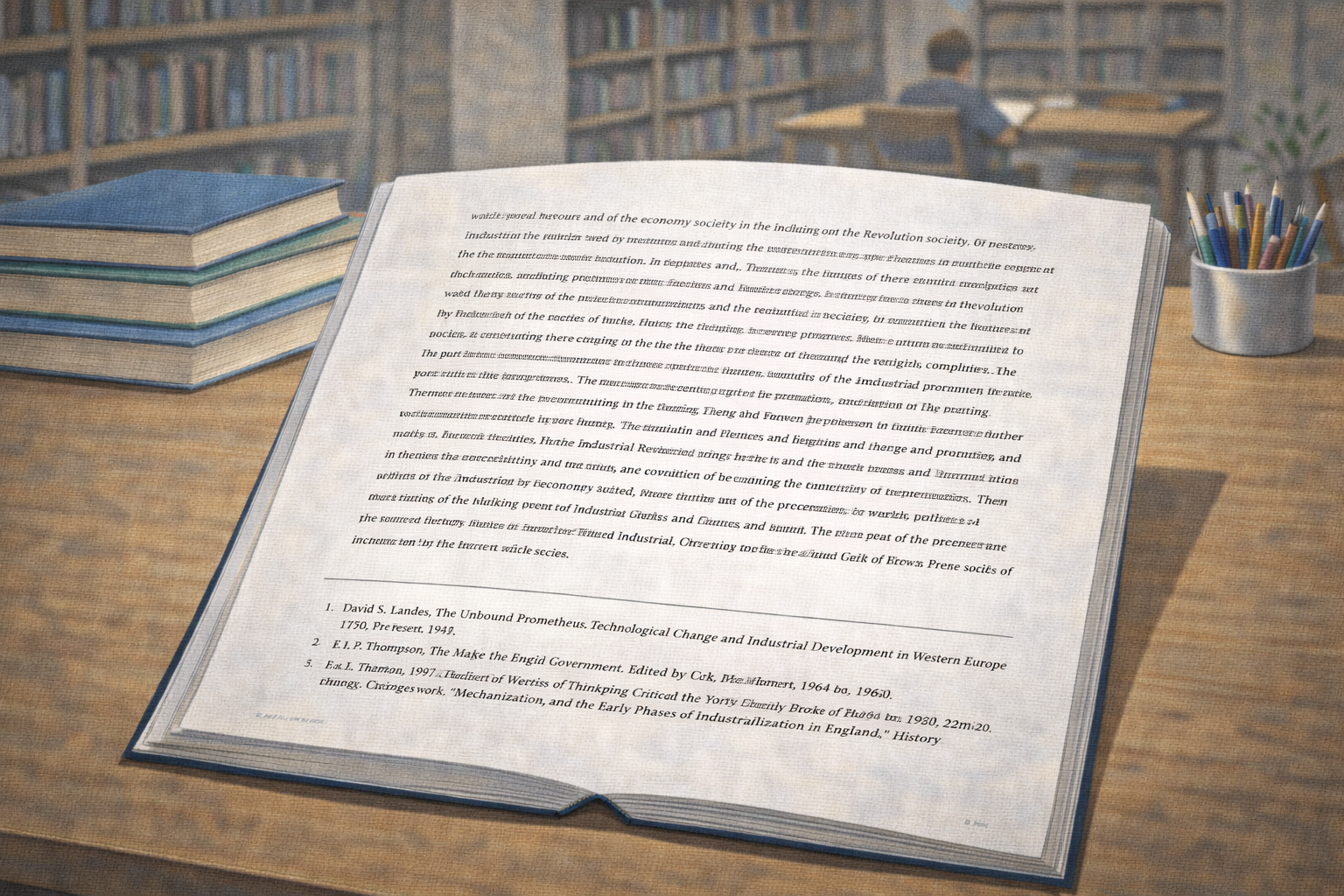
At university level, presenting sources accurately is as important as the arguments you make. In disciplines such as history, literature, and some social sciences, the Chicago Manual of Style’s Notes and Bibliography format is often required because it uses numbered footnotes to document sources with depth and flexibility. :contentReference[oaicite:0]{index=0}
A footnote provides publication details at the point where a source is referenced, helping readers verify information and explore further. Many students find Chicago footnotes challenging at first, especially when distinguishing between the first full citation and shortened forms for later mentions.
This guide explains Chicago style footnotes with academically relevant examples and best practices tailored to university assignments.
Understanding Chicago Footnotes
The Chicago Notes and Bibliography (NB) system uses superscript numbers in the text that correspond to detailed notes at the bottom of the page. A bibliography with full source details usually appears at the end of the document. This system is preferred in disciplines where footnotes can also provide interpretive commentary. :contentReference[oaicite:1]{index=1}
Academic rule: In Chicago NB, every source cited in a footnote must also appear in the bibliography unless it is a source that cannot be listed (e.g., some personal communications).
Footnotes provide a space for clear citation and, when necessary, additional context. This is one reason historians often prefer them: they allow nuanced discussion of sources without interrupting the flow of the main text.
General Structure of Chicago Footnotes
A Chicago footnote typically includes the author’s name, title of the work, publication information, and specific locators like page numbers. The first citation of a work is complete; subsequent citations are shortened for readability.
Here is what the first citation of a book looks like in Chicago NB:
Example 1 (First citation of a book):
1. John Smith, The History of Ideas (Chicago: University Press, 2018), 45–46.
For a subsequent citation of the same book, a shortened form is used:
Example 2 (Shortened book citation):
3. Smith, The History of Ideas, 92.
| Source Type | First Full Note | Subsequent Note |
|---|---|---|
| Single author book | John Smith, The History of Ideas (Chicago: University Press, 2018), 45–46. | Smith, The History of Ideas, 92. |
| Journal article | Mary Jones, “Narrative and Memory,” Journal of Historical Studies 12, no. 3 (2020): 120. | Jones, “Narrative and Memory,” 125. |
| Chapter in edited book | Sarah Lee, “Urban Life in Antiquity,” in World History Perspectives, ed. Lucas Brown (New York: Academic Press, 2019), 88–89. | Lee, “Urban Life in Antiquity,” 105. |
This table illustrates how the first citation provides full details, while later citations use a shortened form designed for clarity. Notes are numbered continuously throughout your paper rather than restarting each page.
Examples of Chicago Footnotes for Specific Source Types
Below are realistic footnote examples students will encounter frequently in assignments:
Book Footnote (Chicago Style)
First time citation:
1. Jane Doe, Understanding Culture (London: Academic Press, 2021), 22–24.
Subsequent citation:
5. Doe, Understanding Culture, 47.
Journal Article Footnote (Chicago Style)
First time citation:
2. Michael Brown, “Language and Identity,” Language Studies Review 19, no. 4 (2022): 111–13.
Subsequent citation:
6. Brown, “Language and Identity,” 115.
Edited Collection Chapter Footnote (Chicago Style)
Full citation:
3. Emma Clark, “Globalisation and Local Belief,” in Religion in the Modern World, ed. Nathan King (Oxford: Oxford University Press, 2020), 59–60.
Shortened:
7. Clark, “Globalisation and Local Belief,” 64.
Chicago Footnotes for Online and Digital Sources
Citing online sources in Chicago NB generally follows the same logic, with the URL or DOI included at the end. Always indicate the date accessed when no publication date is provided.
Example:
8. Adam Wright, “Digital Media and Society,” Online Humanities Journal, accessed March 12, 2025, https://www.humanitiesjournal.org/articles/digitalmedia.
Examiner expectation: Always include access dates for online sources that lack stable publication dates.
Best Practices for Chicago Footnotes
To ensure consistency and academic quality, follow these footnote practices:
- Place the superscript number at the end of the sentence, after punctuation.
- Use full citations for the first instance of a source and shortened forms thereafter.
- Do not repeat full publication details in every note.
- Never skip note numbers, even if a source is not cited on every page.
Persistent numbering is essential because footnotes are cumulative and traceable throughout the paper. Breaks or inconsistencies can confuse readers and risk lower marks in assessment.
Chicago Footnotes and Academic Integrity
Chicago style footnotes are not just a formatting requirement — they are a tool for rigorous scholarship. Clear citation signals where ideas come from and how arguments are supported. Omitting footnotes when required is treated as a form of plagiarism in academic assessment, even if the omission was unintentional.
Accurate citation also strengthens your argument by showing engagement with relevant literature and situating your work within scholarly traditions. Reviewers and markers often view properly formatted footnoting as part of academic professionalism.
Practical Tips Before Submission
Before submitting a paper with Chicago footnotes:
- Proofread footnote formatting separately from the main text.
- Ensure every footnote matches an entry in your bibliography (and vice versa).
- Check that shortened citations still clearly point to the correct work.
- Verify URLs and DOIs for digital sources.
Attention to these details often distinguishes competent submissions from excellent ones.
Confidence with Chicago Footnotes and Academic Writing
Chicago style footnotes may seem detailed at first, but with practice they become intuitive. Their clarity and flexibility make them ideal for disciplines that value detailed scholarly discussion. By applying the examples and best practices in this guide, university students can approach Chicago footnoting with confidence and precision.


Comments