
Harvard referencing is a core academic skill expected of university students across disciplines such as business, social sciences, education, and health. While the system appears straightforward at first glance, many students lose marks due to small but significant formatting errors in their citations and reference lists.
Unlike styles with a single governing manual, Harvard referencing exists as a family of conventions. Universities often issue their own guidance, but all Harvard systems share the same underlying principles: author–date in-text citations and a detailed, alphabetised reference list.
This article provides clear, assignment-ready Harvard referencing examples. It explains the logic behind the style, demonstrates correct formatting for common source types, and highlights frequent mistakes that examiners penalise.
What Is Harvard Referencing and How It Works
Harvard referencing is an author–date citation system designed to make sources easy to identify within academic writing. The author’s surname and year of publication appear in the text, while full publication details are listed at the end of the document.
The system prioritises transparency and traceability. A reader should be able to locate the exact source of any cited idea using only the in-text citation and the reference list.
Because Harvard styles vary slightly between institutions, students must always follow their department’s specific guidelines where differences exist.
Key principle: Every in-text citation must match exactly one entry in the reference list.
Basic Harvard In-Text Referencing Examples
Harvard in-text references usually include the author’s surname and the year of publication, enclosed in parentheses. This format is used when paraphrasing ideas.
Example:
Effective feedback improves student engagement (Brown, 2021).
If the author’s name is mentioned in the sentence, only the year appears in parentheses.
Example:
Brown (2021) argues that effective feedback improves student engagement.
Harvard Referencing Examples for One Author
Sources written by a single author follow the simplest Harvard format. This applies to books, journal articles, and most reports.
| Format | Example |
|---|---|
| Parenthetical | (Smith, 2020) |
| Narrative | Smith (2020) |
Both formats are acceptable, and students may switch between them to improve sentence flow.
Harvard Referencing Examples for Two or More Authors
When a source has two authors, both surnames are included in the in-text citation, joined by “and”.
Example:
Group work enhances critical thinking (Jones and Patel, 2019).
For three or more authors, Harvard systems typically use the first author’s surname followed by “et al.”
Example:
Assessment design influences learning outcomes (Nguyen et al., 2022).
Harvard Referencing Examples for Direct Quotations
Direct quotations require a page number in addition to the author and year. This allows readers to locate the exact passage.
Example:
“Feedback is most effective when it is timely and specific” (Brown, 2021, p. 45).
If the quotation is integrated into the sentence, the citation follows immediately after the quoted material.
Examiner expectation: Page numbers are mandatory for all direct quotations.
Harvard Reference List Examples
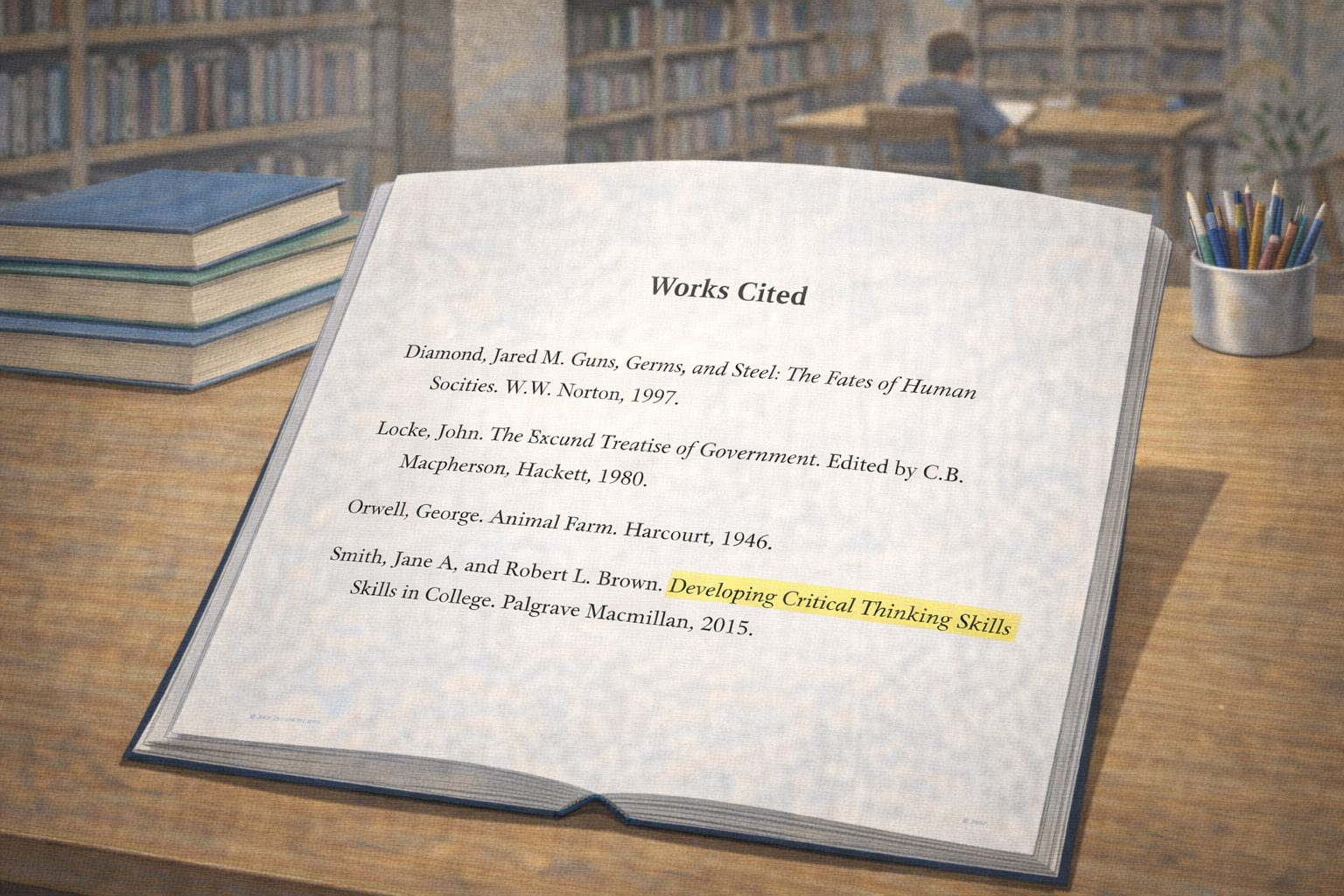
The reference list appears at the end of the assignment and includes full publication details for every source cited. Entries are arranged alphabetically by author surname.
Each reference list entry follows a structured format that varies by source type.
Book Reference Example (Harvard)
Format:
Author, Initial(s). (Year) Title of book. Edition (if not first). Place of publication: Publisher.
Example:
Brown, T. (2021) Effective Feedback in Higher Education. 2nd edn. London: Routledge.
Journal Article Reference Example (Harvard)
Format:
Author, Initial(s). (Year) ‘Title of article’, Title of journal, volume(issue), page numbers.
Example:
Nguyen, L., Harris, J. and Smith, R. (2022) ‘Assessment design and student learning’, Journal of Higher Education, 45(3), pp. 210–225.
Website Reference Example (Harvard)
Format:
Organisation or Author (Year) Title of webpage. Available at: URL (Accessed: date).
Example:
World Health Organization (2023) Mental health in education. Available at: https://www.who.int (Accessed: 15 March 2024).
Harvard Referencing Examples for Multiple Sources
When more than one source supports a statement, they may be cited together within the same parentheses. Sources are ordered alphabetically and separated by semicolons.
Example:
Student engagement is influenced by assessment design and feedback quality (Brown, 2021; Jones and Patel, 2019; Nguyen et al., 2022).
Common Harvard Referencing Mistakes Students Make
Harvard referencing errors often arise from inconsistency rather than lack of understanding. Small formatting issues can still lead to lost marks.
- Missing page numbers in quotations
- Inconsistent use of “et al.”
- Mismatch between in-text citations and reference list entries
- Incorrect punctuation or italics in reference list entries
Critical warning: If a source appears in-text but not in the reference list, it is treated as incomplete referencing.
Harvard Referencing and Academic Writing Quality
Correct Harvard referencing strengthens academic writing by integrating evidence smoothly into arguments. It signals credibility and respect for existing scholarship.
Well-referenced work demonstrates analytical engagement rather than simple description. Paraphrasing supported by accurate citations is generally preferred over excessive quoting.
Markers often associate accurate referencing with overall academic competence.
Final Guidance on Harvard Referencing Examples
Harvard referencing is not just a technical requirement but a key component of academic integrity and scholarly communication. Mastery of the system allows students to focus on argumentation rather than formatting concerns.
By applying these Harvard referencing examples consistently and checking institutional guidelines, students can avoid common errors and present their work professionally.
Accurate in-text citations combined with a well-structured reference list reflect a high standard of university-level writing.

Comments