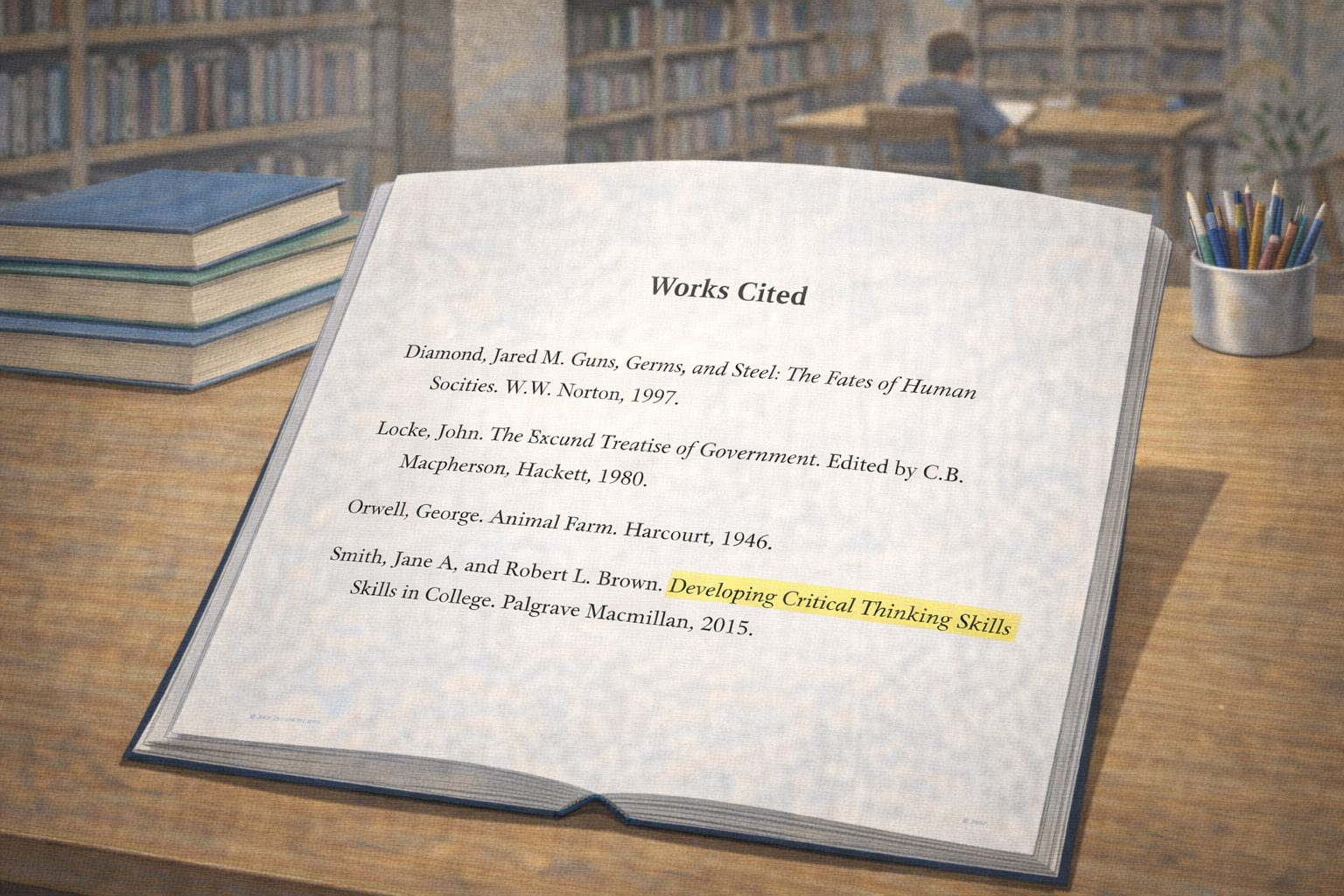
In university-level writing, correct referencing is not optional; it is a core academic skill. For students in literature, languages, cultural studies, and many humanities disciplines, the Modern Language Association (MLA) referencing system is the required standard. One of its most important components is the Works Cited page, which lists all sources referenced in the assignment.
An MLA Works Cited page does more than acknowledge sources. It demonstrates academic integrity, allows readers to locate original materials, and shows that your argument is grounded in credible scholarship. Despite its importance, many students struggle with formatting details such as punctuation, italics, and ordering.
This guide explains MLA Works Cited formatting rules and provides clear MLA works cited examples that can be applied directly to university essays and research papers.
What Is an MLA Works Cited Page?
The Works Cited page is a complete list of all sources referenced in your essay, presented at the end of the document. In MLA style, every in-text citation must correspond exactly to an entry in the Works Cited list, and no uncited sources should appear there.
MLA emphasises authorship, titles, and containers (such as journals or websites), reflecting the humanities focus on texts and authorship. Unlike APA, which prioritises publication date, MLA places the author’s name first to foreground intellectual contribution.
Academic rule: Every source cited in-text must appear in the Works Cited page, and every entry in the Works Cited page must be cited in the text.
Failure to maintain this one-to-one relationship is a common reason for referencing deductions in humanities assignments.
General MLA Works Cited Formatting Rules
Before examining specific MLA works cited examples, it is essential to understand the general formatting rules that apply to the entire page. These rules apply regardless of source type.
- The Works Cited page begins on a new page at the end of the paper.
- The title “Works Cited” is centred at the top of the page.
- Entries are listed in alphabetical order by the author’s last name.
- All entries use double spacing.
- Each entry uses a hanging indent.
Consistency is critical. Examiners expect uniform formatting across the entire list, not partial compliance with MLA conventions.
Core Structure of an MLA Works Cited Entry
MLA citations follow a standard structure built around elements rather than fixed templates. These elements are presented in a specific order and separated by periods.
The basic structure is:
Author. Title of Source. Title of Container, Other Contributors, Version, Number, Publisher, Publication Date, Location.
Not every source will include all elements, but the order remains consistent. Understanding this structure helps students adapt MLA style to new or unusual source types.
MLA Works Cited Examples for Common Academic Sources
The following MLA works cited examples reflect the most frequently used sources in university assignments.
| Source Type | MLA Works Cited Entry |
|---|---|
| Book (single author) | Smith, John. Modern Literary Theory. Oxford University Press, 2021. |
| Journal article | Jones, Mary. “Narrative Identity in Postmodern Fiction.” Journal of Literary Studies, vol. 18, no. 2, 2020, pp. 45–60. |
| Chapter in edited book | Brown, Alan. “Memory and History.” Cultural Perspectives, edited by Susan Lee, Routledge, 2019, pp. 88–104. |
| Website | Williams, Sarah. “Digital Humanities Today.” Humanities Online, 12 Mar. 2023, www.humanitiesonline.org/digital-humanities. |
This table illustrates how MLA adapts the same core structure across different source types while maintaining consistent punctuation and formatting.
Book Works Cited Examples in MLA Style
Books remain a central source in humanities research, and MLA book citations are among the most commonly assessed formats.
Single-author book:
Smith, John. Modern Literary Theory. Oxford University Press, 2021.
Book with two authors:
Taylor, Anne, and Mark Green. Language and Culture. Cambridge University Press, 2018.
Note that MLA uses “and” rather than an ampersand and places only the first author’s name in inverted order.
Journal Article Works Cited Examples in MLA
Journal articles require additional details because they appear within a container (the journal). Volume, issue, year, and page range are essential.
Print or PDF journal article:
Jones, Mary. “Narrative Identity in Postmodern Fiction.” Journal of Literary Studies, vol. 18, no. 2, 2020, pp. 45–60.
Online journal article with DOI:
Clark, Emma. “Gender and Representation in Film.” Film Studies Quarterly, vol. 12, no. 1, 2022, pp. 22–39, doi:10.1177/film.2022.001.
Including a DOI strengthens the credibility of digital academic sources and is preferred when available.
Website Works Cited Examples in MLA
Web sources are common in contemporary assignments, but they require careful handling. MLA prioritises authorship and page title over the URL.
Website with named author:
Williams, Sarah. “Digital Humanities Today.” Humanities Online, 12 Mar. 2023, www.humanitiesonline.org/digital-humanities.
Website with no named author:
“Global Literature Trends.” World Literature Review, 2022, www.worldlitreview.org/trends.
Examiner warning: Do not place URLs at the beginning of MLA entries. URLs always appear at the end.
Common MLA Works Cited Mistakes Students Make
Even strong essays can lose marks due to small referencing errors. The most frequent MLA Works Cited mistakes include:
- Using APA-style commas instead of MLA periods.
- Failing to italicise book and journal titles.
- Listing sources that were not cited in the text.
- Inconsistent use of hanging indents.
These errors signal weak attention to academic conventions, which can undermine an otherwise well-argued paper.
How the MLA Works Cited Page Supports Academic Writing
The Works Cited page is not merely a technical requirement. It demonstrates scholarly engagement and ethical research practice. A well-constructed MLA Works Cited page shows that a student understands how academic knowledge is produced, circulated, and credited.
Markers often view referencing accuracy as a proxy for overall academic discipline. Clean, consistent MLA formatting creates a positive first impression before the essay content is even read.
Final Guidance for Mastering MLA Works Cited
Mastering MLA Works Cited formatting takes practice, but the rules are logical and consistent once understood. By following the examples in this guide and applying them carefully, students can produce citation lists that meet university standards and protect against avoidable grade penalties.
When in doubt, prioritise clarity, consistency, and adherence to official MLA conventions. Accurate referencing strengthens not only your academic credibility but also the persuasive power of your writing.


Comments