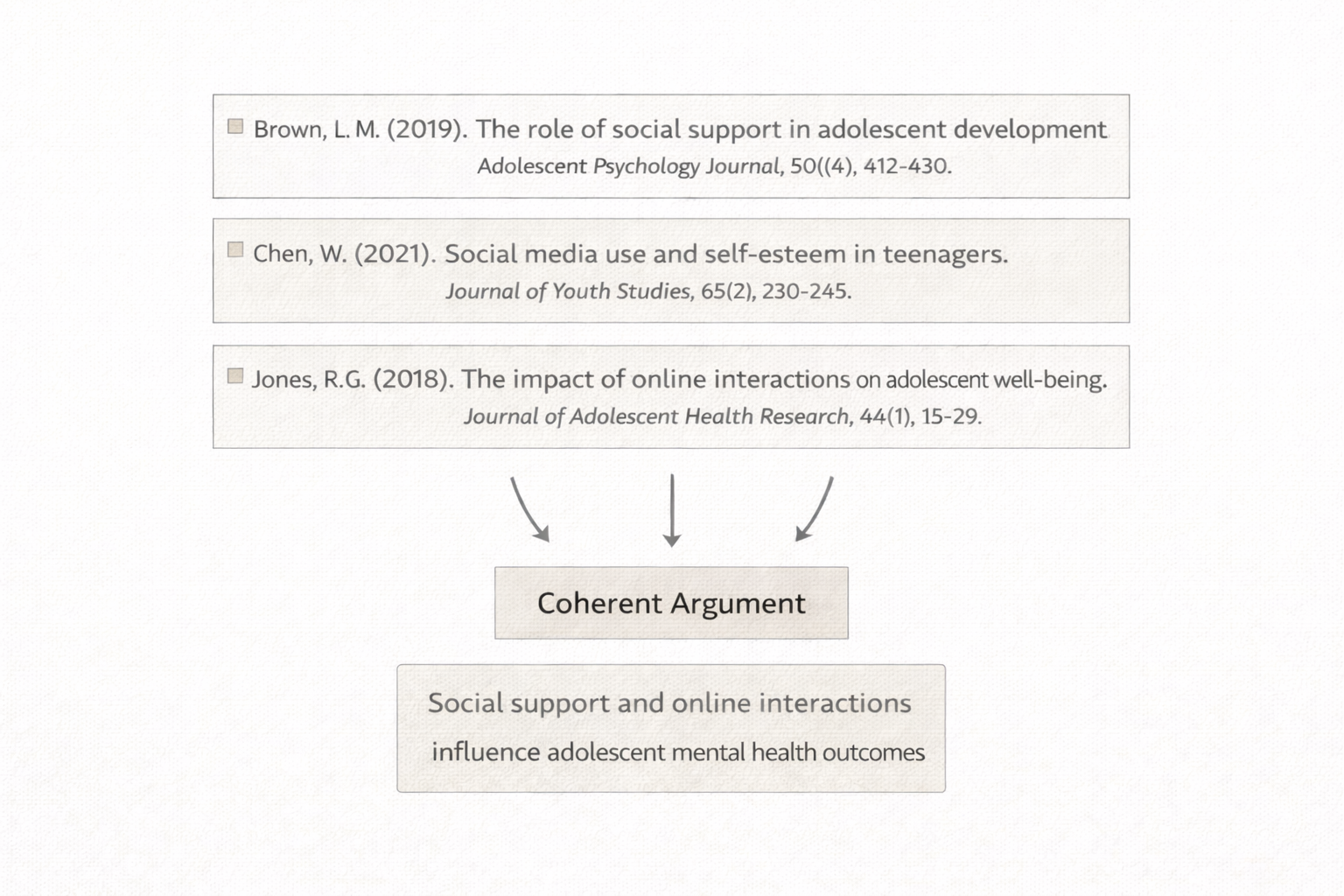
Learning how to synthesise literature is one of the most significant transitions students face in academic research writing. At university level, it is no longer sufficient to summarise sources individually or list what each author has said. Instead, students are expected to combine ideas, compare findings, and build a coherent academic argument grounded in existing research.
Many students struggle with synthesis because it requires analytical thinking rather than mechanical writing. Common problems include source-by-source summaries, excessive quotation, and a lack of clear connections between studies. These issues often result in feedback such as “too descriptive” or “lacks critical engagement.”
This article explains how to synthesise literature in a clear, practical, and academically rigorous way. It breaks down the concept of synthesis, outlines a step-by-step process, and shows how synthesis strengthens literature reviews, essays, and dissertations.
What It Means to Synthesise Literature in Academic Writing
Synthesising literature means integrating ideas from multiple sources to create a new, coherent understanding of a topic. Rather than treating each study as an isolated contribution, synthesis focuses on relationships between studies.
This process involves comparing arguments, identifying patterns, highlighting disagreements, and evaluating strengths and limitations. The resulting discussion reflects the writer’s analytical judgement rather than the structure of the source material.
Synthesis combines sources to produce insight; summary merely reports what sources say.
Understanding this distinction is essential for meeting higher-level academic criteria.
Why Synthesis Is Central to Academic Assessment
Examiners use synthesis as a key indicator of academic maturity. A synthesised discussion demonstrates that a student understands the literature as a body of knowledge rather than as a collection of unrelated texts.
In literature reviews, synthesis shows how existing research informs the current study. In essays, it supports argument development. In dissertations, it justifies research design and originality.
Without synthesis, even well-referenced work is often assessed as descriptive and superficial.
Common Misconceptions About Synthesising Literature
One common misconception is that synthesis means paraphrasing sources. While paraphrasing is important, synthesis goes beyond language to address ideas and relationships.
Another misunderstanding is that synthesis requires agreement between sources. In reality, disagreement and contradiction are often the most valuable elements to synthesise.
Clarifying these misconceptions helps students approach synthesis with confidence rather than uncertainty.
The Difference Between Summarising and Synthesising Sources
Summarising focuses on condensing a single source’s key points. Synthesising, by contrast, requires drawing connections across multiple sources.
A summary might explain what one author argues, while a synthesis explains how several authors approach the same issue differently or similarly.
The table below highlights the key differences.
| Aspect | Summary | Synthesis |
|---|---|---|
| Focus | Single source | Multiple sources |
| Purpose | Report content | Integrate and analyse ideas |
| Structure | Source-by-source | Theme- or argument-driven |
| Academic value | Foundational | Critical and advanced |
This distinction underpins effective literature synthesis.
Step 1: Reading Sources Actively and Analytically
Synthesis begins during reading, not writing. Active reading involves identifying each source’s main argument, methodology, and contribution to the field.
Students should note points of agreement, disagreement, and recurring concepts across sources. These observations form the raw material for synthesis.
Passive reading, by contrast, encourages descriptive writing and weak integration.
Step 2: Grouping Sources by Themes or Concepts
Effective synthesis requires organising sources around ideas rather than authors. Themes may be theoretical perspectives, variables, findings, or methodological approaches.
Grouping sources thematically allows the writer to discuss multiple studies within a single analytical framework.
This approach reduces repetition and strengthens coherence.
Step 3: Comparing and Contrasting Sources
Comparison is at the heart of synthesis. Students should examine how studies align, diverge, or build upon one another.
Comparisons may focus on findings, interpretations, methods, or contexts. Explicit comparison demonstrates analytical control.
Using comparative language such as “similarly,” “in contrast,” or “while X argues” helps signal synthesis clearly.
Step 4: Evaluating Strengths and Limitations Across Studies
Synthesis is not neutral aggregation; it involves evaluation. Students should assess the strengths and weaknesses of studies collectively.
This may include commenting on sample size, methodology, theoretical framing, or applicability of findings.
Evaluation distinguishes synthesis from compilation.
Critical evaluation enhances academic credibility.
Step 5: Integrating Sources into Thematic Paragraphs
A synthesised paragraph typically discusses several sources within one coherent discussion. It begins with a clear thematic claim rather than an author name.
Evidence from multiple sources is then integrated to support, complicate, or challenge that claim.
Paragraphs should end with analytical insight, not with a citation.
Example of Synthesised Writing (Illustrative)
The following example demonstrates synthesis rather than summary.
Illustrative example:
Several studies emphasise the role of feedback in student learning, though they differ in how feedback effectiveness is defined. While Johnson (2019) highlights timeliness as the key factor, Lee and Ahmed (2020) argue that specificity has a greater impact on learning outcomes. More recent research by Patel (2022) integrates these perspectives, suggesting that feedback is most effective when both timely and tailored to individual performance. This progression indicates a shift from single-factor explanations toward more nuanced models of feedback practice.
This paragraph synthesises ideas, compares perspectives, and adds interpretation.
Maintaining Your Academic Voice While Synthesising
One challenge students face is losing their own voice when working with multiple sources. Effective synthesis maintains the writer’s analytical perspective.
Sources should support or challenge the writer’s argument rather than replace it. The student remains the organiser and interpreter of ideas.
Clear topic sentences help maintain authorial control.
Using Synthesis to Build Arguments
Synthesis is essential for argument-driven writing. By integrating sources, students can show how evidence supports their claims.
Rather than citing one study per point, synthesised arguments draw on multiple sources to strengthen validity.
This approach is particularly important in discussion sections and literature reviews.
Common Errors That Undermine Literature Synthesis
One frequent error is presenting sources sequentially without connection. This results in descriptive writing.
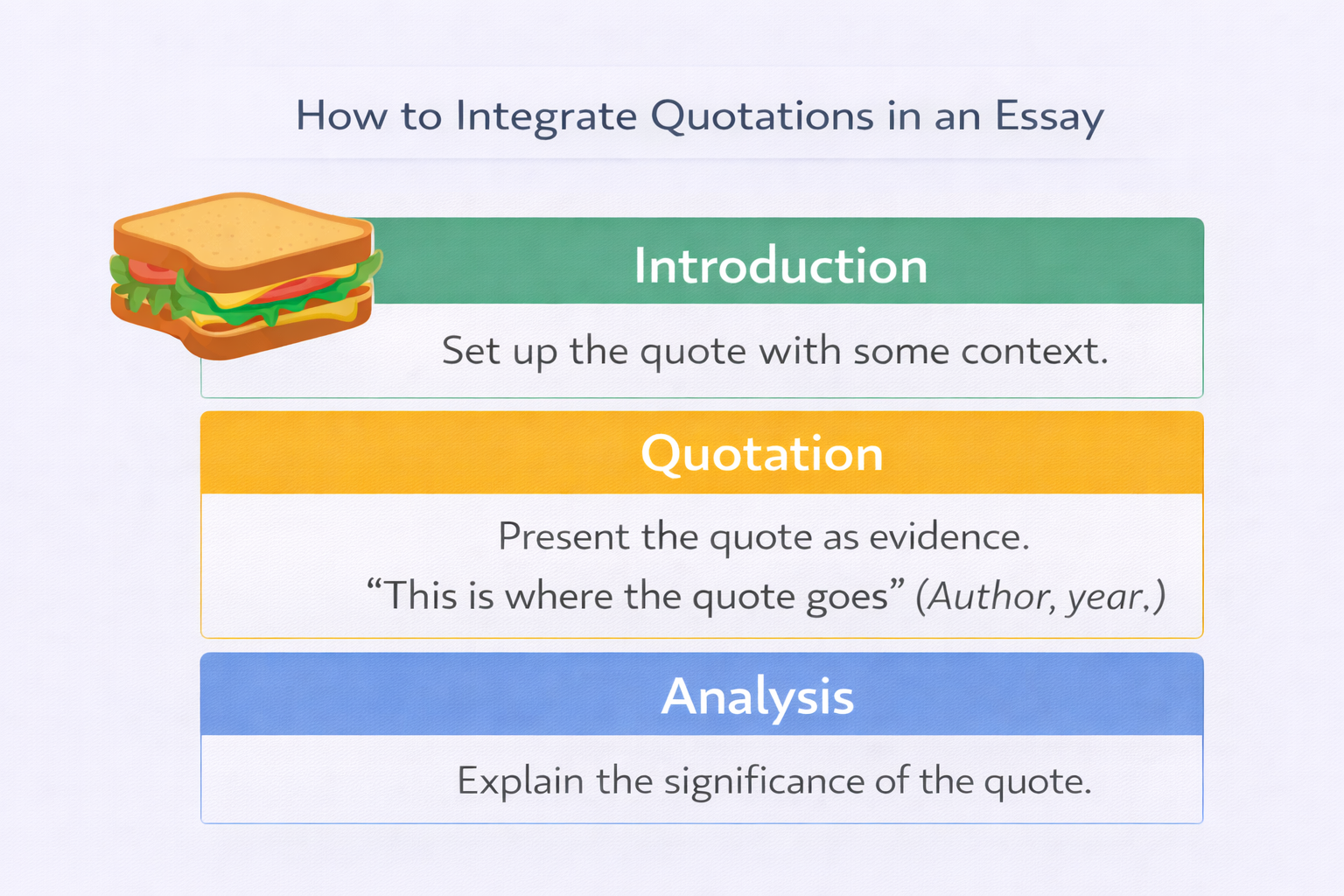
Another issue is overusing quotations, which interrupts analytical flow and reduces synthesis.
Students should also avoid synthesising sources with incompatible contexts without acknowledging differences.
Using Tables and Matrices to Support Synthesis
Before writing, synthesis can be supported by organising sources in comparison tables or matrices. These tools help visualise patterns and gaps.
While tables may not appear in the final text, they are valuable planning aids.
Structured preparation improves analytical clarity.
Synthesis Across Different Academic Levels
At undergraduate level, synthesis may focus on basic comparison and thematic grouping. At postgraduate level, deeper evaluation and theoretical integration are expected.
Doctoral-level synthesis requires original positioning within the literature and sustained critical dialogue.
Understanding these expectations helps students calibrate their approach.
Synthesising Literature Ethically and Accurately
All synthesised ideas must be properly cited. Combining ideas from multiple sources does not remove the need for attribution.
Accurate citation protects academic integrity and clarifies intellectual contributions.
Synthesis should never obscure source origins.
Planning for Synthesis Before Writing
Effective synthesis is planned, not improvised. Creating thematic outlines before drafting helps maintain focus.
Planning also prevents redundancy and ensures balanced coverage.
Time invested in planning improves writing efficiency.
How Synthesis Strengthens Literature Reviews and Research Writing
Synthesised literature demonstrates command of the research field. It shows that the student can integrate knowledge rather than merely consume it.
This skill underpins strong literature reviews, discussions, and theoretical frameworks.
Without synthesis, research writing remains fragmented and underdeveloped.
Applying Literature Synthesis with Academic Confidence
Learning how to synthesise literature is a turning point in academic development. It transforms writing from descriptive reporting into analytical scholarship.
By grouping sources thematically, comparing ideas critically, and maintaining a clear academic voice, students can meet and exceed university expectations.
Strong synthesis not only improves grades but also builds the foundation for independent research thinking.

Comments