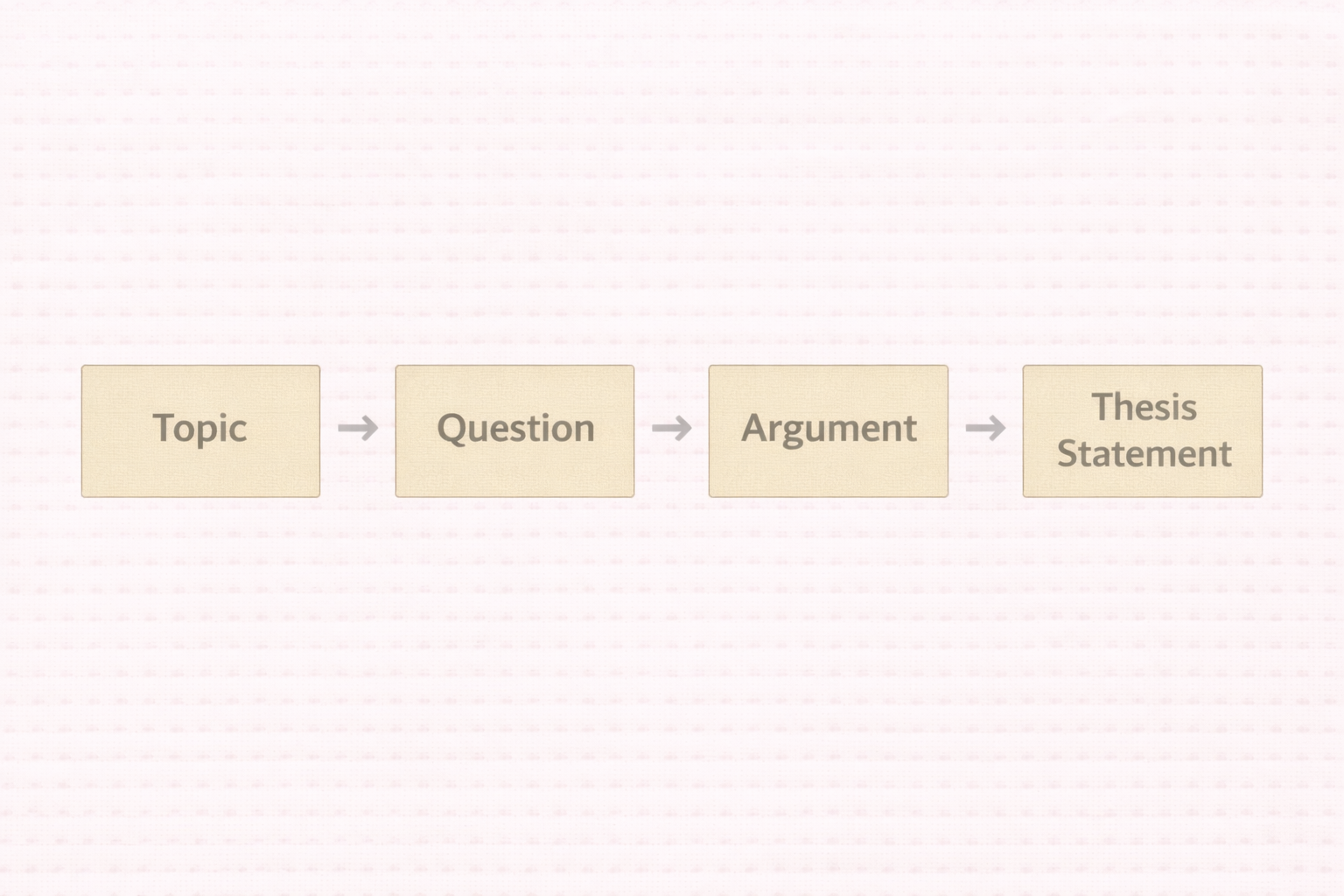
Many university essays fail not because of weak grammar or poor referencing, but because they lack a clear and effective thesis statement. Students often begin writing with a topic in mind but without a precise argument to guide their analysis. As a result, their essays become descriptive, unfocused, or inconsistent.
This guide explains how to write a thesis statement step by step. It breaks down the process into manageable academic stages, clarifies what examiners expect, and shows how a strong thesis statement shapes the entire structure of an essay.
What a Thesis Statement Is and Why It Matters
A thesis statement is a concise sentence that presents the central argument of an essay. It tells the reader what position the writer is taking and signals how the essay will develop that position through analysis and evidence.
In academic writing, a thesis statement is not a topic announcement or a statement of fact. Instead, it is an arguable claim that requires justification. Examiners rely on the thesis statement to assess clarity of purpose, analytical depth, and coherence.
A thesis statement should guide the reader’s expectations and the writer’s reasoning throughout the essay.
Step 1: Understand the Assignment Question Fully
Before drafting a thesis statement, it is essential to analyse the assignment question carefully. Many weak thesis statements emerge because students misunderstand what the question is asking them to do.
Directive terms such as “discuss,” “evaluate,” “compare,” or “critically analyse” determine the type of argument required. A thesis statement must respond directly to these instructions, not merely to the general topic.
Step 2: Identify the Central Issue or Debate
Strong thesis statements emerge from academic debates rather than from neutral topics. Identifying the underlying issue allows the writer to take a position that can be argued and defended.
For example, an essay on social media is too broad. An essay examining whether social media weakens democratic participation presents a debatable issue that can support a focused thesis statement.
Step 3: Take a Clear and Defensible Position
A thesis statement must express a clear stance. Avoid language that merely describes or summarises existing research. Instead, state what you argue, conclude, or demonstrate.
Hedging excessively or attempting to remain neutral often weakens academic writing. While nuance is important, a thesis statement should still communicate a firm position.
A thesis statement that avoids commitment undermines the analytical strength of the entire essay.
Step 4: Narrow the Scope of the Argument
One of the most common thesis statement problems is over-breadth. If a thesis statement attempts to cover too many ideas, it becomes impossible to defend within the word limit.
Narrowing the scope allows for deeper analysis and clearer reasoning. A focused thesis statement improves coherence and helps ensure that each paragraph contributes directly to the central argument.
Step 5: Ensure the Thesis Is Arguable, Not Obvious
An effective thesis statement must be arguable. Statements that are universally accepted or purely factual do not invite analysis or critical discussion.
For example, stating that “climate change affects the environment” does not constitute an argument. In contrast, arguing that “market-based climate policies are insufficient without regulatory enforcement” requires justification and evaluation.
Step 6: Align the Thesis with Evidence and Analysis
A thesis statement should be realistic in relation to the evidence available. If the claim cannot be supported using academic sources, it becomes difficult to defend convincingly.
Before finalising a thesis statement, students should consider whether they can support it with scholarly literature, data, or theoretical frameworks relevant to the discipline.
Step 7: Refine Language for Precision and Clarity
Strong thesis statements are concise and precise. Avoid vague terms such as “many,” “various,” or “a lot,” unless they are clearly defined or justified.
Academic clarity improves when the thesis statement uses specific concepts, frameworks, or variables. Precision signals confidence and analytical control.
Common Thesis Statement Errors to Avoid
Even when students follow the correct steps, certain recurring mistakes weaken thesis statements. Recognising these errors can significantly improve essay quality.
| Error | Academic Impact |
|---|---|
| Topic description instead of argument | Results in descriptive, low-analysis essays |
| Overly broad claims | Prevents focused and defensible analysis |
| Obvious or factual statements | Eliminates critical engagement |
| Misalignment with question | Directly lowers relevance marks |
Careful revision of the thesis statement can prevent these issues before they affect the entire essay.
Where the Thesis Statement Should Appear
In most university essays, the thesis statement appears near the end of the introduction. This placement allows the writer to move from general context to a specific argument logically.
However, the exact positioning may vary slightly depending on discipline or instructor preference. Regardless of location, the thesis statement must be clearly identifiable.
Revising the Thesis Statement During Drafting
Thesis statements often evolve as research and writing progress. It is normal for an initial thesis to change as new evidence or insights emerge.
Revisiting and refining the thesis during revision helps ensure alignment between argument, evidence, and conclusion.
Academic Support for Thesis Development
Students working on complex or high-stakes assignments often benefit from structured academic guidance. Services such as essay writing support and editing and proofreading can help refine thesis statements and improve overall argumentation.
For longer projects, especially postgraduate work, dissertation writing support can assist with aligning thesis statements across chapters and maintaining conceptual coherence.
Final Academic Guidance
Writing a strong thesis statement step by step requires clarity, discipline, and critical engagement. A well-constructed thesis shapes the direction of an essay and provides a framework for analysis.
By understanding the question, identifying a debatable issue, taking a clear position, and refining language carefully, students can produce thesis statements that meet academic expectations and support high-quality university writing.



Comments