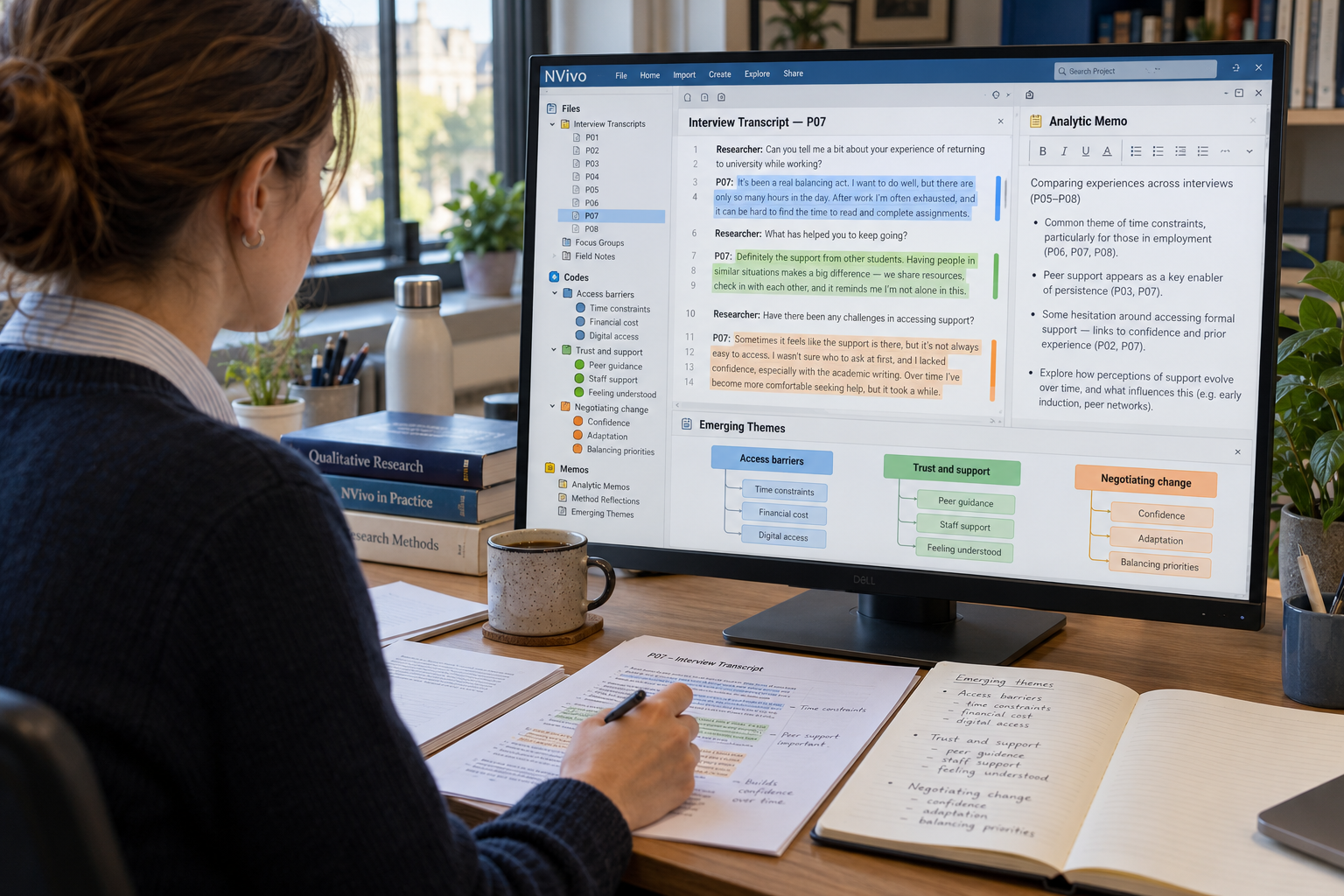
Qualitative research can generate a large volume of textual data from interviews, focus groups, open-ended questionnaires, documents, field notes, and reflective journals. The analytical challenge is not simply storing these materials but examining them systematically to identify patterns of meaning that answer the research questions. Qualitative data analysis software can help researchers manage this process without replacing the interpretive decisions on which credible qualitative analysis depends.
NVivo coding for beginners can initially seem complicated because students encounter software terminology at the same time as they are learning qualitative analysis. Coding involves assigning meaningful labels to relevant segments of data, while thematic analysis involves developing a broader interpretation of patterned meaning across the dataset. NVivo provides tools for organising, retrieving, comparing, annotating, and reviewing this material, but it does not decide what a passage means or which themes should appear in a dissertation.
A strong NVivo workflow therefore begins with methodology rather than software features. Researchers need a clear research question, prepared data, an explicit coding approach, iterative engagement with the transcripts, and a defensible process for moving from codes to themes. This guide explains that process step by step, showing how students can use NVivo to support thematic analysis while retaining the analytical reasoning expected in university research.
What Is NVivo and What Does It Do in Qualitative Research?
NVivo is qualitative data analysis software designed to help researchers organise and work with materials such as interview transcripts, documents, survey responses, audio, video, and other qualitative sources. It allows researchers to collect relevant extracts under codes, retrieve those extracts later, write analytical notes, examine relationships within the dataset, and maintain an organised record of the analysis. These functions become especially valuable when a dissertation contains many transcripts or when the same concepts appear across multiple participants.
The important distinction is between managing analysis and performing interpretation. Epic Essay's guide to coding qualitative data explains that coding is a researcher-driven process and that software can improve organisation without performing the analysis for the researcher. A passage still needs to be read in context, interpreted, and assigned an analytically meaningful code by the researcher.
This means NVivo should not be described in a methodology chapter as though it independently "found the themes." Themes emerge through sustained analytical engagement with the dataset, the research question, coded material, patterns, contradictions, and the researcher's interpretive decisions. NVivo supports this process by making the evidence easier to organise and revisit.
NVivo is an analytical support tool, not an automatic qualitative researcher. The software can organise coded evidence, but the researcher remains responsible for interpretation, theme development, and methodological justification.
How NVivo Coding Fits into Thematic Analysis
Thematic analysis is used to identify and interpret patterns of meaning within qualitative data. A typical analysis involves becoming familiar with the dataset, coding meaningful features, examining relationships among codes, developing candidate themes, reviewing those themes, defining them, and writing an analytical account. The process is iterative rather than a simple sequence completed once.
Epic Essay's complete guide to thematic analysis describes this movement from familiarisation and coding toward theme development and refinement. NVivo can support several of these stages by storing transcripts, recording codes, retrieving coded extracts, and helping researchers examine how developing patterns are represented across the dataset.
The distinction between a code and a theme is essential. A code is a concise analytical label attached to a relevant segment of data. A theme is a broader pattern of shared meaning organised around a meaningful central idea that contributes to answering the research question. Several related codes may contribute to a theme, but simply grouping similarly named codes does not automatically create a defensible theme.
| Analytical Level | Purpose | Example |
|---|---|---|
| Data extract | Participant's original account | "At home I kept getting distracted, and I stopped feeling connected to my classmates." |
| Initial code | Labels a meaningful feature of the extract | Home distractions |
| Related code | Captures another relevant meaning | Social disconnection |
| Category or code cluster | Organises related analytical ideas | Challenges of remote study |
| Candidate theme | Expresses a broader patterned meaning | Learning Alone: The Erosion of Academic Connection |
The table demonstrates that analysis becomes progressively more interpretive. Moving from a quotation to a code involves identifying what is analytically significant, while moving from codes to a theme requires explaining how multiple pieces of evidence form a coherent pattern of meaning.
Before Opening NVivo: Prepare Your Qualitative Data Properly
Good coding begins before data are imported into software. Interview recordings should be transcribed to the level of detail required by the research methodology, transcripts should be checked for obvious errors, and participant identifiers should be handled according to the approved ethical protocol. Consistent document naming also makes later retrieval much easier.
Researchers should decide what contextual information needs to remain attached to each participant. Depending on the study, this could include participant group, programme level, employment role, interview date, study site, or another analytically relevant characteristic. Such information can later support comparisons, but only variables justified by the research design should be collected and retained.
Ethical data handling remains important after transcription. Names and identifiable details may need to be removed or replaced with participant codes, and files should be stored according to institutional requirements. Importing data into NVivo does not remove the researcher's responsibility for confidentiality and secure data management.
Before formal coding begins, researchers should also read the transcripts. Epic Essay's guide to qualitative thesis research emphasises that qualitative analysis begins with careful engagement with the collected information. Familiarisation gives later coding contextual depth that cannot be obtained by mechanically selecting sentences on screen.
Step 1: Create an NVivo Project and Organise Your Files
The first practical step is to create a project and establish a simple organisational structure. The exact NVivo interface and terminology can vary between versions, but the underlying principle remains stable: the project should contain the materials required for the analysis in a form that allows them to be retrieved systematically. Researchers should avoid creating unnecessary complexity before they understand their dataset.
Interview transcripts can then be imported into the project and checked to ensure that each file is complete and correctly identified. Consistent names such as P01, P02, and P03 can be easier to manage than inconsistent filenames containing personal information. If the study contains different data types, the researcher can organise them logically while preserving the distinctions required by the research design.
At this stage, it is useful to keep a record of what has been imported and what remains outstanding. A missing transcript or duplicate document can create confusion later, particularly when the researcher begins comparing code frequencies or participant coverage. Organisation is therefore part of analytical transparency rather than merely administrative tidiness.
Do not begin mass coding immediately after importing the files. Confirm that the dataset is complete, anonymised where required, and organised consistently before analytical coding begins.
Step 2: Familiarise Yourself with the Transcripts
Familiarisation means reading the data closely enough to begin understanding its content, context, tone, contradictions, and recurring ideas. Even when the researcher conducted the interviews personally, transcription and repeated reading can reveal details that were not obvious during the conversation. Initial observations should be treated as provisional rather than final themes.
NVivo can support familiarisation by allowing researchers to read sources and record notes, annotations, or memos while reviewing the data. The objective is not to label every sentence immediately. Instead, the researcher begins asking what participants are describing, what appears important, where accounts differ, and how the material relates to the research question.
For example, several students discussing online learning might mention concentration, isolation, flexibility, family interruptions, and reduced access to lecturers. These observations can inform later coding without forcing the dataset into a fixed structure prematurely. Familiarisation helps the researcher understand the context in which each statement was made.
Skipping this stage can produce superficial coding because fragments of text are labelled without adequate attention to the surrounding narrative. Qualitative analysis depends on context, so efficient software use should never replace careful reading.
Step 3: Decide Whether Your Coding Will Be Inductive, Deductive, or Hybrid
Before creating a large code structure, researchers should understand the analytical orientation guiding their coding. Inductive coding develops codes primarily through engagement with the dataset. Deductive coding begins with concepts informed by theory, previous research, a framework, or specific research questions.
Many dissertations use a hybrid approach. A researcher might begin with several theoretically informed areas while remaining open to unexpected patterns that emerge from participants' accounts. The important requirement is transparency about how the coding framework was generated.
The differences are summarised below.
| Coding Approach | Starting Point | Typical Use | Main Caution |
|---|---|---|---|
| Inductive | Patterns identified through close engagement with data | Exploratory research | Avoid pretending the researcher has no prior knowledge or assumptions |
| Deductive | Theory, framework, literature, or predefined concepts | Theory-informed research | Do not force every extract into predetermined codes |
| Hybrid | Combination of prior concepts and emerging insights | Many applied qualitative dissertations | Explain clearly which elements were predefined and which developed through analysis |
Choosing an approach does not eliminate iteration. Even a deductive codebook may need refinement when the data reveal distinctions that the original framework did not capture. Likewise, inductive coding still needs to remain focused on the purpose of the research.
Step 4: Create Your First Codes in NVivo
Initial coding involves identifying data segments relevant to the research question and assigning concise labels that capture their analytical significance. Depending on the study, a segment may be a phrase, sentence, several sentences, or a longer passage. The amount selected should preserve enough context for the coded extract to remain understandable when retrieved later.
Suppose a participant says, "I liked being able to watch lectures whenever I wanted, but I found it much harder to ask lecturers quick questions." Possible initial codes might include "flexibility of recorded lectures" and "reduced informal lecturer access." These labels capture different meanings contained in the same extract.
Codes should normally be specific enough to remain analytically useful. Vague labels such as "education," "problem," or "participant opinion" provide little indication of what the data actually express. More precise labels make later comparison and theme development easier.
At the same time, beginners should avoid trying to invent perfect code names during the first transcript. Coding is iterative. Labels can be renamed, divided, combined, reorganised, or abandoned as the researcher's understanding of the dataset develops.
Step 5: Use Descriptive and Interpretive Codes Carefully
Some codes remain close to what participants explicitly describe. These descriptive or semantic codes can identify topics such as "long commuting time," "supervisor feedback delays," or "difficulty accessing software." They are useful for establishing what participants are discussing.
Other codes are more interpretive. A participant may never use the phrase "loss of academic belonging," yet several statements about isolation, reduced peer interaction, and feeling invisible in online classes may support that interpretation. Such coding moves beyond topic description toward meaning.
A strong thematic analysis can involve both levels, depending on its methodological orientation. Problems arise when the researcher jumps to abstract interpretations without sufficient evidence or remains entirely descriptive when the research question requires deeper explanation. Coding should progressively support the level of interpretation appropriate to the study.
Epic Essay's qualitative coding guide explains several coding forms, including descriptive, in vivo, axial, and selective coding. Researchers should use coding techniques because they fit the analytical approach, not simply because NVivo makes it possible to create many code labels.
Step 6: Build and Maintain a Clear Codebook
As coding progresses, similar labels can begin overlapping. One transcript may be coded as "lack of peer contact," another as "social isolation," and a third as "disconnection from classmates." These could represent meaningful distinctions, or they may reflect inconsistent naming of essentially the same idea.
A codebook helps maintain analytical consistency. It can record the code name, working definition, inclusion criteria, exclusion criteria, and an example extract. The document should evolve as understanding develops rather than being treated as permanently fixed after the first transcript.
| Code | Working Definition | Include | Exclude |
|---|---|---|---|
| Social disconnection | Experiences of reduced interpersonal connection with peers during study | Isolation, missing classmates, reduced informal peer interaction | Difficulty contacting teaching staff unless linked explicitly to peer relationships |
| Study flexibility | Perceived control over when or where learning occurs | Flexible schedules, recorded lectures, studying around employment | General satisfaction not connected to flexibility |
| Home distractions | Interruptions arising from the home study environment | Family interruptions, noise, household responsibilities | Digital notifications unless described as part of the home environment |
The codebook encourages the researcher to think about conceptual boundaries rather than simply accumulating labels. It also provides useful evidence when explaining the analytical process in a methodology chapter or research audit trail.
Step 7: Code the Dataset Iteratively Rather Than Transcript by Transcript in Isolation
Beginners often code Transcript 1 completely, move to Transcript 2, and continue until the final document without revisiting earlier decisions. This can create inconsistency because the researcher's understanding develops as new participants introduce different perspectives. A code created during Interview 8 may reveal a pattern that was present but unnoticed in Interview 2.
Iterative coding means moving backwards and forwards through the dataset. New codes may prompt the researcher to revisit earlier transcripts, while repeated concepts may lead to merging or refining existing codes. Contradictory cases can also require reconsideration of an emerging interpretation.
NVivo makes retrieval useful here because coded extracts can be brought together for comparison. Researchers can examine whether a code captures the same idea across participants or whether it has become too broad and needs division. This is one of the practical advantages of using qualitative software for a moderately sized dataset.
The process should remain connected to the research question. A code can be interesting without being analytically important. Coding every detail simply because software can store it may produce an unmanageable project containing hundreds of labels with little interpretive direction.
Step 8: Use Memos to Record Analytical Thinking
Coding identifies relevant pieces of data, but qualitative analysis also requires a record of how the researcher's interpretation develops. Memos provide a place to document questions, comparisons, emerging relationships, contradictions, uncertainties, and possible themes. They form part of the analytical reasoning that connects codes to the final written findings.
A useful memo might note that students who praise online-learning flexibility also describe weaker social connection. The researcher could record questions about whether flexibility and isolation operate as competing experiences rather than independent topics. Later interviews can then be examined with this possibility in mind.
Memos should not be restricted to polished conclusions. Recording uncertainty can be valuable because it shows how interpretations were challenged and refined. A researcher might initially believe that "lack of motivation" forms one coherent pattern but later discover that participants distinguish between academic exhaustion, environmental distraction, and lack of social accountability.
This documentation contributes to transparency. The final dissertation may not reproduce every memo, but the researcher has a clearer audit trail showing how analytical decisions developed rather than presenting finished themes as though they appeared instantly.
Step 9: Review and Refine Your NVivo Codes
Once substantial coding has been completed, the code structure should be reviewed systematically. Some codes may contain only one irrelevant extract, while others may have become so broad that they combine several distinct meanings. Duplicate or overlapping labels may also have developed during early coding.
Researchers should inspect the extracts gathered under each code rather than judging the code solely from its name. Ask whether the extracts belong together conceptually, whether important distinctions are being hidden, and whether the code contributes to answering the research question. A code can be renamed if the original label no longer captures the evidence accurately.
Useful refinement actions may include:
- Merging codes that represent the same analytical idea
- Splitting broad codes containing distinct meanings
- Renaming vague codes using more precise analytical language
- Removing codes that are irrelevant to the research question
- Rechecking extracts that may have been coded inconsistently
- Examining negative or contradictory cases
- Clarifying code definitions in the codebook
Reducing the number of codes is not automatically the objective. The purpose is to improve conceptual clarity. Twenty well-defined codes can be more analytically useful than ten overly broad categories or two hundred fragmented labels.
Step 10: Move from Codes to Candidate Themes
Theme development begins when the researcher examines how codes combine to tell a broader analytical story. This is not simply a process of creating a parent folder and moving several codes underneath it. A theme should capture a coherent pattern of shared meaning that contributes to answering the research question.
Imagine codes such as "missing informal conversations," "feeling invisible online," "reduced peer support," and "hesitation to contact classmates." These might contribute to a candidate theme concerning the erosion of social connection in digital learning. The theme expresses an interpretive idea connecting the codes rather than merely renaming their shared topic as "social issues."
A candidate theme should be supported by sufficient evidence across the dataset while remaining sensitive to meaningful variation. Researchers should examine whether extracts genuinely fit together and whether the theme is distinct from other candidate themes. A striking quotation from one participant is not enough to establish a dataset-wide pattern.
The analytical progression can be represented as follows.
| Initial Codes | Developing Pattern | Candidate Theme |
|---|---|---|
| Missing informal conversations | Reduced spontaneous interaction | Learning Alone: The Erosion of Academic Connection |
| Feeling invisible online | Reduced sense of presence | Learning Alone: The Erosion of Academic Connection |
| Reduced peer support | Weakening interpersonal support | Learning Alone: The Erosion of Academic Connection |
| Hesitation to contact classmates | Barriers to initiating interaction | Learning Alone: The Erosion of Academic Connection |
The table illustrates an analytical hierarchy rather than a software requirement. NVivo can organise these codes and extracts, but the researcher must explain why they form a coherent pattern and what that pattern means in relation to the study.
Step 11: Review Candidate Themes Against the Data
Candidate themes should be treated as provisional. Researchers need to examine whether each theme works at the level of individual extracts and across the wider dataset. Some themes may need to be combined, separated, reframed, or removed entirely.
A useful question is whether the extracts within a theme share a meaningful central idea. If a theme called "Challenges" contains technical problems, loneliness, financial pressure, family responsibilities, assessment anxiety, and dissatisfaction with feedback, it may be too broad to provide useful interpretation. The apparent theme may simply be a container for unrelated negative experiences.
Researchers should also look for evidence that challenges their emerging interpretation. Negative cases and contradictory accounts can reveal conditions under which a pattern does not operate. Rather than weakening qualitative analysis, these differences can produce a more nuanced explanation.
NVivo's retrieval and comparison functions can support this review by bringing coded evidence together, but methodological judgement remains central. A theme should survive because it explains the data convincingly, not because its code contains the largest number of references.
Step 12: Define and Name Your Final Themes
Once the thematic structure has stabilised, each theme should be defined clearly. The researcher should be able to explain what the theme captures, what its central organising idea is, how it relates to the research question, and what distinguishes it from other themes. If this cannot be expressed clearly, the theme may still require refinement.
Theme names should communicate analytical meaning rather than merely repeat the interview topic. Names such as "Online Learning," "Feedback," or "Challenges" identify subjects but reveal little about the pattern discovered through analysis. A name such as "Flexibility at the Cost of Connection" communicates a more specific interpretive argument.
The researcher should then identify compelling extracts that demonstrate each theme while representing the dataset fairly. Quotations should support the analysis rather than replace it. The written findings need to explain why the quotation matters and how it contributes to the broader interpretation.
Epic Essay's comparison of thematic and content analysis stresses that strong thematic analysis develops a coherent analytical story from codes and emerging patterns. The final theme structure should therefore communicate meaning rather than simply catalogue frequently mentioned topics.
Should You Use NVivo Word Frequency to Create Themes?
Word-frequency tools can help researchers explore vocabulary within a dataset, but frequent words are not automatically important themes. Participants may repeatedly use ordinary words because of the interview topic, while analytically important experiences may be described using several different expressions. Frequency alone therefore cannot establish thematic significance.
For example, the word "feedback" may appear hundreds of times in interviews specifically conducted about academic feedback. Its frequency reveals little by itself. A less frequent pattern involving fear of asking supervisors for clarification could be much more important to the research question.
Automated text-search and frequency tools can be useful for exploration, checking terminology, or locating material that deserves closer reading. Their output should be interpreted within the wider qualitative context rather than treated as an automatic coding solution.
The most frequently occurring word is not necessarily the most important theme. Thematic significance depends on patterned meaning and relevance to the research question, not simple word counts.
Should Every Sentence Be Coded in NVivo?
There is no universal requirement to code every sentence of every transcript. The appropriate level of coding depends on the research question, methodological orientation, analytical approach, and stage of analysis. Some studies use detailed line-by-line coding, while others code selected segments that are relevant to the analytical purpose.
Overcoding can become a problem when the researcher assigns labels to material that has little relationship to the research question. This creates a large, fragmented code structure that is difficult to interpret. Undercoding creates the opposite risk by overlooking important variation or context.
The researcher should therefore ask whether the selected passage contributes meaningfully to understanding the phenomenon under investigation. Coding should remain systematic without becoming mechanical. Consistency matters more than producing the maximum possible number of coded references.
Context also matters when determining segment size. Coding only three words may remove the statement from the circumstances that give it meaning, whereas coding several pages may make the code too broad. Select enough material to preserve the meaning relevant to the analytical decision.
Common NVivo Coding Mistakes Beginners Should Avoid
A common beginner mistake is creating too many codes too quickly. Researchers may create a new code for every slightly different phrase, eventually producing hundreds of overlapping labels. Regular review and a working codebook can prevent unnecessary fragmentation.
Another mistake is allowing the software structure to dictate the analysis. Creating parent and child codes can be organisationally useful, but hierarchical folders are not automatically themes and subthemes. The final thematic structure should follow the analytical meaning in the data rather than the appearance of the NVivo interface.
Students also sometimes use code frequency as evidence that a theme is important. A code mentioned by 15 participants is not automatically more significant than one discussed deeply by six participants. Frequency can provide context, but qualitative importance depends on relevance, meaning, and the analytical claims being made.
Finally, researchers may paste screenshots of NVivo into a dissertation instead of explaining the analytical procedure. Screenshots can sometimes provide supplementary evidence, but they cannot replace a clear account of how data were coded, how codes were refined, and how themes were generated.
How to Report NVivo Coding in a Dissertation Methodology
The methodology chapter should describe the analytical procedure rather than simply state that "data were analysed using NVivo." The software is a tool; readers need to understand what the researcher actually did with it. Explain how transcripts were prepared, how coding began, whether the approach was inductive or deductive, how the code structure evolved, and how themes were developed and reviewed.
A methodology might state that anonymised interview transcripts were imported into NVivo and read repeatedly for familiarisation. Relevant extracts were then coded using an inductive or hybrid approach, with code definitions recorded and refined as analysis progressed. Related codes were compared and organised into candidate themes, which were reviewed against coded extracts and the wider dataset before final themes were defined.
Epic Essay's dissertation methodology guide notes that examiners expect analytical techniques such as coding and thematic analysis to be described clearly and aligned with the research questions. Naming NVivo without describing the analytical decisions does not meet that requirement.
The software version may also be stated where relevant to institutional requirements or reproducibility. More importantly, the methodology should make clear that theme development involved researcher interpretation. This prevents the misleading impression that software automatically converted transcripts into findings.
How to Present NVivo-Supported Themes in the Findings Chapter
The findings chapter should normally be organised around the final analytical themes rather than around the NVivo project structure. Each theme needs an analytical explanation supported by carefully selected participant extracts. Quotations should demonstrate the evidence while the surrounding prose explains the pattern and its relevance to the research question.
Researchers can identify quotations using anonymised participant labels such as P03 or Interviewee 7, depending on the approved reporting approach. Consistency is important so readers can distinguish different voices without revealing participant identities. Long strings of quotations with little interpretation should be avoided.
Counts can occasionally provide useful contextual information, but they should not transform thematic analysis into an informal quantitative survey. Writing that "11 of 15 participants mentioned X" may be relevant in some methodological approaches, yet the analytical value still lies in explaining what X meant, how it varied, and why it matters.
The findings should ultimately tell an analytical story. NVivo may help the researcher retrieve supporting extracts efficiently, but the written chapter must connect evidence, interpretation, research questions, and themes in a coherent academic argument.
A Step-by-Step NVivo Coding Workflow for Beginners
A structured workflow can make the first NVivo project much easier to manage. The steps should remain iterative because qualitative analysis often requires returning to earlier transcripts and revising analytical decisions as understanding develops.
The following sequence provides a practical starting point:
- Clarify the qualitative research question and analytical approach.
- Transcribe, check, anonymise, and organise the qualitative data.
- Create the NVivo project and import the required source files.
- Read the dataset carefully before extensive coding.
- Record initial observations using notes or analytical memos.
- Decide whether coding will be inductive, deductive, or hybrid.
- Code meaningful data segments using clear, specific labels.
- Maintain working definitions for important codes.
- Review earlier transcripts as new codes and interpretations develop.
- Merge, split, rename, or remove codes where analytically justified.
- Compare related codes and identify candidate patterns of meaning.
- Develop candidate themes rather than treating code folders as finished themes.
- Review each theme against its coded extracts and the wider dataset.
- Examine contradictions and alternative interpretations.
- Define and name final themes clearly.
- Select representative extracts to support the written findings.
- Document the analytical procedure transparently in the methodology chapter.
This workflow keeps NVivo in its appropriate role. The software organises and retrieves the evidence, while the researcher determines what that evidence means and how it answers the research question.
Using NVivo Coding to Produce a Rigorous Thematic Analysis
NVivo coding becomes valuable when it supports systematic engagement with qualitative data rather than replacing that engagement. Beginners should first understand the research question and thematic-analysis approach, prepare and familiarise themselves with the data, and then use the software to organise meaningful coding decisions. A large or visually complex NVivo project is not evidence of analytical quality by itself.
The strongest workflow remains iterative. Initial codes are reviewed as the researcher encounters new evidence, code definitions become more precise, contradictory cases are examined, and related codes are developed into candidate themes. Themes are then reviewed against both their supporting extracts and the wider dataset before being defined and written into the findings.
Most importantly, students should be able to explain every major analytical decision without relying on the phrase "NVivo generated it." When the researcher can show how raw transcripts became codes, how codes developed into meaningful patterns, and how those patterns answer the research question, NVivo becomes what it is intended to be: a powerful organisational tool supporting transparent, thoughtful, and academically defensible qualitative analysis.



Comments