
Writing a doctoral dissertation is one of the most demanding academic tasks a student will ever complete. Unlike undergraduate or master's research projects, doctoral research requires original contributions to knowledge, deep theoretical understanding, and strong analytical writing. Applying effective PhD research writing tips helps doctoral students organize complex ideas, present evidence clearly, and maintain academic rigor throughout their dissertation.
Many doctoral candidates discover that conducting research and writing about research are two different skills. Even when the research itself is strong, poorly structured writing can make the dissertation difficult for examiners to follow. Clear academic writing ensures that the contribution of the research is visible and persuasive.
This guide explains essential strategies for PhD research writing, including structuring arguments, developing academic clarity, integrating literature, and maintaining consistency throughout a long research document.
Understanding the Expectations of PhD-Level Research Writing
Doctoral writing differs significantly from other forms of academic writing. At the PhD level, the dissertation must demonstrate original thinking, advanced critical analysis, and a clear contribution to existing academic knowledge.
PhD students are expected not only to summarize previous research but also to critically evaluate it and position their own work within the scholarly debate. This means that doctoral writing must clearly explain how the research addresses gaps in the literature and advances understanding within the field.
Because the dissertation may contain tens of thousands of words, maintaining clarity and coherence across chapters becomes essential.
PhD writing must demonstrate original contribution, critical thinking, and strong engagement with existing academic research.
Planning Your PhD Dissertation Before Writing
Effective doctoral writing begins with careful planning. Attempting to write large sections of the dissertation without a clear structure often leads to confusion and repeated revisions.
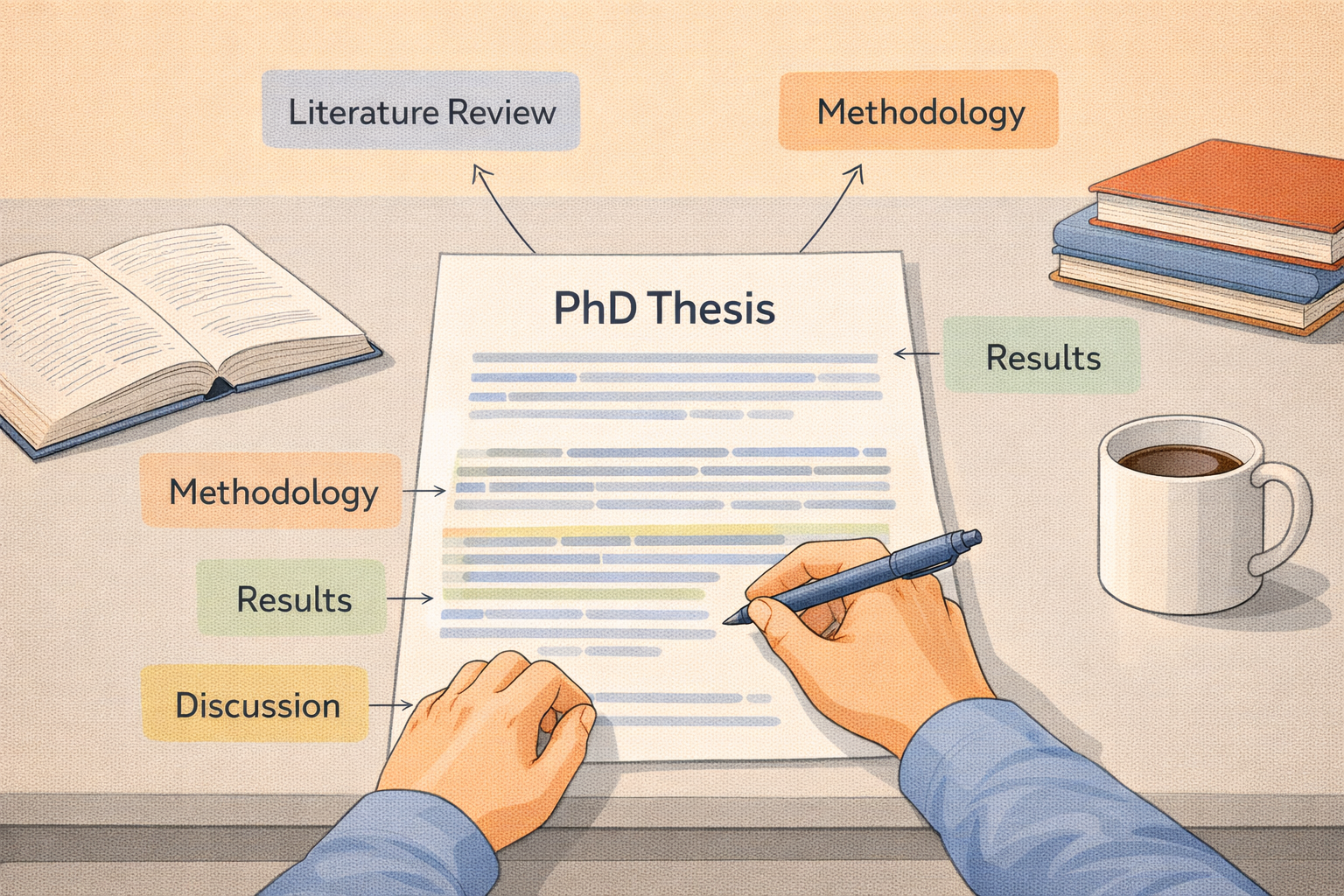
Before writing begins, students should develop a detailed outline of their dissertation chapters. This outline should identify the purpose of each chapter and explain how it contributes to the overall research argument.
Planning the dissertation structure also helps maintain logical progression from the research problem to the final conclusions.
| Chapter | Purpose |
|---|---|
| Introduction | Defines the research problem and objectives |
| Literature Review | Examines existing research and theoretical frameworks |
| Methodology | Explains research design and data collection methods |
| Results or Findings | Presents research data and analysis |
| Discussion | Interprets findings and connects them to the literature |
| Conclusion | Summarizes research contributions and implications |
A clear structure ensures that readers can follow the development of the research argument.
Developing Clear and Focused Research Arguments
Strong PhD writing is built around clear academic arguments. Each chapter should contribute directly to answering the central research question.
Doctoral students should ensure that their arguments are supported by evidence, including theoretical frameworks, empirical data, and relevant scholarly sources. Claims must be carefully justified rather than presented as assumptions.
Writing effective academic arguments also involves explaining how individual findings connect to broader theoretical debates within the discipline.
Integrating Literature Effectively
One of the most important aspects of PhD research writing is engaging with existing academic literature. The literature review should not simply summarize previous studies but should critically evaluate them.
Effective literature integration involves identifying patterns, disagreements, and gaps in existing research. Students should demonstrate how their study responds to these gaps and advances academic understanding.
Throughout the dissertation, references to existing literature help situate the research within the broader academic conversation.
Maintaining Academic Clarity in Long Documents
Because doctoral dissertations are extensive documents, maintaining clarity throughout the text can be challenging. Long paragraphs, complex arguments, and detailed explanations may overwhelm readers if not presented carefully.
Students should focus on writing clearly structured paragraphs that introduce one idea at a time. Each paragraph should begin with a clear topic sentence, followed by explanation and supporting evidence.
Consistent terminology also helps maintain clarity. Using different terms for the same concept can confuse readers and weaken the research argument.
Managing the Writing Process During Doctoral Research
Writing a PhD dissertation requires long term discipline and consistent progress. Many students struggle with writing because they attempt to complete large sections of the dissertation at once.
Breaking the writing process into smaller tasks can make the project more manageable. For example, students may focus on completing one subsection at a time rather than attempting to write entire chapters in a single session.
- Set regular writing goals.
- Write short sections consistently.
- Review and revise drafts frequently.
- Discuss progress with supervisors.
- Track sources and references carefully.
Developing a structured writing routine helps maintain momentum throughout the research project.
Strengthening Analysis and Interpretation
PhD dissertations must move beyond description and demonstrate strong analytical thinking. This means that research findings should be interpreted critically rather than simply presented.
Students should explain why their findings matter and how they contribute to existing theoretical or practical knowledge. The discussion chapter is particularly important because it connects research results to broader academic debates.
Strong analytical writing shows how evidence supports the overall research argument.
| Writing Type | Characteristics |
|---|---|
| Descriptive Writing | Summarizes information without interpretation |
| Analytical Writing | Evaluates evidence and explains significance |
Doctoral writing should emphasize analysis rather than simple description.
Editing and Revising the Dissertation
Writing the first draft of a PhD dissertation is only the beginning of the process. Editing and revision are essential for improving clarity, coherence, and academic quality.
Students should review their writing carefully to identify unclear explanations, repetitive ideas, and inconsistent terminology. Editing also involves checking citations, formatting, and referencing accuracy.
Supervisors often provide feedback during the revision process, helping students strengthen the clarity and impact of their research.
Editing is where strong research becomes strong academic writing.
Developing Confidence in Doctoral Research Writing
Writing a PhD dissertation is a challenging but rewarding process. By applying effective PhD research writing tips, doctoral students can present their research clearly and demonstrate the significance of their work.
Successful doctoral writing combines careful planning, clear argumentation, critical analysis, and consistent revision. These practices help ensure that the final dissertation communicates its research contribution effectively.
Ultimately, strong PhD writing not only fulfills degree requirements but also contributes to the advancement of knowledge within the academic community.
Comments