
Many students associate essay quality with writing style or vocabulary. In academic assessment, however, the strongest indicator of a high-quality essay is effective planning. Well-planned essays are clearer, more focused, and more persuasive, regardless of discipline.
Planning essays effectively means making deliberate decisions before drafting begins. These decisions shape the argument, determine the structure, and control how evidence is used. When planning is weak or rushed, essays often become descriptive, repetitive, or unfocused.
This article explains how to plan essays effectively at university level, offering a structured, academically grounded approach that supports confident and efficient writing.
What Effective Essay Planning Really Means
Effective essay planning is not about filling out a template or writing a brief list of bullet points. It is an intellectual process that involves analysing the task, deciding on an argument, selecting relevant evidence, and organising ideas into a logical sequence.
At university level, planning is where most critical thinking occurs. Students evaluate sources, test ideas, and clarify their position before committing anything to a final draft.
An effectively planned essay feels intentional rather than improvised, with each paragraph serving a clear purpose.
Key academic principle: Examiners reward essays that demonstrate structured thinking before structured writing.
Why Planning Essays Effectively Improves Academic Performance
Planning reduces uncertainty. Students who plan thoroughly know what they are arguing, why they are arguing it, and how each section contributes to the whole.
Effective planning also improves time management. Instead of rewriting large sections, students refine ideas at the planning stage, where changes are easier and less time-consuming.
Most importantly, planning supports coherence, which is one of the most heavily weighted assessment criteria in university marking rubrics.
Understanding the Assignment Before Planning
Effective planning begins with accurate task interpretation. Many essays fail not because of weak writing, but because they do not answer the question that was set.
Before planning arguments or structure, students must understand what the assignment is asking them to do.
This stage defines the boundaries of the essay and prevents irrelevant content.
Identifying Command Words
Command words such as “analyse,” “critically evaluate,” or “compare” determine the type of reasoning required.
Planning essays effectively means aligning your approach with these instructions.
Misinterpreting command words leads to mismatched responses.
Clarifying Scope and Constraints
Essay questions often contain implicit limits, such as time periods, theoretical perspectives, or case-study boundaries.
Effective planning acknowledges these constraints early.
This prevents overgeneralisation.
Developing a Clear Central Argument
Every effective essay is built around a central argument or position. Planning is where this argument is defined and refined.
An argument is not a topic. It is a claim that can be supported, challenged, and defended using evidence.
Without a clear argument, essays tend to become descriptive summaries.
Testing Your Argument During Planning
Effective planning involves questioning your own position.
Students should ask whether their argument is specific, defensible, and directly related to the question.
If an argument cannot be clearly stated in one or two sentences, it is not yet ready.
Planning Research Strategically
Planning essays effectively includes planning how research will be used, not simply collecting sources.
At university level, evidence must be relevant, credible, and integrated into the argument.
Randomly assembled sources weaken analytical depth.
Selecting Sources with Purpose
Each source should support a specific claim or perspective.
Effective planning groups sources by argument rather than by author.
This improves paragraph coherence.
Balancing Breadth and Depth
Planning helps students decide where depth is required and where broader coverage is sufficient.
This balance is essential in word-limited assignments.
Overloading paragraphs with citations often indicates poor planning.
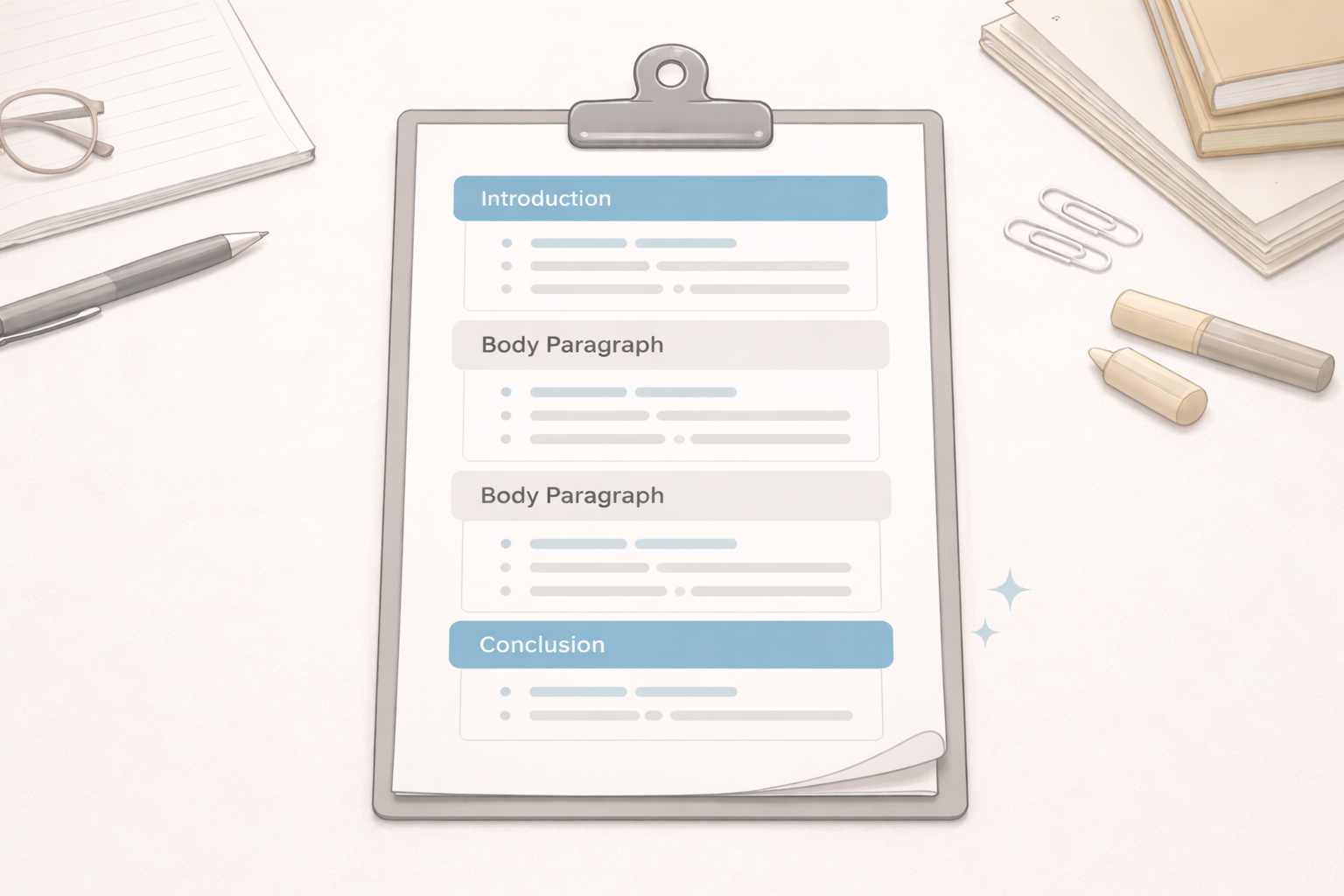
Structuring the Essay Before Writing
Structure is the visible outcome of effective planning. It determines how easily a reader can follow the argument.
Planning essays effectively means deciding on structure before drafting begins.
This prevents disorganised or repetitive writing.
Planning the Introduction
Introductions should contextualise the topic, define scope, and present the central argument.
Planning ensures the introduction is proportionate and purposeful.
Overly long introductions often signal uncertainty.
Mapping Body Paragraphs
Each body paragraph should advance one clear idea.
Effective planning determines the order in which ideas appear.
This sequencing supports logical progression.
Planning the Conclusion
Conclusions should synthesise insights rather than repeat content.
Planning helps students decide what the essay ultimately demonstrates.
This reinforces analytical significance.
Common Planning Errors Students Make
Understanding common mistakes helps students plan more effectively.
Most errors occur when planning is rushed or skipped.
Avoiding these mistakes significantly improves essay quality.
- Beginning to write without a clear argument
- Planning structure after drafting
- Using sources without a defined purpose
- Ignoring assessment criteria during planning
Each of these errors results in avoidable weaknesses.
Table: Components of Effective Essay Planning
The table below outlines key components involved in planning essays effectively and their academic benefits.
| Planning Component | Primary Focus | Academic Benefit |
|---|---|---|
| Task analysis | Understanding requirements | Relevance and focus |
| Argument development | Defining position | Analytical clarity |
| Research planning | Source selection | Stronger evidence integration |
| Structural outlining | Idea organisation | Logical coherence |
These components work together to produce coherent academic writing.
Planning Essays Effectively Under Time Pressure
Effective planning is possible even when deadlines are tight.
Short planning sessions focused on argument and structure are more valuable than extensive unstructured drafting.
Even a brief outline improves clarity.
Prioritising Key Planning Decisions
When time is limited, students should prioritise task interpretation, argument definition, and paragraph structure.
Detailed note-taking can be reduced.
Strategic planning remains essential.
Academic Support for Essay Planning
Some students benefit from guided planning support, especially for complex assignments.
Structured assistance is often provided through academic essay writing support, which focuses on early-stage clarity and structure.
For extended projects, dissertation planning support helps students manage complexity.
Once drafts are completed, clarity and coherence can be refined through professional editing and proofreading.
Using Planning to Strengthen Academic Writing
Planning essays effectively is not an optional skill in higher education. It is the foundation of academic success.
Well-planned essays demonstrate clarity of thought, logical structure, and purposeful evidence use.
Students who prioritise planning write with greater confidence, efficiency, and analytical depth.


Comments