Academic writing requires more than good ideas; it demands clear structure, logical progression, and disciplined organisation. One of the most effective tools for achieving these qualities is a well-constructed essay outline.
Despite its importance, many students either skip outlining entirely or treat it as a superficial planning step. As a result, essays often appear disorganised, repetitive, or analytically weak.
This article explains what an essay outline is, why it is essential in higher education, and how to design outlines that support strong academic performance across disciplines.
What an Essay Outline Is and What It Is Not
An essay outline is a structured plan that maps out the logical flow of an essay before full drafting begins. It identifies the main argument, supporting points, evidence placement, and overall progression.
Importantly, an outline is not a summary of sources or a list of random ideas. Its purpose is organisational rather than descriptive.
At university level, outlines function as intellectual scaffolding that supports analytical depth and coherence.
Definition: An essay outline is a logical framework that organises arguments, evidence, and analysis before writing begins.
Why an Essay Outline Matters in Academic Writing
One of the most common reasons essays lose marks is weak structure. Ideas may be strong individually, but without clear organisation, their impact is diluted.
An essay outline helps writers maintain focus on the central argument while ensuring each paragraph contributes meaningfully to that argument.
For examiners, a well-structured essay signals clarity of thought, critical control, and academic maturity.
How Essay Outlines Support Logical Argument Development
Academic essays are expected to present arguments logically rather than narratively. An outline forces writers to consider how each claim leads to the next.
By planning argumentative progression in advance, students reduce the risk of abrupt topic shifts or unsupported assertions.
This logical sequencing is particularly important in argumentative and analytical essays.
Core Components of a Standard Essay Outline
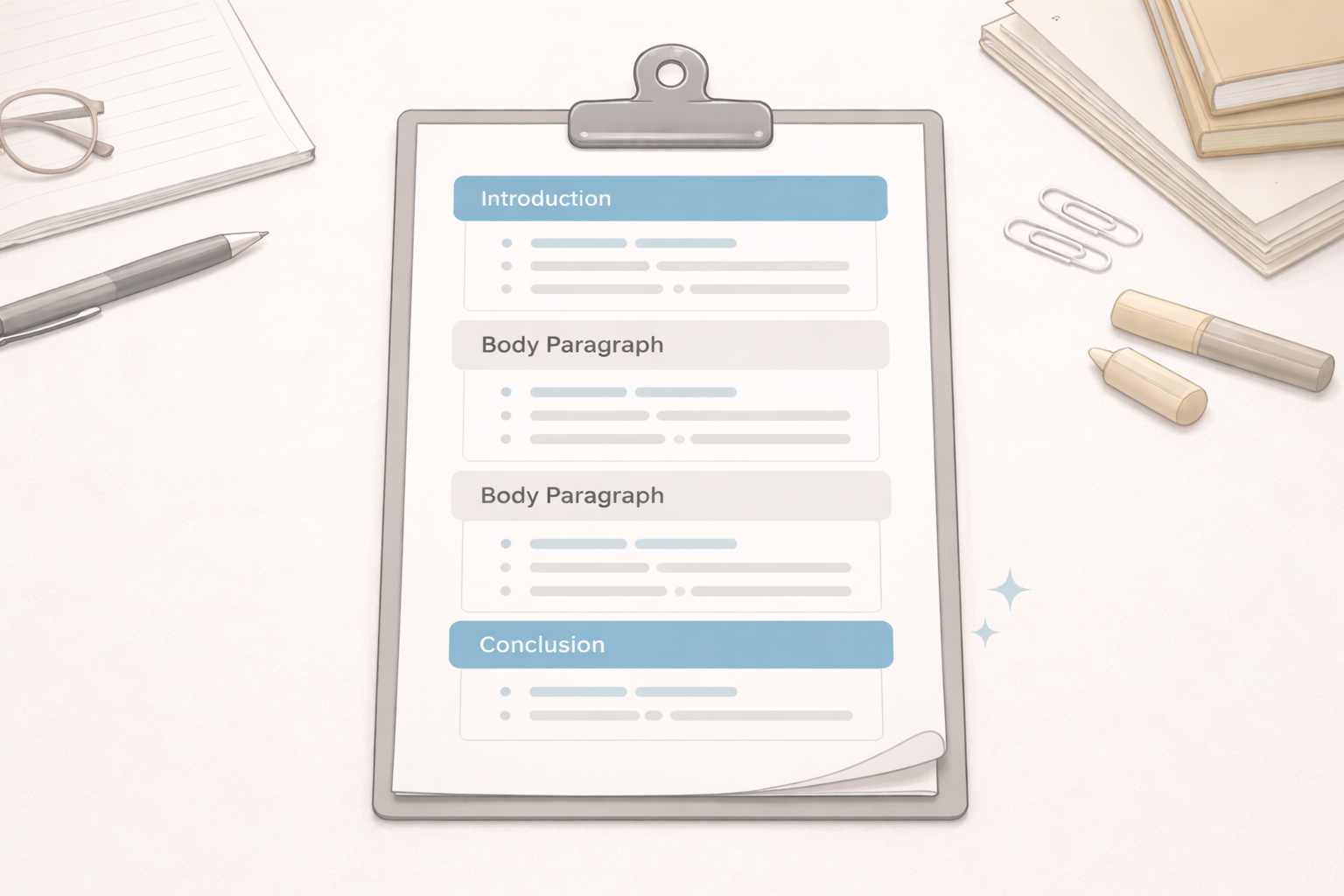
Although outlines vary by discipline and task, most academic essay outlines share a common structural logic.
Each component serves a distinct purpose in guiding the reader through the argument.
- Introduction focus and thesis direction
- Main body arguments arranged logically
- Evidence and examples aligned with each claim
- Counterarguments where appropriate
- Conclusion synthesis points
This structure ensures balance between argument, evidence, and analysis.
Planning the Introduction Within an Essay Outline
The introduction sets the intellectual direction of the essay. In an outline, this section should clarify the topic context and argumentative focus.
Rather than writing full sentences, outlines typically specify the function of the introduction and the intended thesis position.
Clear planning at this stage prevents vague or overly broad introductions.
Structuring Body Paragraphs in an Essay Outline
Each body paragraph should advance a single, clearly defined point. An effective essay outline assigns one argument to each paragraph.
Within the outline, it is useful to note what evidence will support the point and what analysis will follow.
This approach prevents repetition and ensures balanced development.
Using Topic Sentences as Structural Anchors
Topic sentences act as signposts for readers and examiners. Including provisional topic sentences in an outline strengthens paragraph focus.
Even brief topic sentence notes help maintain argumentative discipline during drafting.
This practice is especially valuable in longer essays.
Integrating Evidence at the Outline Stage
One major benefit of outlining is the ability to plan evidence placement deliberately.
Rather than inserting sources randomly, outlines allow writers to align evidence directly with claims.
This improves analytical depth and reduces the risk of evidence dumping.
Examiner expectation: Evidence should be selected and positioned strategically, not added after drafting.
Addressing Counterarguments Through Outlining
In many disciplines, engaging with counterarguments is essential for high-level analysis.
An essay outline allows students to decide where opposing views will be introduced and how they will be evaluated.
This planning avoids defensive or superficial rebuttals.
Common Essay Outline Formats
Essay outlines can take different forms depending on assignment requirements and personal working style.
The most effective format is one that promotes clarity rather than visual complexity.
| Outline Format | Key Features | Best Used For |
|---|---|---|
| Bullet-point outline | Concise, flexible structure | Short to medium-length essays |
| Sentence outline | Detailed paragraph planning | Complex analytical essays |
| Decimal outline | Hierarchical organisation | Long research-based assignments |
Choosing an appropriate format depends on essay length and analytical demands.
Adapting Essay Outlines for Different Assignment Types
Not all essays require the same structural emphasis. Descriptive, analytical, and argumentative essays differ in organisation.
An effective essay outline reflects these differences rather than applying a generic template.
Understanding task instructions is therefore essential before outlining begins.
Common Mistakes When Creating an Essay Outline
Some students overcomplicate outlines, turning them into mini-essays. Others keep them too vague to be useful.
Another frequent mistake is failing to revise the outline after research reveals new insights.
An outline should be a flexible planning tool, not a rigid constraint.
Critical warning: An outline that does not evolve with your argument will weaken analytical coherence.
Using Essay Outlines to Improve Drafting Efficiency
Well-prepared outlines significantly reduce drafting time. Writers spend less effort deciding what comes next and more on analysis.
This efficiency is particularly valuable under exam or deadline pressure.
Outlining also reduces the need for extensive structural revisions later.
Final Guidance on Building Effective Essay Outlines
An essay outline is not an optional extra but a core academic skill that supports clarity, coherence, and critical thinking.
By planning arguments, evidence, and progression in advance, students improve both writing quality and confidence.
Mastery of essay outlining ultimately leads to stronger, more persuasive academic work.



Comments