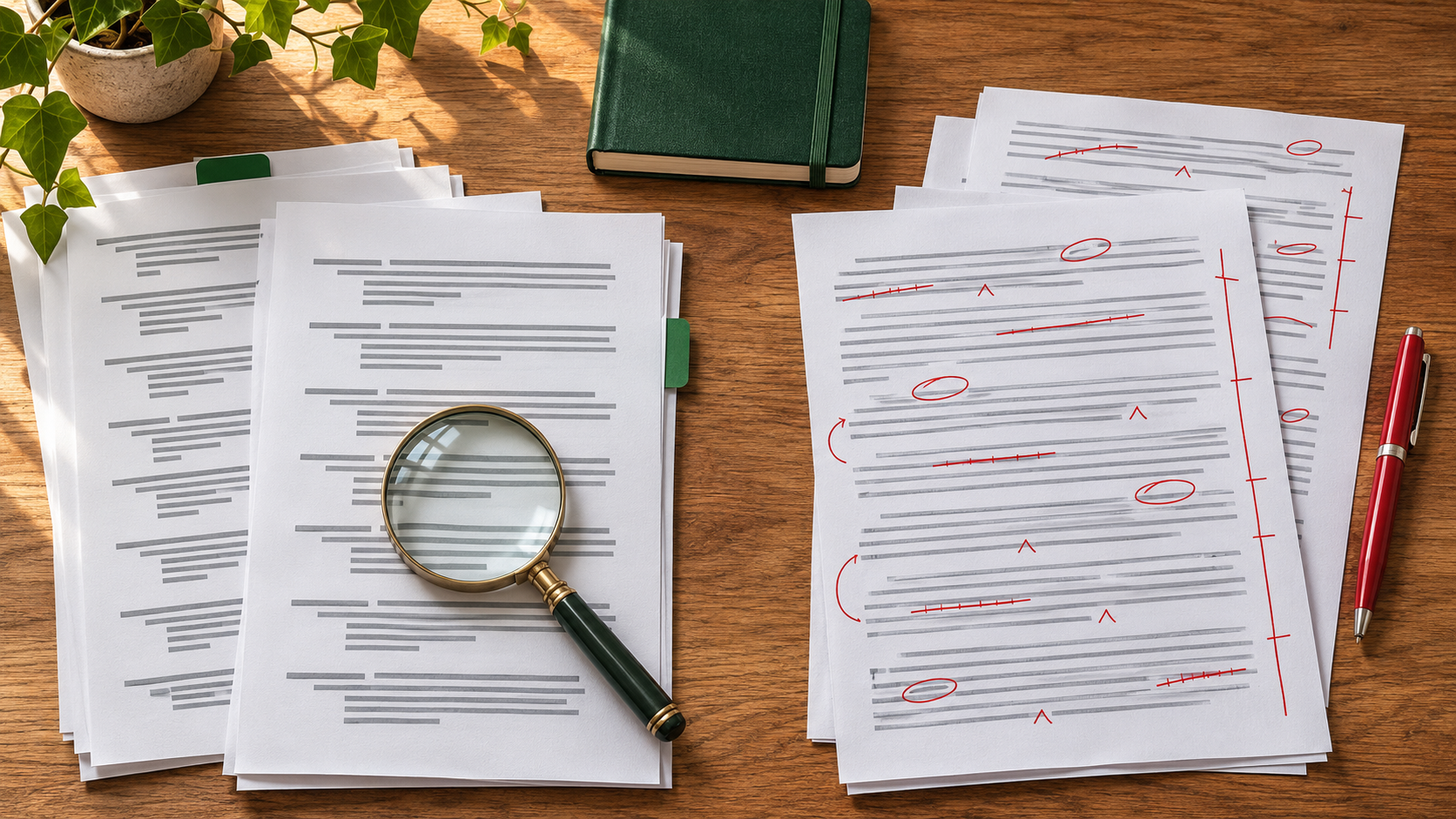
Accurate referencing and clear writing are essential to credible academic work. A dissertation may contain well-developed arguments and careful research yet still include missing citations, incorrect publication details, grammatical errors, or inconsistently formatted references. These problems affect the finished document in different ways. Some make the writing difficult to follow, while others prevent readers from identifying the evidence supporting particular claims. Recognising the difference matters because correcting the language of a sentence does not necessarily establish that the research evidence behind it is accurate.
Reference checking vs proofreading: what is the difference? Reference checking examines the accuracy, completeness, consistency, and traceability of citations and bibliographic information. Depending on its scope, it may also involve verifying whether cited sources support the statements attributed to them. Proofreading concentrates primarily on spelling, grammar, punctuation, and presentation errors in an otherwise completed document. Although the two activities overlap, they require different methods and levels of investigation. This guide explains their purposes, provides realistic examples, examines common referencing problems, and demonstrates how students can combine both processes before submitting academic assignments, dissertations, and research papers.
Reference Checking vs Proofreading: What Is the Main Difference?
The fundamental difference concerns what each activity attempts to verify. Reference checking asks whether readers can identify the sources used and whether the recorded information corresponds to those sources. Proofreading asks whether the writing and its presentation are technically correct. For example, correcting a misplaced comma improves the presentation of a sentence, but it does not establish whether a cited journal article exists. Similarly, correcting an author's surname in a reference list does not address grammatical problems elsewhere in the assignment. Both tasks contribute to academic quality, but neither replaces the other.
The University of Wisconsin–Madison's APA citation guidance explains that in-text citations must correspond to the appropriate reference-list entries. This relationship makes source identification possible. Meanwhile, ordinary academic proofreading addresses language and presentation issues that remain after substantive writing has been completed. Epic Essay's guide to proofreading and editing differences provides further context for understanding the final technical review stage.
The following table compares the two processes and distinguishes their principal responsibilities. Actual professional service packages may combine these activities, so the agreed scope should always be checked.
| Academic Feature | Reference Checking | Proofreading |
|---|---|---|
| Primary purpose | Establish accurate, complete, and traceable citation information. | Correct technical language and presentation errors. |
| Typical checks | Citation matching, author names, publication years, titles, source details, and identifiers. | Spelling, grammar, punctuation, typography, and formatting consistency. |
| Source examination | May involve consulting original publications and assessing whether claims are supported, if included in the agreed scope. | Does not ordinarily require reading the underlying research publications. |
| Expected result | References readers can trace, with discrepancies identified for correction. | A more accurate and consistently presented manuscript. |
The distinction is particularly important when purchasing academic support. Some proofreading services include basic citation-format checks but do not verify bibliographic metadata or examine cited studies. Conversely, a reference-checking service may correct the bibliography without examining the grammar of the main text. Students should establish what the reviewer will actually verify rather than infer the scope from a general description such as comprehensive academic proofreading.
What Does Reference Checking Actually Involve?
Reference checking can operate at several levels, and distinguishing them helps students understand what has genuinely been verified. The first level concerns correspondence between citations and the final source list. The second involves confirming bibliographic information against reliable publication records. A more extensive review examines whether the research evidence supports the statements attributed to it. These activities are related but not equivalent. A document can have perfectly matched citations while referring to an incorrect publication, and a correctly identified publication can still be used to support a misleading claim.
Checking In-Text Citations Against the Reference List
The first task is comparing every citation in the body of the assignment with the final reference list. In common author–date systems, the author's surname and publication year should direct the reader to the corresponding entry. Problems arise when an author is cited under a different year, a publication appears in the text but not the bibliography, or multiple works by the same author are insufficiently distinguished. The University of Northampton's Harvard referencing guidance
Consider a fictional dissertation that cites (Patel, 2023) in its literature review but includes a reference entry labelled Patel (2022). The discrepancy cannot be resolved simply by choosing whichever year appears more often. The student must consult the publication to identify the correct date and then make the citation and reference consistent. A reference checker may flag the mismatch, but the researcher's source records provide the basis for deciding which information is accurate. A similar approach applies when different researchers share a surname or when several publications by one author appeared in the same year.
Verifying Author Names, Publication Details, and DOIs
The next level involves checking whether the bibliographic information accurately identifies the publication. Journal articles may require verification of author names, titles, journal details, volume and issue numbers, page ranges, and digital object identifiers. Books may require an edition and publisher, while reports may identify an institutional author and report number. Incorrect details can direct readers to an unrelated publication or prevent them from finding the source altogether. However, students should verify the version they actually consulted rather than automatically substitute a newer edition or a more recent publication date.
Crossref's official guidance on metadata lookupCrossref's DOI verification guidance. Nevertheless, a functioning DOI does not demonstrate that the surrounding citation is correct or that the publication supports the student's argument. The title, authors, date, and actual contents must still correspond to the cited source. A working link establishes a route to a publication, not the validity of every claim attributed to it.
Checking Whether Sources Support Academic Claims
A deeper evidence review examines the relationship between an academic statement and the research cited to support it. For example, a study reporting an association between student attendance and academic performance cannot automatically establish that attendance caused higher grades. Likewise, findings obtained from a small qualitative sample should not be represented as population-wide statistical estimates. The Penn State University Libraries' source-evaluation guidance
Evidence checking can involve reading the original publication's methods, findings, and limitations. The researcher should determine whether the quotation is accurate, whether the paraphrase preserves context, and whether the cited work supports the strength of the conclusion. These checks become particularly important in literature reviews, where several studies may be combined into a broader argument. However, an external proofreader is not ordinarily responsible for reconstructing the student's interpretation. If a potential mismatch is discovered, the appropriate response is to flag it for the author to investigate.
What Does Academic Proofreading Check?
Proofreading addresses technical problems that remain once the academic content is substantially complete. These include spelling errors, punctuation mistakes, incorrect grammatical agreement, inconsistent capitalisation, and presentation irregularities. A carefully proofread dissertation should communicate its existing research with fewer distractions. Nevertheless, proofreading does not establish whether the evidence is sufficient, the methodology is appropriate, or the argument is valid. These matters require academic revision and evaluation by the researcher, with appropriate supervisory support where available.
For example, the sentence "The findings was consistent across the interviews" contains a grammatical agreement error. Changing "was" to "were" corrects the sentence without altering its stated meaning. However, a proofreader cannot determine from that sentence alone whether the findings genuinely were consistent across interviews. That judgement depends on the research data. This example illustrates the limits of surface-level correction: a grammatically accurate statement may still be academically unsupported. Good proofreading improves the presentation of existing claims without presenting itself as an audit of their truth.
Proofreading may also include checking citation punctuation and formatting consistency, depending on the service agreement. A reviewer might notice inconsistent use of parentheses around dates or variations in the layout of journal titles. Such issues are different from independently verifying the original publications. Epic Essay's thesis proofreading checklist
Reference Checking vs Proofreading: Practical Before-and-After Examples
Realistic examples make the distinction clearer because the same paragraph may contain language mistakes and citation problems simultaneously. A reader might encounter a sentence with a missing comma, an incorrect publication year, and a claim that goes beyond the source's findings. Correcting only the punctuation would leave important research problems unresolved. Conversely, fixing the citation would not improve the sentence's grammatical accuracy. Each issue requires the appropriate checking procedure, and some demand the researcher's independent judgement.
The following examples are fictional and demonstrate different checking decisions. They do not represent verified research publications or real bibliographic records.
| Original Problem | Type of Review | Appropriate Action |
|---|---|---|
| The findings was consistent across the interviews. | Proofreading | Correct "was" to "were" while preserving the author's intended statement. |
| An in-text citation shows Patel (2023), while the reference list records Patel (2022). | Citation matching and source verification | Consult the actual publication and correct the inaccurate year in the relevant location. |
| A reference contains an article title that does not match the publication associated with its DOI. | Bibliographic verification | Compare the recorded metadata with the publisher's publication information. |
| A sentence claims that an intervention caused improvement, but the cited study reports only a correlation. | Evidence checking | Flag the overstatement and ask the researcher to reassess the conclusion against the evidence. |
| The reference list uses inconsistent punctuation between journal titles, volume numbers, and page ranges. | Referencing-style review and proofreading | Apply the required style consistently without changing bibliographic facts. |
The examples show that editorial boundaries depend on the nature of the problem. Correcting grammatical agreement is fundamentally different from deciding whether a research finding supports a causal claim. Publication metadata can be checked against authoritative records, while interpretation must remain under the researcher's intellectual control. Students should therefore avoid judging an academic service by the quantity of corrections alone. A responsible reviewer identifies what can be fixed technically and what requires further verification or an author-led decision.
Why Referencing Style Changes the Checking Process
Reference checking must follow the citation system required by the assignment or institution. APA, Harvard, IEEE, MLA, and Chicago use different conventions for identifying sources and presenting bibliographic information. In APA, in-text author–date citations ordinarily correspond to an alphabetical reference list. Harvard commonly follows a similar principle, although individual universities maintain their own variations. IEEE uses numbered citations linked to a source list ordered by first appearance rather than alphabetically. These distinctions affect how missing entries, inconsistent identifiers, and ordering problems should be investigated.
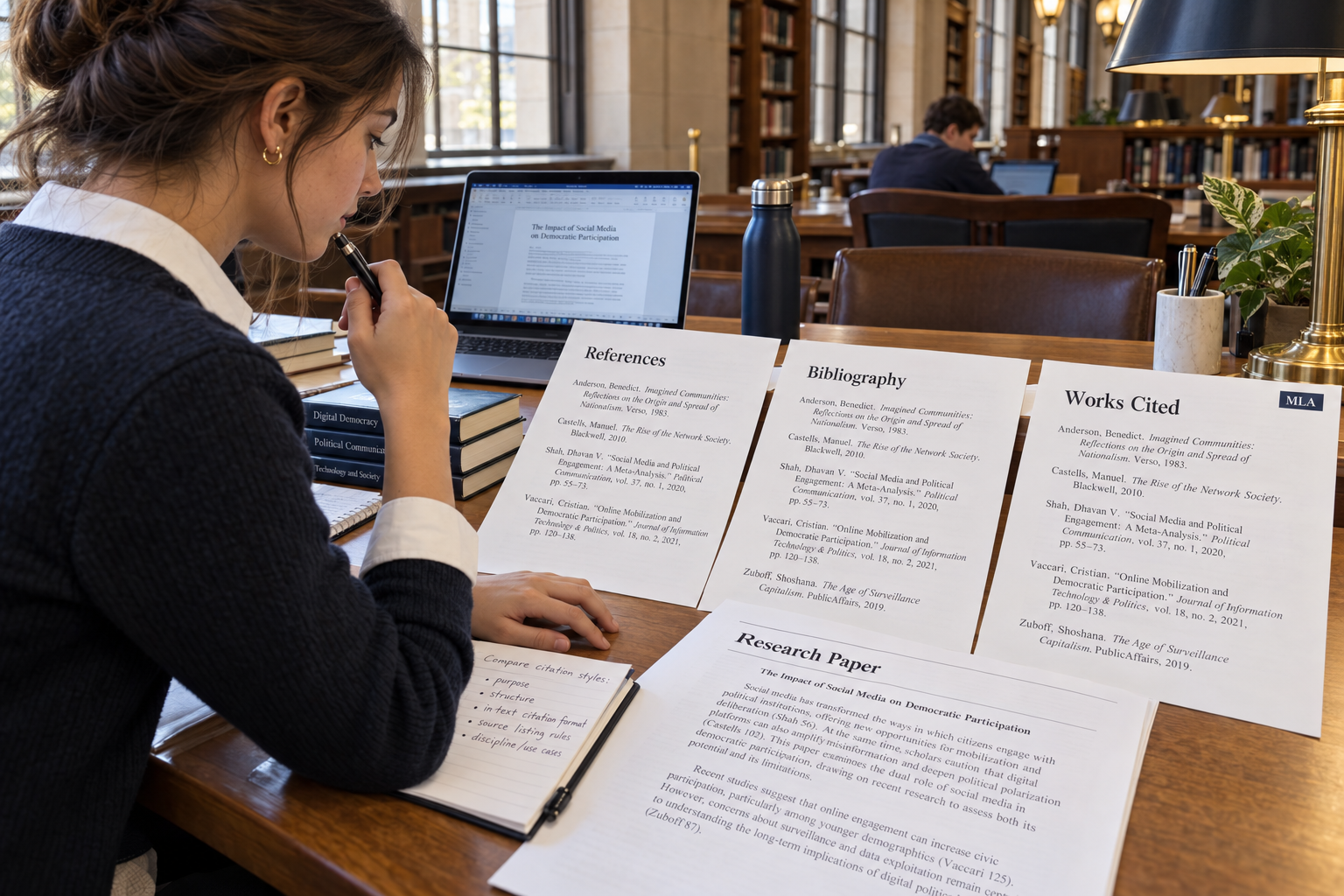
Epic Essay's comparison of reference lists, bibliographies, and works citedHarvard referencing examples guide, while engineering and computing students may find the IEEE referencing guide
Style-specific exceptions matter. APA has particular rules for personal communications and secondary citations, while some footnote-based systems employ different relationships between notes and the bibliography. Consequently, a missing reference-list entry should be investigated before being labelled an error. Students should consult their department's official guidance rather than assume that every citation must appear in exactly the same format. An accurate reference check applies the right rules to the right kind of source.
Can Reference Managers and Automated Tools Replace Manual Checking?
Reference-management software can reduce repetitive work by storing publication details and generating citations in selected styles. Tools such as Zotero, EndNote, and Microsoft Word's referencing features may be useful when a dissertation contains numerous sources. However, automatically generated entries depend on the underlying metadata and citation settings. If an imported record contains the wrong author, date, title, or publication type, the resulting citation may reproduce that error consistently throughout the document. The University of Sunderland's referencing guidance
Crossref can help locate publication records and DOIs, but a metadata match is not a substitute for checking the actual source. Similarly, spellcheckers can identify language errors without verifying whether an article supports a claim. Generative AI systems may produce plausible-looking citations containing inaccurate or nonexistent details. Penn State University's guidance recommends independently verifying sources rather than assuming that machine-generated bibliographic information is reliable. These tools are therefore most effective as aids to a structured review, not replacements for academic judgement.
Similarity checking software serves a different purpose again. A similarity report identifies text matches against material in its comparison database; it does not determine whether a citation is accurate, whether an argument is properly supported, or whether the student has interpreted a source fairly. A low similarity percentage should not be treated as confirmation that reference checking is complete. The appropriate approach is to examine source details, evaluate attribution, and consider the evidence independently.
How to Complete Reference Checking and Proofreading Before Submission
The two activities work best when they form part of an organised final review. Substantive academic revisions should normally come first because changes to arguments and evidence may require additional sources or different citations. Reference checking should then establish that the manuscript accurately records and uses the evidence actually consulted. Proofreading can follow once the text and bibliography are substantially stable, although a final citation check remains worthwhile after any late revisions.
A practical workflow involves the following stages:
- Confirm the required referencing style and whether the assignment calls for a reference list, bibliography, or another source-list format.
- Compare every in-text citation with the final source list and investigate unmatched entries or inconsistent author–date combinations.
- Verify publication details using original sources, publisher records, library catalogues, or appropriate identifier databases.
- Review significant quotations, paraphrases, statistics, and research claims to confirm that the cited evidence supports them.
- Proofread the completed manuscript for grammatical errors, punctuation, spelling, presentation, and citation-style consistency.
- Inspect the final document after corrections to ensure that no references, quotations, or formatting elements were accidentally changed.
This sequence separates source accuracy from language quality without treating them as unrelated responsibilities. A revised sentence may require its citation to be checked again, while a corrected reference entry may reveal that a claim was attributed to the wrong publication. Final quality control is therefore iterative rather than a single mechanical pass. Students can use Epic Essay's thesis submission checklist
What Should You Do When Reference Checking Reveals a Serious Problem?
Some errors cannot be resolved through formatting changes. A source may not exist, a quotation may be inaccurate, or the cited research may not support the claim made in the assignment. These problems require the author to revisit the evidence rather than ask a proofreader to produce a replacement. For example, if a cited article is found to report an association rather than causation, the researcher must reconsider the conclusion and determine what the available evidence actually justifies. Changing a word in the bibliography would not resolve the underlying analytical weakness.
Students should also distinguish between an inaccessible source and an unverifiable source. A journal article behind a subscription paywall may be legitimate and accessible through the university library. Conversely, a citation that cannot be located through reasonable searches requires further investigation, even when its formatting appears correct. The appropriate response is to consult the original reading notes, publisher records, or library support. If the publication cannot be verified, it should not remain in the assignment merely because it appears convincing.
Should You Pay for Reference Checking or Proofreading?
The appropriate service depends on the manuscript's needs. A dissertation with accurate, verified references but frequent grammar and punctuation problems may benefit from permitted proofreading assistance. A manuscript with inconsistent citation years, missing source details, and uncertain DOIs requires reference checking. Where both problems occur, a combined service may be useful, provided the agreement clearly explains what is included. Students should not assume that basic proofreading covers independent DOI verification, source retrieval, or investigation of whether cited studies support academic claims.
University regulations must also be considered. The University of Bristol's research-degree academic integrity guidanceUniversity of Auckland's guidelines
Epic Essay's dissertation and research paper services
Reference Checking and Proofreading: Two Essential Final Reviews
Reference checking and proofreading contribute to academic quality in different but complementary ways. Reference checking establishes whether citations are complete, traceable, and accurate, with deeper verification examining whether evidence supports the claims made. Proofreading addresses language and presentation problems that may distract readers or obscure meaning. Neither process compensates for incomplete research, unsupported analysis, or unresolved methodological weaknesses. Those matters remain the responsibility of the researcher.
The most reliable approach is to complete substantive revisions, verify the sources actually used, and then undertake a careful technical review. Students should investigate questionable references rather than silently replace them, preserve the intended meaning of their writing, and follow the referencing system required by their institution. When both processes are completed thoughtfully, the final document becomes easier to read and its supporting evidence easier to examine. That combination strengthens the transparency and credibility of academic work without compromising the author's intellectual contribution.


Comments