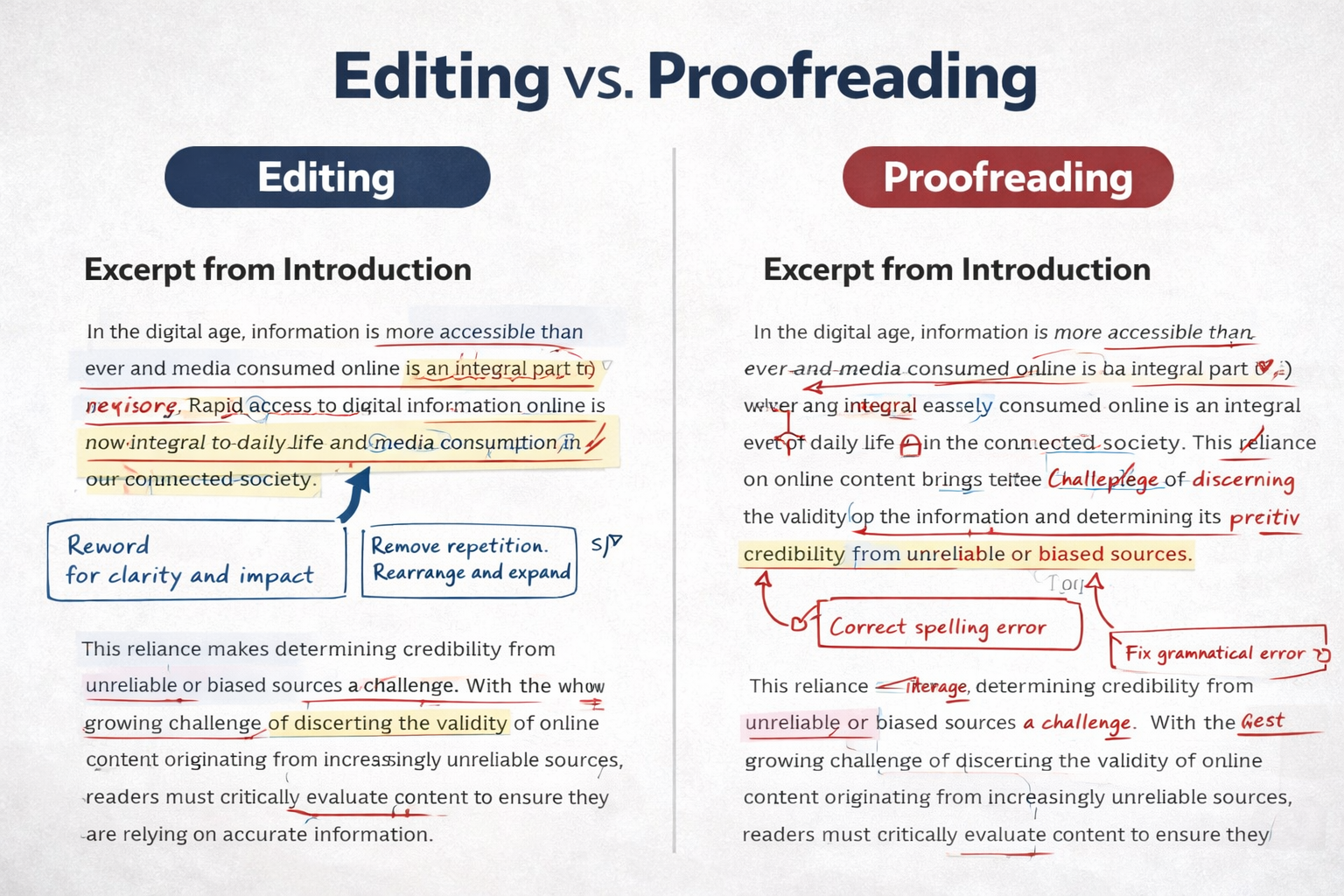
In academic writing, the terms proofreading and editing are often used interchangeably, yet they refer to very different processes with distinct purposes, skillsets, and outcomes. Understanding the proofreading vs editing difference is vital for university and college students who want to enhance the quality, clarity, and credibility of their essays, dissertations, theses, and research reports. Misunderstanding or misapplying these processes can lead to suboptimal revisions, academic penalties, or wasted time.
Proofreading and editing are both essential components of high‑quality academic work—but they occur at different stages and focus on different aspects of text improvement. This comprehensive guide examines what each process involves, how they differ, and practical examples to help students decide when to prioritise proofreading, editing, or both.
What Editing Means in Academic Writing
Editing is the substantive process of revising a draft to improve its overall structure, logic, and academic quality. It involves addressing content clarity, argument coherence, paragraph flow, and stylistic consistency. Editing is not merely about correcting errors; it is about transforming a draft into a well‑organised and academically credible piece of writing.
Academic editing typically includes: content review for alignment with assignment criteria, refinement of thesis statements, restructuring paragraphs to ensure logical progression, enhancement of clarity and tone, and consistency in terminology. In some cases, editing also involves fact‑checking or refining evidence integration to strengthen analytical arguments. Effective editing often requires an understanding of academic conventions, discipline‑specific expectations, and critical reasoning.
For students, editing may mean rewriting sections for clarity, integrating feedback from supervisors, or elevating descriptive passages into analytical arguments. Editing is not the final stage of polishing; rather, it is a core developmental stage that shapes the intellectual quality of the text.
What Proofreading Entails
Proofreading, by contrast, is primarily a surface‑level process that occurs after the substantive content and structure have been finalised. Its main goal is to ensure technical accuracy in spelling, grammar, punctuation, formatting, and citation style. Proofreading does not typically involve changing sentence structure, rearranging paragraphs, or rephrasing arguments unless they contain grammatical errors.
In academic contexts, proofreading corrects typographical errors, ensures consistent application of style guides (e.g., APA, MLA, Chicago), checks reference accuracy, and verifies formatting compliance. Proofreading happens late in the revision process, ideally after editing has addressed all structural and conceptual issues. It is the last step before submission and focuses on presenting polished, error‑free text.
For example, a proofreader might correct subject‑verb agreement errors, inconsistent use of abbreviation styles, missing commas, or incorrectly formatted citations, but they would not alter the organization of arguments or refine research claims.
Direct Comparison: Proofreading vs Editing
To clarify the proofreading vs editing difference, the table below offers a detailed, side‑by‑side comparison of their core features, focus areas, and typical outcomes in academic writing.
| Aspect | Editing | Proofreading |
|---|---|---|
| Primary Purpose | Improve clarity, structure, and argument quality | Correct surface‑level errors |
| Timing in Writing Process | After drafting, before final polishing | Final step before submission |
| Focus Areas | Content organisation, logical flow, academic tone | Grammar, spelling, punctuation, formatting |
| Depth of Changes | Substantial rewriting and restructuring | Minor text corrections |
| Skill Requirements | High — understanding of academic conventions and reasoning | Moderate — strong grammar and detail orientation |
| Typical Tools | Academic style guides, peer/supervisor feedback | Grammar checkers, formatting checklists |
This comparison illustrates that while editing and proofreading both aim to improve writing quality, they address different layers of the writing process. Editing shapes the intellectual argument and coherence, whereas proofreading ensures technical accuracy and presentation polish.
Why Understanding Their Differences Matters for Students
Students who misunderstand the proofreading vs editing difference often attempt to proofread too early or edit too late. Proofreading a poorly structured draft is inefficient because it does not address fundamental problems like unclear arguments or weak paragraphs. Conversely, extensive editing late in the process without final proofreading can result in lingering technical errors that undermine academic credibility.
For example, a dissertation written with excellent theoretical insight may still be penalised if it contains persistent grammar mistakes or formatting errors. Similarly, a carefully proofread text may be academically incoherent if its structure and arguments are weak. Recognising when each process is appropriate ensures that academic writing is both conceptually sound and technically polished.
When to Prioritise Editing and When to Proofread
In academic writing workflows, editing should precede proofreading. This sequence ensures that substantive issues are resolved before polishing the final product. Below is a practical checklist for students to decide when to edit and when to proofread:
- Begin with editing: Once your first complete draft is ready, focus on editing for logical structure, clarity, and content completeness.
- Check argument flow: Ensure your thesis statement, paragraph development, and evidence integration are coherent.
- Seek feedback: Incorporate feedback from supervisors or academic peers during the editing phase.
- Proceed to proofreading: After all major revisions are done, proofread for grammar, spelling, formatting, and citation accuracy.
- Final verification: Re‑check formatting requirements specific to your institution before submission.
Following this sequence reduces the risk of repeated revisions and enhances academic quality at each stage.
Examples of Editing vs Proofreading in Practice
Understanding how editing and proofreading differ becomes clearer with concrete examples:
Editing Example
Suppose a paragraph in a thesis concludes without linking back to the research question. An editor would revise the paragraph to connect its claims to the central research aim, potentially adding new transitional sentences or reorganising sentences for improved coherence. This is a substantive editing change that reshapes the argument.
Proofreading Example
If a section contains inconsistent use of past and present tense or misplaced commas, a proofreader would correct these technical issues without altering the paragraph’s conceptual content. These are surface‑level corrections that enhance readability and precision.
Skills Required for Effective Proofreading and Editing
Both processes require distinct yet complementary skills. Effective editing demands a deep understanding of academic conventions, critical reasoning, and structural coherence. Editors must recognise logical fallacies, weak transitions, and organisational problems. In contrast, effective proofreading requires meticulous attention to detail, mastery of grammar rules, and familiarity with formatting standards like APA, MLA, or Chicago.
For students, developing both sets of skills over time enhances academic writing capability. Practising editing improves critical thinking and structural awareness, while consistent proofreading fosters technical accuracy and professionalism.
Closing Insights on Proofreading vs Editing Difference
Understanding the proofreading vs editing difference is essential for producing high‑quality academic writing. Editing shapes the intellectual substance of your work, refining argumentation and structure, whereas proofreading ensures technical precision and presentation excellence. Both processes are necessary, but they must occur at different stages of the writing workflow. Students who master this sequence improve both the clarity and credibility of their academic texts.
By applying the strategies outlined above, you can approach academic revision with confidence, ensuring that your writing is both conceptually robust and technically flawless.


Comments