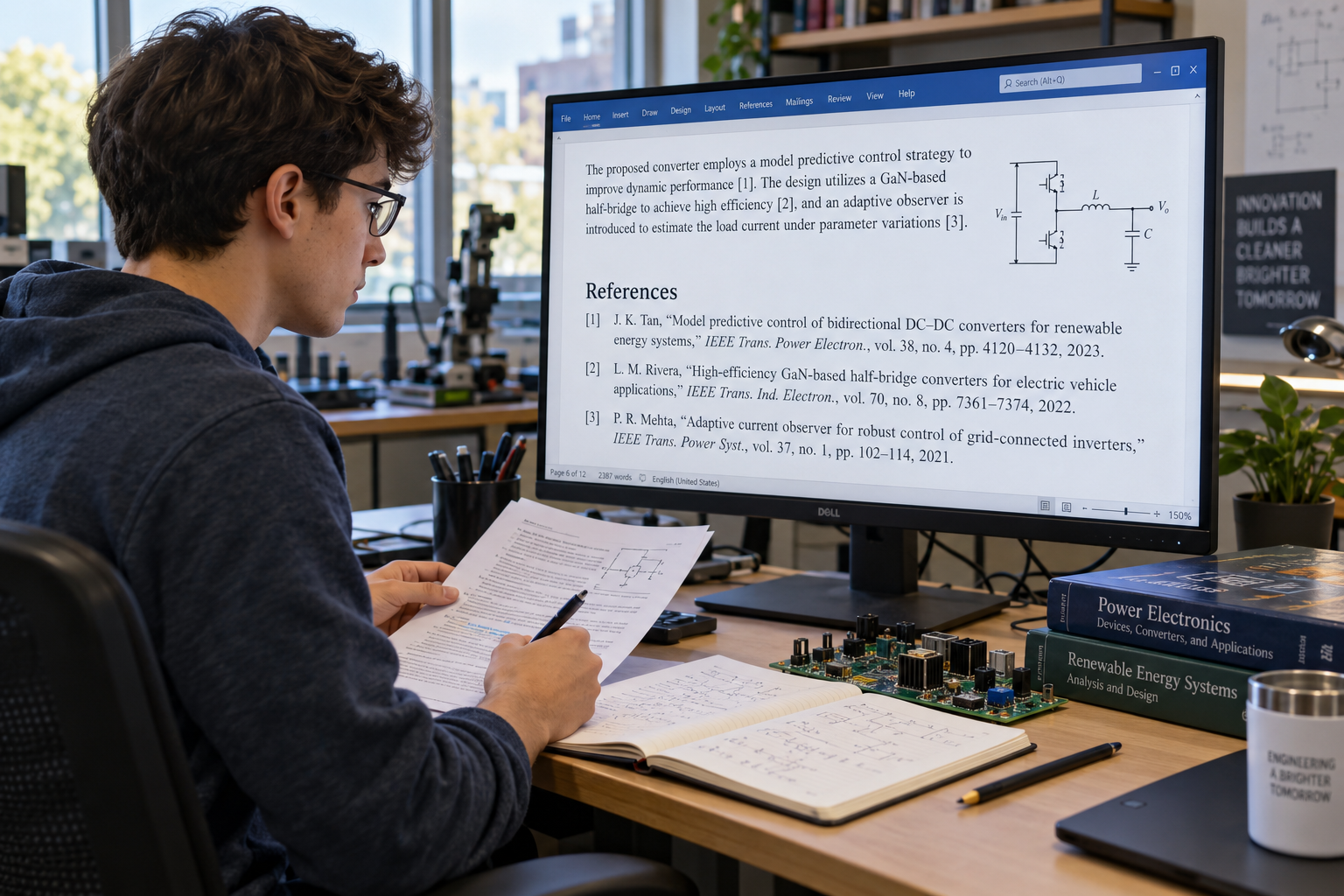
Academic referencing is especially important in engineering, computer science, electronics, telecommunications, and related technical disciplines, where research papers often contain numerous claims, algorithms, standards, datasets, and previous technical findings. Readers need to identify the evidence behind these claims without lengthy author-date citations interrupting equations, technical explanations, or engineering arguments. IEEE referencing addresses this need through a compact numerical citation system.
In IEEE style, sources cited in the text are identified by numbers enclosed in square brackets, such as [1], [2], and [3]. Each number corresponds to one entry in the reference list, and sources are numbered according to the order in which they are first cited rather than alphabetically by author. When the same source is used again, its original reference number is reused.
This IEEE referencing guide explains how in-text numbers and reference list entries work together and provides practical examples for university students. It covers single and multiple citations, repeated references, page and section locators, journal articles, conference papers, books, websites, reports, theses, DOIs, author names, and common referencing mistakes. Students should still check their university or module requirements because institutional adaptations can occasionally differ from the current IEEE publication rules.
What Is IEEE Referencing?
IEEE referencing is the citation system used in publications of the Institute of Electrical and Electronics Engineers and widely encountered in technical and engineering disciplines. Instead of placing an author's surname and publication year in the text, IEEE identifies references numerically. The first source receives [1], the second new source receives [2], and the numbering continues as additional sources are introduced.
The official IEEE Author Center editorial guidance provides the current editorial resources for IEEE journals, including the IEEE Reference Guide. The reference guide specifies how citations appear in the text and how different source types are formatted in the reference section.
This numerical structure makes IEEE substantially different from author-date systems such as APA and Harvard. Epic Essay's guide to academic referencing styles explains that citation systems differ in presentation while sharing the underlying purposes of acknowledging intellectual ownership, supporting claims, and allowing readers to trace evidence.
IEEE follows a numbered citation system: assign a source its reference number when it first appears and reuse that same number whenever the source is cited again.
How IEEE In-Text Citations Work
IEEE in-text citations are represented by Arabic numerals inside square brackets. According to the current IEEE Reference Guide, reference numbers appear on the line of text and inside the sentence punctuation. This produces compact citations such as [1] rather than author-date forms such as (Smith, 2025).
For example, a student might write that machine-learning techniques have improved fault-detection capabilities in industrial systems [1]. The number [1] directs the reader to reference [1] in the reference list, where the complete publication information is provided. If a second source is subsequently introduced, it becomes [2].
IEEE citations can also be integrated grammatically into a sentence. A student could write, "As demonstrated in [3], the proposed algorithm reduces computational complexity." The author's name does not have to appear, although it can be mentioned when relevant to the discussion.
The relationship between first appearance and numbering can be illustrated clearly.
| Point in the Paper | Source | IEEE Citation |
|---|---|---|
| First source introduced | Journal article A | [1] |
| Second new source introduced | Conference paper B | [2] |
| Journal article A cited again | Same first source | [1] |
| Third new source introduced | Technical report C | [3] |
| Conference paper B cited again | Same second source | [2] |
The numbering therefore identifies sources rather than individual citation events. This distinction becomes particularly important when a paper is revised because moving, deleting, or adding sources can affect the numbering sequence.
Where Should IEEE Citation Numbers Be Placed?
IEEE reference numbers should appear where the relationship between a claim and its supporting source is clear. A citation placed after a specific technical statement normally indicates that the source supports that statement. Placing a single citation at the end of a long paragraph containing several unrelated claims can create ambiguity about which information actually comes from the source.
The current IEEE Reference Guide states that references appearing in text are placed inside square brackets and inside the punctuation. A sentence might therefore end with a construction such as "The model achieved improved classification accuracy [4]." Students should avoid importing punctuation conventions from another referencing system without checking the IEEE rules.
Source integration still matters even though IEEE citations are visually short. Epic Essay's guide to academic source integration explains that citations need to make the relationship between external evidence and the writer's argument clear. IEEE's numbers reduce visual interruption, but they do not remove the need to position citations logically.
Students should also distinguish citations from footnotes. IEEE reference numbers point to bibliographic entries in the reference list. They should not be treated as sequential explanatory notes or used to hide substantive information that belongs in the main text.
How to Cite the Same Source More Than Once in IEEE Style
A source keeps the number assigned when it first appears. If a journal article first appears as reference [4], later use of that article should still be cited as [4]. The source does not receive a new number simply because it appears in a different paragraph or section.
This rule prevents duplicate references. If the same article were assigned [4], [9], and [15] on three separate occasions, readers might reasonably assume that these numbers represented three different publications. The reference list would also become unnecessarily repetitive.
When a particular location within an existing reference needs to be identified, IEEE permits additional information to be placed with the original reference number. The official guide gives forms such as [3, pp. 5–10], [3, Sec. 4.5], [3, Fig. 1], and [3, Ch. 2, pp. 5–10]. The exact locator should correspond to what the writer is directing the reader toward.
Never assign a new IEEE number simply because you are citing a source for the second or third time. Reuse its original number and add an appropriate locator when one is needed.
How to Cite Multiple References in IEEE Style
Technical statements may require support from several publications. In this situation, IEEE presents the relevant reference numbers individually. For example, a claim supported by references 2, 4, and 7 can be cited using [2], [4], [7]. Each number still corresponds to its own independent reference-list entry.
An important detail is that the current IEEE Reference Guide specifies that reference ranges should be written out rather than represented using an en dash. Therefore, references 1 through 4 are represented as [1], [2], [3], [4] under the current IEEE guidance rather than compressed into a range such as [1]–[4]. Students using older IEEE examples may encounter the earlier range convention and should follow the current guide or the explicit requirements of their institution.
IEEE also instructs writers not to combine several different sources under one reference number. Every bibliographically distinct source should have its own number. Reference [8], for example, should represent one source rather than a list of three papers grouped together merely because they support the same statement.
This one-number-per-source principle keeps the evidence traceable. Readers can identify precisely which publication each number represents and inspect the relevant source independently.
How the IEEE Reference List Is Organised
The IEEE reference list follows numerical citation order. Reference [1] is the first source cited in the paper, reference [2] is the second new source, and so on. The list is therefore not alphabetised by the surname of the first author.
Reference numbers appear in square brackets in their own column. The bibliographic details following each number vary according to the source type, but consistency in punctuation, author initials, titles, publication information, and electronic identifiers remains important. A journal article is formatted differently from a book or conference proceeding because each source type contains different identifying information.
Students accustomed to APA or Harvard sometimes alphabetise the list automatically. Doing this in IEEE style can disconnect the citation numbers from the intended references. The sequence should instead mirror the first appearance of sources in the document.
The differences can be summarised as follows.
| Feature | IEEE | Typical Author-Date System |
|---|---|---|
| In-text citation | [1] | (Author, Year) |
| Source numbering | Order of first citation | Not normally used |
| Repeated source | Original number reused | Author-date citation repeated |
| Reference-list order | Numerical citation order | Usually alphabetical |
| Author shown in citation | Not required by the citation itself | Usually included |
The table highlights why switching between referencing systems requires more than changing the appearance of individual citations. The organisational logic of the entire reference list changes as well.
How Author Names Are Written in IEEE References
IEEE reference entries normally present an author's given name as an initial followed by the surname. The current IEEE Reference Guide specifies that the author's or editor's given name is abbreviated to an initial and precedes the family name. This differs from styles in which reference entries begin with an inverted surname-first form.
Author order should match the source itself because publication order can carry disciplinary significance. Students should not rearrange authors alphabetically. If the source lists J. Chen before M. Patel, that order should be retained when the source is formatted according to IEEE requirements.
The current IEEE guide also provides a specific rule for long author lists in IEEE publications. It states that all authors should be listed up to six names; where more than six names are listed, the primary author's name is followed by "et al." The guide also notes circumstances in which "et al." may be used for non-IEEE publications when names are not provided.
These details demonstrate why automated references need checking. Metadata imported from websites or reference managers may invert names, omit authors, or apply rules from another style. The final reference should be compared with the current IEEE guidance and the source record.
How to Reference a Journal Article in IEEE Style
Journal articles are common sources in engineering and computing because rapidly developing technical fields rely heavily on peer-reviewed research. An IEEE journal reference normally contains author names, the article title, journal title or recognised abbreviation, volume, issue where applicable, page range or article number, publication date, and relevant electronic identifier.
A simplified structural model is:
[1] A. A. Author and B. B. Author, "Title of article," Journal Title, vol. x, no. x, pp. xx-xx, year.
An illustrative fictional reference might appear as:
[1] J. K. Mensah and R. Chen, "Machine learning for predictive maintenance in smart manufacturing," Int. J. Ind. Comput., vol. 18, no. 3, pp. 215-228, 2025.
The example demonstrates the pattern rather than documenting a real publication. Students should retrieve the actual volume, issue, pages, article number, DOI, and publication date from the source or an authoritative bibliographic record instead of guessing missing information.
How to Reference a Conference Paper in IEEE Style
Conference proceedings are especially important in fields such as computer science, electrical engineering, artificial intelligence, and telecommunications because new technical work is frequently presented at conferences. Students therefore need to distinguish a conference paper from a conventional journal article.
An IEEE conference reference identifies the author, paper title, conference proceedings or conference name, relevant location and publication details, year, and pages or other identifiers where applicable. The exact format depends on whether the paper appears in published proceedings and how those proceedings are documented.
A simplified model is:
[2] A. A. Author, "Title of paper," in Proc. Conference Name, Location, year, pp. xx-xx.
For example, a fictional entry could be:
[2] M. L. Otieno, "Energy-efficient routing for wireless sensor networks," in Proc. Int. Conf. Smart Commun. Syst., Nairobi, Kenya, 2025, pp. 88-94.
Students should verify the official conference title and publication details. Informal shortening can create ambiguous references, particularly when several conferences use similar acronyms.
How to Reference a Book in IEEE Style
Books are frequently used for established theory, engineering principles, programming concepts, mathematical methods, and foundational technical material. An IEEE book reference normally identifies the author or authors, book title, edition where relevant, publication location, publisher, and year.
A simplified structure is:
[3] A. A. Author, Title of Book, xth ed. City, Country: Publisher, year.
A fictional example might appear as:
[3] P. R. Kamau, Fundamentals of Embedded Systems, 2nd ed. Nairobi, Kenya: Technical Academic Press, 2024.
Edition information is important when several versions of a technical book exist because page numbering, examples, standards, and technical content may change between editions. Students should reference the edition they actually consulted rather than automatically citing the newest version.
How to Reference Websites and Online Sources in IEEE Style
Engineering and computing assignments increasingly rely on online technical documentation, institutional reports, manufacturer specifications, standards information, datasets, and official web resources. These materials require enough information for readers to identify the responsible author or organisation, title, publication details where available, access information where required, and electronic location.
The IEEE Reference Guide contains dedicated examples for online sources rather than treating every digital item as an ordinary webpage. This distinction matters because an online journal article, technical manual, dataset, report, and website are different source types even when all were accessed through a browser.
Epic Essay's guide to citing online sources explains the importance of identifying authorship and publication information instead of relying on a URL alone. A link tells the reader where something can be accessed, but it does not by itself identify who created the material or what type of publication it is.
Students should also evaluate online evidence before citing it. A manufacturer's technical documentation may be appropriate for a product specification, while a peer-reviewed paper may be more appropriate for a claim about the effectiveness of an algorithm. Correct IEEE formatting cannot compensate for weak source selection.
How to Reference Technical Reports and Standards
Technical reports can contain important research findings, engineering evaluations, institutional analyses, and project results that do not appear in conventional journals. Their IEEE references need to identify the author or responsible organisation, report title, institution or publisher, location where required, report number if available, and publication date.
Standards are similarly important in technical disciplines because students may need to cite specifications governing communication protocols, electrical systems, software engineering, cybersecurity, or other engineering practices. A standards reference should identify the issuing organisation, standard title, standard number, and relevant publication information according to IEEE's source-specific rules.
Students should avoid citing a search-result page when the actual technical report or standard is available. The bibliographic entry should describe the document used as evidence. This makes the source more stable and academically traceable.
Where a standard has several editions or revisions, identify the version actually consulted. Technical requirements can change between editions, so referencing the correct version can be substantively important rather than merely a formatting detail.
How to Reference a Thesis or Dissertation in IEEE Style
Theses and dissertations can be useful sources when they contain detailed methodology, specialist technical work, datasets, or analyses unavailable elsewhere. IEEE provides specific formatting patterns for these works because they are not treated as ordinary books or journal articles.
A thesis reference normally identifies the author, title, degree type, department where appropriate, institution, location, and year. Electronic access information can also be required when the thesis is retrieved online, depending on the form of the source and applicable IEEE example.
A simplified model might be:
[4] T. N. Author, "Title of thesis," M.S. thesis, Dept. Elect. Eng., University Name, City, Country, year.
Students should identify the actual degree and institution accurately. Describing a doctoral dissertation as a master's thesis or omitting essential institutional information makes the source harder to identify and can misrepresent its academic status.
How DOIs and URLs Work in IEEE References
A Digital Object Identifier provides a persistent identifier for many scholarly publications. IEEE references can include a DOI where appropriate, and the current Reference Guide contains detailed rules for its placement and punctuation. Students should copy the DOI accurately from the article record or another authoritative source.
URLs are used where relevant for online sources. IEEE notes that when a print-style reference also includes a URL, the URL can be included at the end of the reference. The guide also distinguishes the punctuation of entries ending with URLs from references ending with conventional bibliographic information.
Students should avoid adding a random browser URL when a stable DOI or authoritative source location is available. Long tracking parameters, temporary library-session addresses, and search-engine links can make references unstable or unusable. Epic Essay's guide to citation rules reinforces the broader principle that references should allow readers to identify and trace the sources supporting academic claims.
Reference-management software can retrieve DOI and URL information automatically, but imported records should be checked. An incorrect DOI is not made correct merely because a reference manager inserted it.
IEEE Reference List Examples for Common Academic Sources
The following examples demonstrate the basic appearance of several frequently encountered IEEE reference types. They use fictional bibliographic details so that students can focus on the structure. A real assignment should always use the publication information from the actual source.
| Source Type | Illustrative IEEE Reference |
|---|---|
| Journal article | [1] J. K. Mensah and R. Chen, "Machine learning for predictive maintenance in smart manufacturing," Int. J. Ind. Comput., vol. 18, no. 3, pp. 215-228, 2025. |
| Conference paper | [2] M. L. Otieno, "Energy-efficient routing for wireless sensor networks," in Proc. Int. Conf. Smart Commun. Syst., Nairobi, Kenya, 2025, pp. 88-94. |
| Book | [3] P. R. Kamau, Fundamentals of Embedded Systems, 2nd ed. Nairobi, Kenya: Technical Academic Press, 2024. |
| Thesis | [4] T. N. Author, "Intelligent control systems for renewable energy networks," Ph.D. dissertation, Dept. Elect. Eng., Example Univ., London, U.K., 2025. |
| Online source | [5] Author or organization, "Title of online resource," Website or Publisher. Accessed: Month day, year. [Online]. Available: URL |
| Technical report | [6] A. B. Author, "Title of technical report," Institution, City, Country, Rep. number, year. |
These examples should not be treated as interchangeable templates. The correct structure depends on the source being referenced, and additional information may be required for electronic publications, standards, datasets, patents, software, preprints, and other specialist materials.
How to Cite Direct Quotations and Specific Pages in IEEE Style
Technical writing typically relies more heavily on paraphrased findings and technical synthesis than on extensive direct quotation. Nevertheless, a quotation may occasionally be necessary when the exact wording of a definition, standard, or authoritative statement matters. The source still needs its normal IEEE reference number.
When directing the reader to a specific page or range within an existing reference, IEEE permits the locator to accompany the citation number. The official Reference Guide gives the form [3, pp. 5–10] for a page range. Other specific elements can be identified using forms such as [3, Fig. 1], [3, eq. (2)], or [3, Sec. 4.5].
Paraphrasing does not eliminate the citation requirement. Rewriting a technical finding, algorithmic principle, or theoretical argument in new language still uses another source's intellectual content. The citation should therefore remain attached to the paraphrased material.
A different sentence structure does not make a borrowed technical idea your own. Cite paraphrased evidence as carefully as quoted wording.
Common IEEE Referencing Mistakes Students Should Avoid
A frequent mistake is using parentheses instead of square brackets. IEEE's numbered references appear as [1], not (1), and they should not be transformed into author-date citations such as (Chen, 2025). Mixing citation systems within one assignment creates inconsistency and can disconnect the text from the reference list.
Another common problem is alphabetising the references. IEEE references follow citation order, so an alphabetised list can cause the number [3] in the text to point to a different source from the one originally intended. This becomes especially problematic when citations are inserted manually.
Students may also assign new numbers to repeated sources, combine several sources under one reference number, or compress current IEEE citations into ranges based on older examples. The current IEEE Reference Guide explicitly states that references should not be combined and that citation ranges are written out individually.
Finally, reference-generator output should not be accepted without verification. Missing authors, incorrect title capitalisation, wrong journal abbreviations, incomplete conference details, and malformed URLs can all survive automated formatting. Reference software can automate formatting, but responsibility for the accuracy of the final IEEE reference remains with the writer.
How to Check IEEE Citations Before Submission
A final reference audit should begin with the assignment instructions. Confirm that IEEE is required and check whether the university has provided a local style sheet. Where local requirements differ from current IEEE publishing conventions, students should normally follow the instructions governing their assessed work.
Next, cross-check the text and reference list. Every citation number should point to the correct entry, every reference should represent only one source, and repeated sources should retain their original numbers. This step is particularly important after major editing because moving paragraphs can disrupt manually managed numbering.
A practical final checklist is:
- Confirm that IEEE is the required referencing style.
- Check that in-text references use square brackets.
- Ensure sources are numbered in order of first citation.
- Reuse the original number whenever a source appears again.
- Confirm that each reference number represents only one source.
- Check multiple citations against the current IEEE presentation rules.
- Ensure the reference list follows numerical rather than alphabetical order.
- Verify author initials and surnames against the source.
- Check journal, volume, issue, page, conference, and publication details where applicable.
- Verify DOIs and electronic locations.
- Check specific page, figure, section, or equation locators where used.
- Compare unusual source types with the official IEEE Reference Guide.
Completing these checks systematically is more reliable than visually scanning the bibliography and assuming that references look correct. A numerical style is compact, but an incorrect number can send the reader to an entirely unrelated source.
Using IEEE Referencing Correctly in Technical Academic Writing
IEEE referencing becomes straightforward once its underlying sequence is understood. New sources receive numbers according to first appearance, those numbers are displayed in square brackets, and the same numbers are reused whenever the sources appear again. The reference list follows that numerical sequence and supplies the complete publication information required to identify each source.
Accuracy depends on more than correct numbering. Journal articles, conference papers, books, theses, technical reports, standards, and websites contain different bibliographic elements, so each should be formatted according to the appropriate IEEE source pattern. Students should also verify authors, publication details, DOIs, URLs, and specific locators rather than relying unquestioningly on automatically generated citations.
For engineering, computing, and other technical assignments, the strongest practice is to record source details during research, insert citations as evidence enters the draft, and conduct a complete reference audit before submission. When IEEE in-text numbers and reference-list entries correspond precisely, the citation system remains unobtrusive while giving readers a clear and reliable path from every technical claim to its supporting evidence.



Comments